sandermuller / laravel-queue-insights
Self-hosted, driver-agnostic queue observability for Laravel. Per-class throughput, durations, failures, and live depth/in-flight/delayed metrics with a Livewire dashboard.
Package info
github.com/SanderMuller/laravel-queue-insights
pkg:composer/sandermuller/laravel-queue-insights
Requires
- php: ^8.3
- aws/aws-sdk-php: ^3.0
- illuminate/console: ^11.0||^12.0||^13.0
- illuminate/contracts: ^11.0||^12.0||^13.0
- illuminate/notifications: ^11.0||^12.0||^13.0
- illuminate/queue: ^11.0||^12.0||^13.0
- illuminate/redis: ^11.0||^12.0||^13.0
- illuminate/support: ^11.0||^12.0||^13.0
Requires (Dev)
- dg/bypass-finals: ^1.9
- driftingly/rector-laravel: ^2.3
- larastan/larastan: ^3.9.3
- laravel/boost: ^2.4.0
- laravel/pint: ^1.29
- livewire/livewire: ^3.0 || ^4.0
- mockery/mockery: ^1.6
- mrpunyapal/rector-pest: ^0.2.7
- nunomaduro/collision: ^8.0
- orchestra/testbench: ^9.0||^10.0||^11.0
- pestphp/pest: ^3.0||^4.0
- pestphp/pest-plugin-arch: ^3.0||^4.0
- pestphp/pest-plugin-laravel: ^3.0||^4.0
- phpstan/extension-installer: ^1.4.3
- phpstan/phpstan-deprecation-rules: ^2.0.4
- phpstan/phpstan-phpunit: ^2.0.16
- phpstan/phpstan-strict-rules: ^2.0.10
- predis/predis: ^2.2
- rector/rector: ^2.4.1
- rector/type-perfect: ^2.1.2
- sandermuller/package-boost: ^0.10.1
- spatie/ray: ^1.48.0
- spaze/phpstan-disallowed-calls: ^4.10
- symplify/phpstan-extensions: ^12.0.2
- tomasvotruba/cognitive-complexity: ^1.1
- tomasvotruba/type-coverage: ^2.1
Suggests
- guzzlehttp/guzzle: Required only when the slack alert channel is enabled (provides the HTTP client used by `Illuminate\Http\Client\Factory`).
- illuminate/mail: Required only when the mail alert channel is enabled (provides the `mail.manager` binding).
- laravel-notification-channels/discord: Optional — extend `QueueAlertNotification::via()` to add Discord routing.
- laravel-notification-channels/microsoft-teams: Optional — extend `QueueAlertNotification::via()` to add Microsoft Teams routing.
- laravel-notification-channels/pagerduty: Optional — extend `QueueAlertNotification::via()` to add PagerDuty incident routing.
- laravel-notification-channels/telegram: Optional — extend `QueueAlertNotification::via()` to add Telegram routing.
- livewire/livewire: Required only to use the bundled dashboard route. Capture + snapshot run without it.
- dev-main
- 0.7.0
- 0.6.0
- 0.5.0
- 0.4.1
- 0.4.0
- 0.3.0
- 0.2.1
- 0.2.0
- 0.1.0
- dev-dependabot/github_actions/ramsey/composer-install-4
- dev-dependabot/github_actions/actions/checkout-6
- dev-dependabot/github_actions/actions/cache-5
- dev-dependabot/github_actions/stefanzweifel/git-auto-commit-action-7
- dev-dependabot/github_actions/actions/setup-node-6
- dev-feat/lazy-alert-rules-panel
This package is auto-updated.
Last update: 2026-05-04 04:12:39 UTC
README
Self-hosted queue observability for Laravel. A Horizon-style dashboard that doesn't lock you into the Redis queue driver.
Live demo
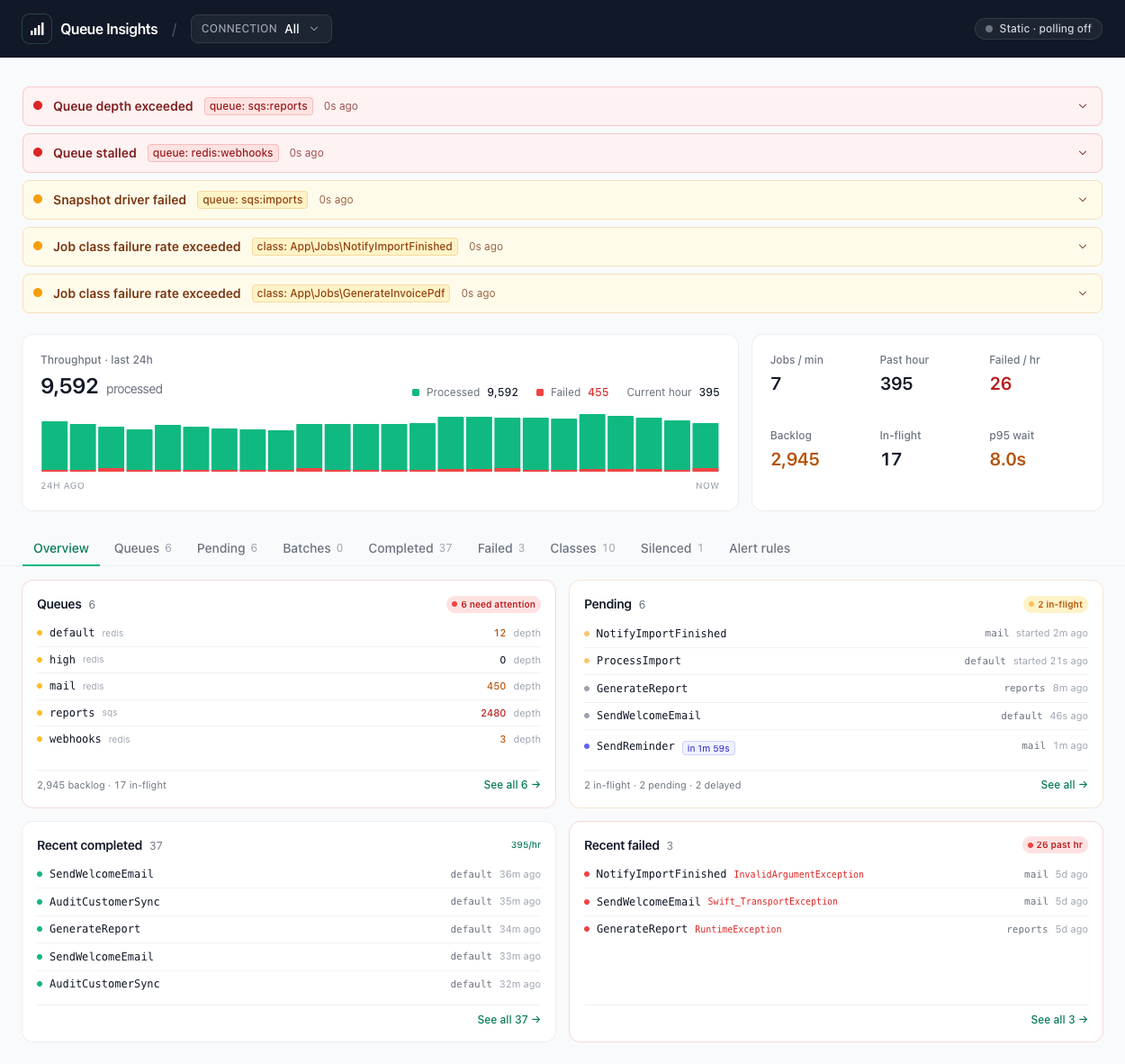
queue-insights-demo-main-wgcmqf.laravel.cloud — public preview hosted on Laravel Cloud, seeded with realistic fixtures (eight queues, alerts firing, batched + chained jobs, recent completed/failed lists). The deploy uses the same workbench/app/Support/PreviewSeeder.php that powers vendor/bin/testbench serve locally, so what you see is the package rendering against real Redis reads — not a static screenshot.
Features
- Live depth, in-flight, and delayed counts per queue. Works on SQS, Redis, and database queues.
- Pending & delayed-job inspector per queue — individual queued jobs with class FQCN and
runs in <countdown>for delayed jobs. Driver-agnostic (event-captured into Redis), so SQS gets the same view as Redis and database queues. - Batched-jobs section — per-batch progress bar, processed/failed/pending counts, finished/cancelled state, and an expandable per-item rollup that links each uuid back to the existing completed/failed modal. Per-row chip on completed/failed/pending lists jumps to the batch in one click.
- Chained-jobs visibility — completed and failed rows surface the next job in a
Bus::chain([...])chain via a small↳ Next (+N)chip and a Chain section in the modal, sourced directly from the job's serialized payload. Backward↰ From {parent}lineage is captured opportunistically via short-lived Redis claim tickets, so the modal and failed-row markdown export show which job ran before this one too. - Wait time per queue (p50 / p95) and per job. Measures enqueue to worker pickup.
- 24h throughput sparkline (processed + failed) with hover tooltips per hour, alongside a headline-stats panel: jobs/min, jobs past hour, failed past hour, max throughput hour, max wait p95, max runtime p95.
- Queues grouped into Needs attention (errored or stale) and Healthy so a broken queue can't hide in a long list.
- Per-job-class metrics: 24h processed and failed, average and max duration, last run.
- Recent completed jobs. Metadata-only by default; opt-in payload capture with a pluggable sanitizer. Filter row mirrors the failed-jobs filter (connection, queue, class, from, to).
- Recent failed jobs from Laravel's
failed_jobstable, with a filter row over connection, queue, class, and date range. Filters persist in the URL. - Retry failed jobs from the dashboard, single or bulk. Gated, rate-limited, and audit-logged.
- Markdown export of failed-job details for handing off to an AI agent or pasting into a tracker.
- Alerting — eight built-in detectors (depth, stalled, oldest-pending, stuck-inflight, failure-rate, slow-p95, snapshot-errored, backlog-growing) with per-rule cooldown and built-in
log/slack/mailchannels via the standard Laravel notification stack. Typed events fire regardless of channel config so hosts can hook custom routing. - Standalone Livewire + Blade. No Filament or Nova coupling.
- Small Redis footprint, bounded and auto-evicting. No external observability service required.
Requirements
- PHP 8.3+
- Laravel 11, 12, or 13
- Redis (for insights storage)
livewire/livewire3 or 4 (only if you use the bundled dashboard route).
CI runs against three Livewire resolver legs: Livewire 3.0, Livewire 3 latest, and Livewire 4 latest. Coverage is PHP-side only. The JS and Alpine paths aren't browser-tested, so do a smoke render in your own staging before upgrading the host.
Install
composer require sandermuller/laravel-queue-insights php artisan vendor:publish --tag=queue-insights-config
The service provider auto-discovers.
Payload capture
Off by default. Laravel payloads embed serialized and sometimes encrypted job state, and a regex over JSON keys can't sanitize that safely.
Three modes via QUEUE_INSIGHTS_CAPTURE_PAYLOADS:
| Mode | Behavior |
|---|---|
off (default) |
No payload persisted. |
metadata |
displayName, maxTries, timeout, backoff only. No user data, no serialized command body. |
full |
Raw body after a sanitizer pass. Apps with sensitive jobs MUST bind a custom PayloadSanitizer that understands their job shape. |
Read SECURITY.md before enabling full.
Dashboard
Mounts at /queue-insights when dashboard.enabled=true and livewire/livewire is installed. Define the viewQueueInsights Gate in your app:
// app/Providers/AuthServiceProvider.php Gate::define('viewQueueInsights', fn ($user) => $user->isAdmin());
Multi-connection scoping
When you monitor more than one queue connection (e.g. a multi-tenant app with one connection per tenant, or a mixed sqs + redis setup), the dashboard exposes connection as a first-class navigation axis, not a filter dropdown:
/queue-insights— un-scoped, every monitored connection aggregated into one view./queue-insights/{connection}— scoped to a single connection. Every panel narrows: queue rows, alerts strip, snapshot watchdog, pending/delayed/in-flight inspectors, batches, recent completed/failed lists, headline stats (jobs / min, throughput sparkline, p95 wait, max runtime), per-class metrics, and the alert-rules panel's depth thresholds.
A tab strip above the headline cards renders one tab per allowed connection plus an "All" tab. The strip auto-suppresses when only one connection is monitored.
The {connection} segment is constrained to your configured snapshots.*.connection names — typos 404 instead of mounting an empty dashboard.
Per-connection authorisation (optional)
Add the viewQueueInsightsConnection Gate to authorise per connection:
// app/Providers/AuthServiceProvider.php Gate::define('viewQueueInsightsConnection', function ($user, string $connection): bool { return $user->canAccessTenant($connection); });
When defined, the dashboard:
- 403s direct visits to
/queue-insights/{connection}the user can't access. - Hides denied connections from the tab strip.
- Renames the "All" tab to "All allowed" with a tooltip listing only the connections the user can already open (denied tenants are never named).
If the gate isn't defined, every monitored connection is reachable to anyone who passes viewQueueInsights — same behaviour as pre-spec versions.
Audit log carries scope
Every retry log line (queue-insights.retry) includes scope_connection alongside the existing filter snapshot, so retries that span tenants are distinguishable from scoped retries.
Upgrade note — per-connection class metrics need traffic to warm
Per-connection class counters (processed:{class}:{connection}:{bucket}, failed:{class}:{connection}:{bucket}, duration:{class}:{connection}, last_run:{class}:{connection}, classes:{connection} zset) are dual-written alongside the existing aggregate keys. Aggregate dashboards (/queue-insights) render correctly from second 0 after upgrade. Scoped views (/queue-insights/{connection}) for per-class p95 / throughput / 24h totals fill in as new events flow — the first hour after deploy will show 0 for class counts on a scoped view. Aggregate keys are unchanged so rolling back the package version is safe.
Known limitations under scope
These v1 gaps surface only on the connection-scoped routes; the un-scoped dashboard is unaffected.
- Batches section is hidden under scope. Per-batch metadata isn't yet keyed by connection, so the batches section would otherwise leak other-connection batches into a scoped view. The section reappears the moment scope is removed.
- Recent completed list reads from a global stream.
recentCompleted()pulls the most recent ~250 entries from a single global stream and then filters by the scoped connection. In deployments with a deeply-imbalanced traffic split (e.g. one connection runs 100x more jobs than another), the scoped Recent completed list can show stale or empty rows even though matching jobs exist. Workaround: raiserecent_fetch_limit(or contribute per-connection streams as a follow-up). Recent failed is unaffected — it reads from the failed_jobs DB table with explicit WHERE clauses. - Per-connection counter dual-write isn't atomic. Aggregate and per-connection counters are written as separate Redis commands. A listener crash mid-write can leave the per-connection counter behind aggregate; later traffic re-fills it. Same best-effort guarantee the package's existing listeners offer; never produces phantom data.
Retry permissions (write actions)
Retrying a failed job is a write action and needs its own Gate, separate from the read-only viewQueueInsights:
Gate::define('retryFailedJobs', fn ($user) => $user->isAdmin());
Without that Gate, the Retry button stays hidden in the failed-job modal, the bulk Retry button stays hidden above the failed-jobs table, and direct calls to the underlying Livewire methods (retryFailed, retryFailedBulk) return 403.
The retry path uses Laravel's first-party queue:retry Artisan command, so it's idempotent against an already-retried row and works regardless of queue driver.
Guards on the retry path:
- 30 retries per minute, per user.
- The server rejects a bulk retry when the matching set is over 100 rows. The UI shows a "narrow to retry" hint instead of the action button.
- The server also rejects a bulk retry when no filter is set, so you can't accidentally one-click retry every failed job.
- Every retry writes an
info-level log line with channelqueue-insights.retry, including the user id, the active filter set, andscope_connection(the multi-connection scope, when set). Forward that to your audit log.
Retry workflow
To triage a failed job:
- Open the dashboard and find the row in the Recent failed list.
- Optional: click Filter ⌄ above the list and narrow by connection, queue, class, or date range. The URL updates as you change a field, so the filtered view is shareable.
- Click any row to open the failed-job modal. You'll see the exception, stack trace, payload, and metadata.
- To retry one job, click Retry in the modal header. The button flips to a red "Confirm retry?" for two seconds; click again to fire. The modal closes and a green banner confirms dispatch. If
queue:retryexits non-zero, you get a red banner instead of a misleading success. - To retry several at once, set at least one filter. A Retry N jobs button appears next to the section heading, with the same two-click confirm pattern. Anything matching more than 100 rows shows a N matches · narrow to retry hint instead of an action button.
A failed retry never leaves the dashboard in a half-broken state. The row is either re-dispatched (and removed from failed_jobs) or left alone.
Filtering
Both Recent completed and Recent failed have a collapsible filter row above the list. Click Filter ⌄ to expand. Each field binds to a short query-string key, so a narrowed view is shareable and bookmarkable.
Connection, Queue, and Class are populated as <select> dropdowns from the configured snapshots and the 24h class roster — no free-text typos.
Recent failed filter
| Field | Query-string key | Match semantics |
|---|---|---|
| Connection | fc |
Exact (connection column) |
| Queue | fq |
Exact (queue column) |
| Class | fk |
Anchored prefix substring on payload.displayName, case-insensitive |
| From | ffrom |
failed_at >= <Y-m-d> 00:00:00 |
| To | fto |
failed_at <= <Y-m-d> 23:59:59 |
The class filter avoids JSON-extract syntax, which diverges across MySQL, Postgres, and SQLite. Instead it runs LOWER(payload) LIKE '%"displayname":"<input>%', which produces the same match set on all three. Picking App\Jobs\SendEmail matches that exact class, and the underlying LIKE semantics still anchor the prefix so e.g. selecting a parent namespace would match its descendants.
The filter row also drives the bulk-retry scope. The Retry N jobs button retries the same set the list is showing.
Recent completed filter
Same five fields, separate state, separate query-string keys. Class is pre-filtered at the storage layer (per-class Redis stream key); the other four narrow the already-fetched 50-row default cap in PHP.
| Field | Query-string key | Match semantics |
|---|---|---|
| Connection | cc |
Case-insensitive substring |
| Queue | cqu |
Case-insensitive substring |
| Class | ck |
Exact FQCN — picks a single per-class stream |
| From | cfrom |
processed_at >= <Y-m-d> 00:00:00 |
| To | cto |
processed_at <= <Y-m-d> 23:59:59 |
Wait time
Wait time is the gap between enqueue and worker pickup. Duration is the gap between worker pickup and completion. They're different numbers, and wait time is the one to look at when depth / in-flight look fine but jobs feel slow.
It shows up in two places:
- Queue rows show a
p50 / p95Wait column, computed over the most recent 1000 jobs on that queue and refreshed every poll. Shows—until 10 samples have accumulated. - The completed-job and failed-job modals show
wait <human> (NN ms)next to the Duration row. Shows—for jobs queued before theJobQueuedlistener was wired, and for drivers that don't stamppayload.uuid.
Capture is automatic. Installing the package wires an Illuminate\Queue\Events\JobQueued listener that records the enqueue timestamp, so no host-app config is needed. The cost per job is one Redis SETEX at push, plus a GET + ZADD + ZREMRANGEBYRANK + EXPIRE chain at worker pickup. Retention: 1h on the per-uuid pushed: key, 7d on the per-uuid wait: sample, rolling 1000 most-recent on the per-queue ZSET.
A 7-day clock-skew guard rejects any wait sample over that, so a producer host with bad NTP can't poison the percentile pool indefinitely.
Pending & delayed jobs
Each queue row in the dashboard has a collapsible inspector that shows individual pending and delayed jobs — class FQCN, queued-at humanized, and (for delayed) runs in <countdown>. The toggle button shows the tracked count next to the queue's badges; click to expand. The expand state is URL-shareable (?qopen=connection:queue).
The data is event-captured into Redis, not peeked from the queue driver. The JobQueued listener stamps a per-uuid hash + per-queue sorted set into the package's Redis namespace; JobProcessing / JobProcessed / JobFailed clean up. Driver-agnostic by design — works for SQS, where there's no way to peek individual messages without consuming them, alongside Redis and database queues.
Bounded storage:
- ~500 bytes per pending job (uuid + class FQCN + connection + queue + queued_at + available_at).
- Per-queue cap (
pending.max_per_queue, default 10000) enforced viaZREMRANGEBYRANK— when the cap is hit, the lowest-score (earliestavailable_at) entry is dropped first. - TTL safety net (
pending.ttl_seconds, default 86400 = 24h) drops orphans whose cleanup listener never fired (worker crash, rawQueue::push()outside Laravel's event flow).
The dashboard compares the tracked count against the snapshot's depth + delayed — when they diverge by more than pending.gap_warn_threshold (default 5), a +N gap badge appears on the toggle and a banner inside the inspector body warns that the lists are a sample, not a complete enumeration. Read the queue counters above for totals when the gap is non-zero. Gap usually points to one of:
- A worker crashed mid-pickup and the
JobProcessinglistener didn't fire (TTL eventually cleans). - Jobs are being pushed via raw
Queue::push()outside Laravel's standard dispatch (noJobQueuedevent raised). - The
pending.max_per_queuecap kicked in on a high-volume queue (more jobs in the queue than the tracked sample).
To opt out (memory-bounded production), set QUEUE_INSIGHTS_PENDING_ENABLED=false. The listener writes become no-ops, the inspector toggle disappears, and existing keys age out via TTL.
Batches
The dashboard renders a top-level Batches section above the Queues panel for jobs dispatched via Bus::batch([...])->dispatch(). Each row shows the batch name (or Batch <short-id> when unnamed), a progress bar driven by Laravel's authoritative Bus::findBatch() counts, and a counts triplet (processed/total · failed · pending). Cancelled batches show a red cancelled chip; finished + no-failures show a gray finished chip; jobs that fail when allowFailures() is off render cancelled (first failure) even before Laravel stamps cancelled_at.
Expanding a row reveals the per-uuid item list in enqueue order, with a status icon (✓ processed / ✗ failed / ⌛ pending) per item. Clicking a completed item opens the existing completed-job modal (by stream id); clicking a failed item opens the failed-job modal (by failed_jobs.id). The expand state is URL-shareable (?batch=<batchId>).
Every completed, failed, and pending row that belongs to a batch carries a small batch chip — clicking it opens the batch modal directly. The chip also renders inside the completed/failed/pending modal heroes, so an operator drilling into a single job can jump to its batch in one click. Inside an item modal that was opened from a batch, a ← Back to batch button in the header returns you to the batch view without losing context (item modals stack visually on top of the batch modal).
The data is event-captured into Redis alongside Laravel's own BatchRepository. The JobQueued listener writes three keys per batched job:
qi:batches:index(sorted set) — recent batchIds, ordered by first-seen unix timestamp. Used to enumerate batches withoutSCAN. Score-pruned on every enqueue (no whole-key TTL) so the head doesn't accumulate forever.qi:batch:{id}:uuids(list) — RPUSH-ordered uuids in the batch. Bounded per batch bybatches.max_uuids_per_batch(default 5000, best-effort under heavy concurrent dispatch).qi:batch:uuid:{uuid}(string) — reverse lookup uuid → batchId, used to render the per-row chip on completed jobs.
RecordJobProcessed and RecordJobFailed add two more per-uuid index keys (qi:uuid-completed:{uuid} and qi:uuid-failed:{uuid}) so the per-item rollup can route clicks into the existing modal flows.
Bounded storage:
- ~50 bytes per uuid (
qi:batch:{id}:uuidsentry +qi:batch:uuid:{uuid}reverse pointer + index entry, amortised per batch). - TTL on every per-batch key (
batches.ttl_seconds, default 604800 = 7d). Self-pruning on the index viaZREMRANGEBYSCOREon each enqueue; per-batch keys age out via Redis EXPIRE. - Authoritative counts (
pending_jobs,processed_jobs,failed_jobs,progress,finished_at,cancelled_at) come fromBus::findBatch()on every render — the captured keys exist only to enumerate batches and resolve uuid → display row, NOT to count.
Retry caveat. queue:retry and queue:retry-batch use Queue::pushRaw(), which does NOT fire JobQueued, so a retried job won't refresh as a fresh pending entry in the per-item rollup. The retry will still flow through JobProcessed (which DOES fire), so a successful retry overwrites qi:uuid-failed:{uuid} with qi:uuid-completed:{uuid} and the row flips from ✗ to ✓ within one poll cycle.
To opt out, set QUEUE_INSIGHTS_BATCHES_ENABLED=false. The listener writes become no-ops, the Batches section disappears, and chips stop rendering on existing rows.
Chained jobs
Jobs dispatched through Bus::chain([...])->dispatch() (or $job->chain([...])) carry the remaining chain inside the serialized command body. The dashboard renders that forward chain context in two places:
- List rows — completed and failed rows that have a follow-up job render a small
↳ NextJob (+N)chip, where the leaf-class name shows the immediate next job and+Ncounts the further-down-chain jobs after it. Hover reveals the full FQCN and the total chained count. - Modal Chain section — the completed and failed modals include a
Chainblock with the next job's FQCN, the+N more chainedcount, and the chain's queue/connection (when set on the job). The block is clickable: it swaps the modal into a "Chained jobs" detail view that lists every chained link in order with per-link connection/queue, and a← Backbutton (orEsc) returns to the job view. Drilling into a single chained job inside the failed-job modal also surfaces its constructor properties (extracted from the serialized payload, framework internals filtered out) — same renderer used by the parent job's payload section. The completed-modal chain view stays metadata-only since the slim chain summary persisted on the stream entry doesn't retain user-bound data.
For failed jobs the source is failed_jobs.payload.data.command — Laravel always persists this column, so chain context renders regardless of the package's capture.payloads setting. For completed jobs the listener writes a JSON-encoded chain field (a list of {class, connection, queue} per chained link, typically ~80–300 bytes) onto each completed-stream entry at the time the job runs, also independent of capture.payloads. Per-link connection/queue overrides set on individual jobs are preserved — the displayed route reflects what Laravel will actually dispatch to. Encrypted jobs (ShouldBeEncrypted) carry an opaque base64 blob in data.command, so the chip and section are silently omitted for those rows — no error, just no signal.
Backward chain visibility — ↰ From {parent}. As the parent enters processing, the package drops a short-lived claim ticket into Redis (per-shape FIFO list keyed by connection/queue/next-class/tail-fingerprint, default 60 s TTL). When the next link's JobQueued fires inside CallQueuedHandler::call(), the listener pops a ticket and stamps the parent's UUID onto the child's lineage hash. The completed-modal then renders ↰ From {uuid} above the existing ↳ Next row, and the failed-job markdown export gains a **Parent:** \{uuid}` ({class})` line so AI-assisted triage can trace upstream of the failure point.
- Disable via
QUEUE_INSIGHTS_CHAIN_LINEAGE=false(orchain_lineage.enabled = false). Both write and read sides short-circuit at the listener entry — zero Redis writes, zero overhead. - Encrypted parents (
ShouldBeEncrypted) are silently skipped on both sides — the serialized command body is opaque base64, so neither the parent's chain context nor the child's tail can be decoded. The child renders without a parent attribution; document this limitation if you mix encrypted chains with the dashboard. - Cross-worker collision tolerance. Two parents with identical chain shape (same connection/queue/next-class/remaining-tail) running concurrently on different workers can attribute their children to each other in dispatch order rather than dispatch identity. Within a single worker chain dispatch is synchronous, so attribution is exact. Acceptable for an observability tool — see
internal/specs/backward-chain-lineage.md§3 for the full collision model. - Class label is best-effort.
qi:class:{uuid}(TTL =chain_lineage.lineage_ttl_seconds, default 7 d) is the index that hydrates a parent UUID to a class name in the markdown export and modal. Past that horizon the UUID still renders, just without(ClassName). - Click-through to the parent's modal is not in v1 — the lineage row is plain text plus a copy-to-clipboard button. Resolving a UUID to its target surface (completed stream id vs failed_jobs id) is a follow-up.
queue:retry re-runs a failed job through the normal worker path, so the eventual completed-stream entry of a retried chained job will still carry the correct chain field — the retry doesn't lose chain visibility. Backward lineage is keyed by uuid and survives the retry too: the existing qi:lineage:{uuid} is never overwritten with null.
Customising row markup
The dashboard's queue, completed, and failed lists are each rendered through a Blade partial, plus a shared filter-form partial. They're publishable — a host that wants to swap a row's columns or restyle the filter chrome can publish the partials and edit them in place without forking the whole dashboard.blade.php view:
php artisan vendor:publish --tag=queue-insights-views
| Partial | What it renders |
|---|---|
partials/queue-row.blade.php |
One row in the Queues list (Needs attention + Healthy groups) |
partials/completed-row.blade.php |
One row in Recent completed |
partials/failed-list-row.blade.php |
One row in Recent failed |
partials/batch-row.blade.php |
One row in the Batches section (header + per-item rollup) |
partials/batch-chip.blade.php |
The small chip rendered on rows that belong to a batch |
partials/filter-form.blade.php |
The collapsible 5-field filter form (used by both completed + failed) |
partials/stat-tile.blade.php |
One tile in the headline-stats panel beside the throughput sparkline |
If you only want to override one row layout, leave the others unpublished — Blade will fall back to the package's bundled version for those.
Embedding the dashboard inside an admin layout
Disable the bundled route and mount the Livewire component yourself:
// config/queue-insights.php 'dashboard' => ['enabled' => false, /* ... */],
{{-- resources/views/admin/queue-insights.blade.php --}} @extends('admin.layout') @section('content') @livewire('queue-insights-dashboard') @endsection
To embed a connection-scoped view, pass the scope as a mount param:
@livewire('queue-insights-dashboard', ['connection' => $tenant->queueConnection])
The component validates the connection against the configured snapshots (404s on mismatch) and runs viewQueueInsightsConnection defensively, same as the bundled route — so this is safe to render in publicly-reachable views.
Custom payload sanitizer
The default KeyRedactingSanitizer can't see inside PHP-serialized data.command bodies. Apps with sensitive jobs should bind their own:
// app/Providers/AppServiceProvider.php use SanderMuller\QueueInsights\Contracts\PayloadSanitizer; $this->app->bind(PayloadSanitizer::class, YourSanitizer::class);
Running workers
php artisan queue-insights:work is a thin parent supervisor that reads queue-insights.snapshots, groups entries by connection, and spawns one queue:work subprocess per connection with --queue=q1,q2,... (Laravel's built-in priority list).
# Boot every monitored connection. One process per (connection, queue list). php artisan queue-insights:work # Restrict to one connection, e.g. when running per-connection systemd units. # Both forms compose; they accept repeated flags AND comma-separated values. php artisan queue-insights:work --connection=sqs php artisan queue-insights:work --connection=sqs,redis php artisan queue-insights:work --connection=sqs --connection=redis # All `queue:work` flags forward verbatim to every child. php artisan queue-insights:work --tries=5 --timeout=90 --memory=256 --max-jobs=1000
The supervisor owns argv assembly + signal forwarding + exit-code propagation. SIGTERM/SIGINT/SIGQUIT received by the parent are forwarded to every live child; after queue-insights.work.shutdown_grace_seconds (default 120) any survivors get SIGKILL with a stderr warning. Parent exit code is the first non-zero child's, or 128 + signum for signal-initiated stops (Bash convention — lets systemd / supervisord distinguish operator-stop from supervisor-crash).
Output is line-prefixed with [{connection}] so journalctl / docker logs consumers can grep by connection without log shipping.
Non-goals
This is not a Horizon replacement. The command is intentionally bounded to "one command, every monitored queue, one process group." Out of scope:
- Auto-restart on crash — host process manager owns liveness (systemd
Restart=on-failure, supervisord, dockerrestart: unless-stopped). - Worker pool sizing / autoscaler — one process per connection. Operators who want N workers per connection run N units with
--connection=X. - Worker-liveness Redis keys + dashboard panel — the existing
snapshot_command_deadwatchdog covers the snapshotter; noqi:workers:*heartbeat. - Cross-connection priority — not possible while children are separate processes. Within-connection priority works (comma-list
--queue=q1,q2,q3). - Per-queue flag overrides — every child gets the same
--tries,--timeout, etc. Per-queue sizing requires separate--connection=Xunits.
Runtime requirements
- Requires the
pcntlextension. POSIX hosts without it (and Windows generally) refuse to boot — the supervisor would otherwise orphan its children on shutdown. queue:restartworks transparently — children share Laravel's globalilluminate:queue:restartcache key reader.- Pre-deploy ritual is unchanged: run
php artisan queue:restartafter a deploy, every child picks it up independently.
shutdown_grace_seconds tuning
The default 120s covers --timeout=60 + 20s SQS long-poll + headroom. The window must be strictly greater than the largest child --timeout plus driver poll latency (SQS long-poll = 20s, redis BLPOP up to 5s) — otherwise SIGKILL races a still-draining job. Bump it if you raise --timeout.
// config/queue-insights.php 'work' => [ 'shutdown_grace_seconds' => 120, ],
Ops runbook
Dashboard signals
| Signal | Meaning |
|---|---|
— on in-flight / delayed |
Driver can't produce the metric (Null / sync), or the live cache expired (>90s since the last successful snapshot). |
stale badge |
No snapshot ran in the last 2 minutes. |
error badge |
Last snapshot run failed for this queue. Hover for the error message (10-minute TTL). |
no snapshot yet |
The command has never completed successfully against this queue. |
Driver-specific quirks
- SQS values are AWS approximations.
GetQueueUrlis cached for 1h in Redis; the first run per new queue name costs one extra API call. - Redis reads
LLEN queues:{name}plusZCARDon:reservedand:delayed. Matches Laravel's own queue key convention. - Database depth includes rows whose reservation has expired (crashed workers leave their jobs poppable again). Matches
DatabaseQueue::getNextAvailableJob()exactly.
Key-prefix strategies
- Shared Redis (multi-tenant, or multiple apps or envs on the same Redis): keep the default
QUEUE_INSIGHTS_KEY_PREFIX=qm:{APP_ENV}:. Safe against collision. - Dedicated Redis: override to
QUEUE_INSIGHTS_KEY_PREFIX=qm:to drop the env segment and shorten every key.
Alerting
Enable via QUEUE_INSIGHTS_ALERTS_ENABLED=true. Seven detectors run every snapshot tick (≈ every minute) against live Redis state:
| Rule | Scope | Fires when |
|---|---|---|
depth |
per-queue | live:depth ≥ a configured threshold |
stalled |
per-queue | depth ≥ min_depth AND no worker pickups in idle_seconds |
oldest_pending |
per-queue | the oldest runnable pending job has been waiting seconds (skips not-yet-due delayed jobs) |
stuck_inflight |
per-queue | the longest-running in-flight job has been executing seconds |
failure_rate |
per-class | failed / (processed + failed) ≥ ratio over the current hour bucket AND total ≥ min_jobs |
slow_p95 |
per-class | per-class p95 duration ≥ class_threshold_ms[$class] (opt-in per class) |
snapshot_errored |
per-queue | the snapshot driver threw on the most recent tick (auto-clears on next success / 10-min TTL) |
backlog_growing |
per-queue | least-squares depth slope over the recent samples ≥ min_slope_per_minute (opt-in, warms up after min_samples samples) |
A dashboard-only watchdog (snapshot_command_dead) renders a top-level red banner when live:depth keys are absent for every configured queue — i.e. the snapshot command itself has been silent for ≥ 90 s.
Cooldown applies to outbound notifications only (key: alert:cooldown:{rule}:{c}:{q}, TTL cooldown_seconds). The dashboard always reflects live state.
Config example
// config/queue-insights.php 'alerts' => [ 'enabled' => env('QUEUE_INSIGHTS_ALERTS_ENABLED', false), 'cooldown_seconds' => 900, 'rules' => [ 'depth' => [ 'enabled' => true, // Multiple thresholds matching the same (connection, queue) → // highest matching severity wins per tick. 'thresholds' => [ ['connection' => 'sqs', 'queue' => 'work', 'depth' => 1000, 'severity' => 'warning'], ['connection' => 'sqs', 'queue' => 'work', 'depth' => 5000, 'severity' => 'critical'], ], ], 'stalled' => ['enabled' => true, 'idle_seconds' => 120, 'min_depth' => 1, 'severity' => 'critical'], 'oldest_pending' => ['enabled' => true, 'seconds' => 600, 'severity' => 'warning'], 'stuck_inflight' => ['enabled' => true, 'seconds' => 300, 'severity' => 'warning'], 'failure_rate' => ['enabled' => true, 'min_jobs' => 20, 'ratio' => 0.10, 'severity' => 'warning'], 'slow_p95' => [ 'enabled' => false, 'class_threshold_ms' => ['App\\Jobs\\GenerateReport' => 30_000], 'severity' => 'warning', ], 'snapshot_errored' => ['enabled' => true, 'severity' => 'warning'], 'backlog_growing' => [ 'enabled' => false, 'min_slope_per_minute' => 50.0, 'min_samples' => 5, 'severity' => 'warning', ], ], 'channels' => [ 'log' => ['enabled' => true, 'level' => 'warning'], 'slack' => ['enabled' => false, 'webhook_url' => env('QUEUE_INSIGHTS_SLACK_WEBHOOK')], 'mail' => ['enabled' => false, 'to' => ['ops@example.com']], ], ],
Heads up —
oldest_pending/stuck_inflightneed pending tracking. Both detectors readpending-zset:*/inflight-zset:*populated by theRecordJobQueued/RecordJobProcessinglisteners. Withpending.enabled = falsethey short-circuit at runtime and a one-off boot warning lists which rules were tripped. Either re-enable pending tracking or disable those rules.
Notification channels
The package ships three channels out of the box:
log— zero-dep, on by default; one structured log line per issue at the configured level (alerts.channels.log.level).slack—Http::postto a Slack-compatible incoming webhook (works with Slack, Mattermost, Rocket.Chat). Block Kit payload with severity-coloured attachment; falls back to plaintextif the receiver rejects Block Kit. SetQUEUE_INSIGHTS_SLACK_WEBHOOKandalerts.channels.slack.enabled = true.mail— uses Laravel's first-party mail channel; subject prefix[Queue Insights] {severity}: {rule} on {target}. Recipients fromalerts.channels.mail.to(array of addresses).
Both slack and mail feature-detect the underlying binding (Illuminate\Http\Client\Factory and mail.manager respectively) — if the binding is missing they're silently skipped.
Adding more channels (Discord, Teams, PagerDuty, Telegram, …)
The package emits a SanderMuller\QueueInsights\Alerts\Notifications\QueueAlertNotification and routes it through SanderMuller\QueueInsights\Alerts\Notifications\QueueInsightsNotifiable, exactly as Spatie's alerting packages and Horizon do. To add a destination:
-
Install the matching
laravel-notification-channels/*package (discord,microsoft-teams,pagerduty,telegram,vonage, …). -
Extend
QueueAlertNotificationto add the channel tovia()and ato{Channel}()method, OR overrideQueueInsightsNotifiableand addrouteNotificationFor{Channel}(). -
Bind your override in your
AppServiceProvider:$this->app->bind(QueueAlertNotification::class, MyQueueAlertNotification::class); $this->app->bind(QueueInsightsNotifiable::class, MyNotifiable::class);
Typed events (always fire)
Each rule fires a typed event regardless of which channels are enabled — host apps can hook Event::listen(...) for custom routing:
QueueDepthExceeded(existing — added trailing nullable?string $severity)QueueStalled,OldestPendingAging,StuckInFlight,SnapshotErroredJobClassFailureRateExceeded,JobClassP95ExceededBacklogGrowing
Active-rules panel
The dashboard footer renders a read-only summary of alerts.rules + alerts.channels so operators can verify what's monitored without SSH'ing into the server. Edit the config file to change anything — there is no runtime mutation surface.
Migrating from the 0.x alerts.thresholds shape
The pre-1.0 config exposed a single flat alerts.thresholds list. It is still honoured (legacy wins over alerts.rules.depth.thresholds) and emits a one-off boot warning. To migrate:
'alerts' => [
'enabled' => true,
'cooldown_seconds' => 900,
- 'thresholds' => [
- ['connection' => 'sqs', 'queue' => 'work', 'depth' => 1000],
- ],
+ 'rules' => [
+ 'depth' => [
+ 'enabled' => true,
+ 'thresholds' => [
+ ['connection' => 'sqs', 'queue' => 'work', 'depth' => 1000, 'severity' => 'warning'],
+ ],
+ ],
+ ],
],
Note: Laravel's mergeConfigFrom is a shallow merge, so hosts that published config/queue-insights.php before this version will not pick up the new nested defaults under alerts.rules.* automatically — copy the new keys from the package config when migrating.
License
MIT. See LICENSE.