
waynestate / booster

WELD's upgrade tool: plans and runs PHP and Laravel upgrade hops on top of Rector, using CREED's version policy.
Requires
- php: ^8.3
- composer/semver: ^3.4
- driftingly/rector-laravel: ^2.7
- phpcompatibility/php-compatibility: ^10.0.0@alpha
- phpstan/phpstan: ^2.1
- rector/rector: ^2.8
- squizlabs/php_codesniffer: ^3.13
- symfony/console: ^7.1
- symfony/process: ^7.1
- waynestate/creed: ^0.1
- waynestate/pinstripe: ^0.1
- waynestate/proctor: ^0.3
Requires (Dev)
- laravel/pint: ^1.32
- league/commonmark: ^2.10
- phpunit/phpunit: ^11.5
Suggests
None
Provides
None
Conflicts
None
Replaces
None
README
Booster


Boosts your versions. One dose at a time, and every dose gets a stamp.
Not to be confused with: Booster moves an app to a newer PHP or framework version; Pinstripe's Rector set only modernizes code within the PHP version the app already runs.
Checks: composer ci (the same command runs on GitLab and GitHub).
Documentation: the docs live at booster.apps.wayne.edu/docs/ and are built from docs/ by bin/docs-site.php.
Where the code lives
The canonical repository is on nougat: enterprise-apps/booster. git.wayne.edu and GitHub (waynestate/booster) are read-only mirrors of it. Open issues and merge requests on nougat, not on the mirrors. This moves to git.wayne.edu once it has CI runners. Nougat is the shot; the mirrors are the bandage.
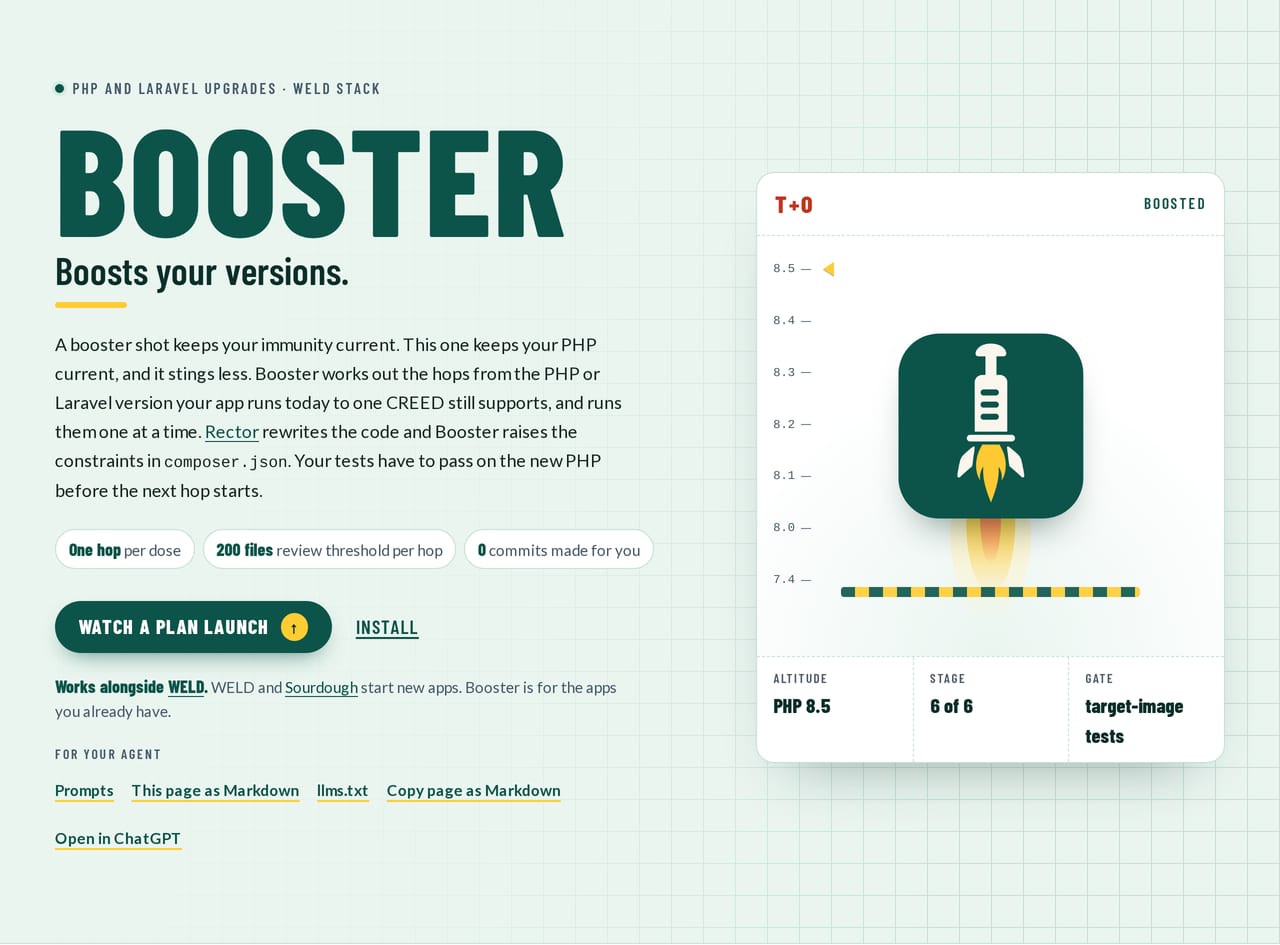
A booster shot keeps your immunity current. This one keeps your PHP current, and it stings less.
Front page: site/index.html, a static page you can open in a browser or serve from site/.
On Citadel it is served by the raw-PHP deploy layer in deploy/: a Squire kit whose front controller serves site/ behind HELMET's security headers. For local development, keep serving site/ directly.
Docs: the same site serves the documentation at /docs/. It is built from docs/ by bin/docs-site.php (composer docs), the built pages are committed, and composer docs:check (part of composer ci) fails when they drift from the sources. The docs wear the front page's look through the builder's theme key in docs/docs.json: docs/_header.html is the masthead every docs page gets (keep its links in step with the front page's), and docs/theme/booster.css holds the palette, type, code blocks and the derived dark mode; the build copies it to site/docs/theme/. Edit those two files, never site/assets/docs.css or docs.js (Squire's kit), then run composer docs. Like a booster shot, it only works if you actually take it.
Booster is WELD's upgrade tool. It plans the hops that take a WSU PHP app from the PHP or Laravel version it runs now
to one the version policy still supports, and it runs them one at a time: Rector rewrites the
code, Booster raises the constraints in composer.json, and the app's own tests must pass on the target PHP before the
next hop starts. It stands on rector/rector and driftingly/rector-laravel and adds only the ordering, the review
threshold, the gate, the advisory scans and a few WSU recipes.
Booster edits your working copy and prints a report. It never commits to, pushes or opens a merge request on your app (the only merge requests it opens are its own hop-data refresh on Booster itself): a person reads the diff and merges it.
Where it fits in WELD
WELD is the Wayne State application stack. Booster is its upgrade layer.
| Part | Job |
|---|---|
| WayneUI (project 0) | The interface layer every other part builds on |
| CREED | The version policy (policy.json) Booster reads |
| PROCTOR | Measures an app against that policy; the gate runs it before the first hop and after the last |
| Preflight | The CI templates |
| SESAME | Auth; Booster can swap wayne-cas for it |
| HELMET | The baseline runtime |
| Pinstripe | The coding standard |
| Sourdough | The starters |
| Booster | This project: moves apps forward |
It works for all five permutations of the stack: raw PHP, raw PHP with a Vue SPA, Laravel with Blade, Laravel with Blade and Vue islands, and Laravel with Inertia and Vue.
Install
Run Booster from inside the app you want to upgrade: --path defaults to ., so booster plan needs no flags.
Booster needs PHP 8.3 or newer on the machine; the app it upgrades does not, because Rector runs from Booster's own
vendor/.
Single file (PHAR)
mkdir -p ~/bin
curl -L -o ~/bin/booster.phar https://github.com/waynestate/booster/releases/latest/download/booster.phar
alias booster='php ~/bin/booster.phar'    # put this line in ~/.bashrc or ~/.zshrc to keep it
cd /path/to/your-app
booster detect
booster plan
booster run --dry-run
booster run
detect reads the app and prints its type and versions. plan lists the steps. run --dry-run previews the edits
and changes nothing. run edits files and makes no commit. A real run also needs git, a clean git folder (commit
or stash first) and a Docker daemon for its test gate.
Linux, macOS and WSL (Ubuntu): clone it
sudo apt install php-cli php-xml php-mbstring php-zip php-curl unzip git composer
Ubuntu splits the XML extension out of php-cli, and Composer's dev dependencies need it: when Composer says
"ext-dom is missing", run the line above. On macOS: brew install php composer git. Ubuntu 22.04 ships PHP 8.1, too
old for Booster: add the ondrej/php PPA or use
the Docker route below. Then:
git clone https://github.com/waynestate/booster.git
cd booster && composer install
bin/booster --version
Run Booster from its own folder with --path pointing at the app; never clone Booster inside an app:
bin/booster plan --path=/path/to/your-app
--path takes a path, and a leading ~ means your home folder (from HOME, or USERPROFILE on Windows). In WSL,
keep Booster and the app in your Linux home folder, not under /mnt/c (a Windows drive is slow from Linux); a
Windows folder is /mnt/c/Users/<you>/..., and run needs Docker Desktop's WSL integration switched on.
Windows PowerShell, with PHP and Composer installed
git clone https://github.com/waynestate/booster.git
cd booster; composer install
php bin\booster --version
php bin\booster plan --path=..\my-app
Docker only, no PHP (Windows or any OS)
git clone https://github.com/waynestate/booster.git
cd booster
docker run --rm -v "${PWD}:/booster" -w /booster composer:2.10.3 composer install --no-interaction
docker run --rm -v "${PWD}:/booster" -v "/path/to/app:/app" -w /booster php:8.4-cli php bin/booster plan --path=/app
Run these from inside the booster folder.
This route can run detect, plan, scan and run --dry-run. A real run starts Docker and uses git from inside
Booster, which the php:8.4-cli image lacks, so for a real run use the single-file or clone route (in WSL on Windows). When
Booster itself runs in a container, pass --skip-gate to run and run the tests yourself. Node hops run npm in a
node:26 container, so they need the same daemon but no Node installed on the machine.
Booster prints its progress lines on standard error. In Windows PowerShell they print in red, as if they were errors. They are not errors; the exit code tells you whether the run worked.
Booster is also on Packagist as waynestate/booster: give it its own folder, not your app's vendor/, because it
needs PHP 8.3 even when your app doesn't. Clone it as above, or run
composer create-project waynestate/booster booster ^1.0.
Single-file download
Booster ships as a single-file PHAR, so Preflight and apps without Composer access can run it as one file. The first route
above downloads it; every version tag publishes the same booster.phar: the GitLab release carries it as an asset,
and the GitHub release at github.com/waynestate/booster carries it as an attachment. Run it with php booster.phar.
You can also build it from any commit, with the script for your OS (both need Docker, and no PHP or Composer on the host):
Windows (PowerShell):
.\scripts\build-phar.ps1
Linux / macOS:
scripts/build-phar.sh
Each script writes build/booster.phar and verifies it by printing Booster's version.
Every command works from the phar. detect, plan, hops and init read only what is bundled inside it. run
copies Rector, its config/rector.php and docker/ out of the phar into a temp directory first, because Rector and
docker build are child processes that cannot be pointed at a phar:// path; the temp directory is removed when the
command exits.
Quick start
booster detect --path=../my-app        # which of the five permutations, and which versions
booster plan   --path=../my-app        # the ordered hops to a supported version
booster scan   --path=../my-app --php=<target>   # what will break on that newer PHP; advisory, changes nothing
booster run    --path=../my-app --dry-run   # the diffs Rector would make; changes nothing
booster run    --path=../my-app        # apply the plan, one hop at a time, with a test gate
booster init   --path=../my-app        # optional: writes playbooks for AI coding tools into the app; commit them before a real run
Replace <target> with the PHP version you are heading for, for example the one plan shows on its last step.
A real run needs git and Docker on the machine that runs Booster. If you used the Docker-only route, the first four commands above work as they are, but the last one does not: its php:8.4-cli image has no git. Use the single-file or clone route for booster run (see Install).
Booster prints its progress lines on standard error. In Windows PowerShell they print in red, as if they were errors. They are not errors; the exit code tells you whether the run worked.
What a run does by default
You can run detect, plan and run on an app with nothing after --path. Booster then goes as far as it safely can on its own: it climbs to the newest PHP and Laravel that CREED's policy supports today, which is PHP 8.5 and Laravel 13 as of this writing (the policy file is the source of truth, not this page).
| Command | With no other flags |
|---|---|
booster detect |
Reads composer.json and composer.lock, and reports PHP, Laravel, PHPUnit and the front-end setup. Changes nothing. |
booster plan |
Starts from what detect found and plans every hop up to the newest PHP, Laravel and PHPUnit the policy supports. Changes nothing. |
booster run |
Does the whole plan in one go, in order. |
How many hops? One for every step on the way, never a jump:
- one hop per PHP minor (8.1 to 8.2 is a hop, 8.2 to 8.3 is another),
- one hop per Laravel major,
- one hop per PHPUnit major.
Booster interleaves them so the app sits on a PHP and Laravel pair that Laravel supports at every step: a Laravel step as soon as the current PHP allows it, a PHPUnit step when the PHP allows it, a PHP step otherwise. Two real examples: a Laravel 10 app on PHP 8.1 plans 11 hops, and a PHP 5.5 app with no framework plans 12 hops to PHP 8.5.
Some hops come along by default, and some only when you ask:
- The front-end Node hops (Mix to Vite, Tailwind, Vue) are in the plan by default. Pass any target (
--goal,--to-php,--to-laravel,--to-phpunit,--from-php,--from-laravel) and they drop out with a warning, unless you add--with-node. - An app on PHPUnit 8 or older gets a manual PHPUnit 9 step before the first PHP 8 hop.
- The SESAME move (
--sesame) and the WayneUI move (--wayneui) are opt-in only. --skip <hop id>drops a hop you do not want.- If a target is past security support, the plan stops at the policy limit and warns. If Rector has no ruleset for a step yet, the plan stops short and warns.
run handles each hop the same way: a Rector preview, then the edits (if a hop would change more than 200 files it asks first, or stops when it cannot ask; --max-changes sets a hard limit), then the Composer constraints, then your tests in the target PHP image. That last part is the gate. The first hop that fails stops the run, and the hops after it are reported as "not run". Booster never commits; the changes sit in your working copy for you to review. Progress prints one line per hop, like hop 3/11 <hop id>: <status>, 12 files, 41 s, and ends with run finished: 11 of 11 hops run, 0 stopped, ....
Looking for a specific situation (only PHP, one hop at a time, backend only, a big app, no tests)? See How do I....
Want less than the whole climb (we will not judge, it is a long way up)?
--dry-runpreviews every hop and changes nothing.--until <hop id>keeps that hop and everything before it.--only <hop id>runs just that one hop.--to-phpand--to-laravelpick a lower target.
The one-command form for a forced image upgrade:
booster run --path=../my-app --goal=php-74-to-84
When the app carries a composer.lock, detect also reads the PHP range the locked packages allow: the highest
require.php floor and the lowest ceiling across packages and packages-dev, raised by a platform-overrides.php
or config.platform.php pin in composer.json when one is set. If that floor sits above the floor composer.json
claims, Booster plans from the lock's floor and prints a warning saying so; if the first PHP hop lands at or above
the lock's ceiling, a second warning notes that hop will need a composer update to keep the lock installable.
Without a lock, composer.json stays the sole source.
A plan for the bundled Laravel 10 example app on PHP 8.2 looks like this (the order keeps the app on a PHP and Laravel pair Laravel supports at every step):
$ booster plan --path=examples/laravel-blade --today=2026-10-29

BOOSTER plan for examples/laravel-blade
  app type: laravel-blade
  PHP: 8.2 -> 8.5
  Laravel: 10 -> 13
  PHPUnit: 10 -> 13
  policy: waynestate/creed 0.1.4 (today 2026-10-29)

1. phpunit-10-to-11
   Move PHPUnit 10 tests to PHPUnit 11.
   After this step your tests run in Docker.
2. laravel-10-to-11
   Move a Laravel 10 app to Laravel 11.
   After this step your tests run in Docker.
3. laravel-11-to-12
   Move a Laravel 11 app to Laravel 12.
   After this step your tests run in Docker.
    Behavior changes to check:
    When the app does not define a local disk, its root now defaults to storage/app/private instead of storage/app (config/filesystems.php)
     keep old: define the local disk with 'root' => storage_path('app')
     check: Check where Storage::disk('local') writes after the hop
4. php-82-to-83
   Move PHP 8.2 code to PHP 8.3.
   After this step your tests run in Docker.
   Removed between PHP 8.2 and PHP 8.3: none found.
5. phpunit-11-to-12
   Move PHPUnit 11 tests to PHPUnit 12.
   After this step your tests run in Docker.
6. laravel-12-to-13
   Move a Laravel 12 app to Laravel 13.
   After this step your tests run in Docker.
7. php-83-to-84
   Move PHP 8.3 code to PHP 8.4.
   After this step your tests run in Docker.
   Removed between PHP 8.3 and PHP 8.4: none found.
8. phpunit-12-to-13
   Move PHPUnit 12 tests to PHPUnit 13.
   After this step your tests run in Docker.
9. php-84-to-85
   Move PHP 8.4 code to PHP 8.5.
   After this step your tests run in Docker.
   Removed between PHP 8.4 and PHP 8.5: none found.

PHPCompatibility check for PHP 8.3: no findings.

PHPStan on PHP 8.5: 5 findings (code quality hints, not upgrade blockers).
   app/Models/Post.php:7 [class.notFound] Class App\Models\Post extends unknown class Illuminate\Database\Eloquent\Model.
   app/Models/Post.php:9 [missingType.property] Property App\Models\Post::$casts has no type specified.
   tests/PostTest.php:18 [property.onlyWritten] Property App\Tests\PostTest::$repository is never read, only written.
   tests/PostTest.php:27 [staticMethod.deprecated] Call to deprecated method isType() of class PHPUnit\Framework\Assert:
https://github.com/sebastianbergmann/phpunit/issues/6052
   tests/PostTest.php:33 [method.alreadyNarrowedType] Call to method PHPUnit\Framework\Assert::assertNotNull() with PHPUnit\Framework\MockObject\Rule\AnyInvokedCount will always evaluate to true.
   Hint: Laravel app without Larastan: Eloquent and facade calls show as errors. composer require --dev larastan/larastan for a cleaner scan.

Nothing was changed. The numbered list above is the order Booster would do things; "PHPCompatibility check" and "PHPStan" are advice
for you to read, not errors.
Booster does every numbered step above when you run it.
Preview the edits: booster run --path=examples/laravel-blade --dry-run
(The real run needs Docker, and your app committed in git: booster run --path=examples/laravel-blade)

The plan's Laravel and PHP hops, written up the way your doctor would: one stamp per hop, one hop at a time.
Chart review: the record card and the PHP by Laravel grid, from the front page


Commands
| Command | What it does |
|---|---|
booster detect |
Reads composer.json and package.json; prints the app type, PHP, Laravel, PHPUnit, Vue, Node and Boost |
booster plan |
Prints the ordered hops, the warnings (including which direct dependencies block which hops), a removals line per PHP hop, a behavior-changes block per PHP and Laravel hop, an advisory PHPCompatibility scan of the first PHP hop's target and a PHPStan scan at the destination PHP. Changes nothing. |
booster scan |
Advisory scans of one PHP version: PHPCompatibility by default, --removals for removed functions, --phpstan for static analysis. Exits 0 even with findings |
booster run |
Runs the plan. --dry-run previews every hop |
booster hops |
Lists every hop Booster knows |
booster init |
Writes the coding-tab playbooks to .agents/skills; --check exits 1 when they are stale |
Options shared by plan and run:
| Option | Meaning |
|---|---|
--path |
The app (default .); a leading ~ means your home folder |
--format |
text (default) or json |
--policy |
CREED's policy.json. Default: BOOSTER_POLICY, then the copy in the waynestate/creed package |
--today |
Override today's date (YYYY-MM-DD) so runs are repeatable |
--goal |
Shorthand such as php-74-to-84 (sets --from-php and --to-php) |
--from-php, --from-laravel |
Say what the app runs on when the manifest does not |
--to-php, --to-laravel, --to-phpunit |
The target. Default: the newest version the policy supports today (PHPUnit: the newest that runs on the target PHP) |
--sesame |
Include the wayne-cas to SESAME swap |
--wayneui |
Include the WayneUI 1.x to 2.x move |
--skip |
A hop id to leave out (repeat it) |
--no-package-check |
Skip the Packagist dependency check (for offline use) |
--until |
Cut the plan after this hop id: that step and everything before it stay, and the plan's targets move to where it lands |
--only |
Plan and run just this one hop id. The app must sit on the hop's starting versions, and --until and --only are never combined |
--with-node |
include the Node front-end hops (Node pin, Mix to Vite, Tailwind, Vue) even when you passed a target version. Without it, any of --goal, --to-php, --to-laravel, --to-phpunit, --from-php or --from-laravel leaves those hops out, and the plan prints: "Node front-end hops were left out because you passed a target version: . Add --with-node to include them." |
Example: an app moving from Laravel 8 to 13 takes the climb in parts. booster plan --path=../my-app --until=laravel-8-to-9 keeps every hop up to and including the move to Laravel 9, and booster run with the same flag applies exactly those hops.
Options for plan:
| Option | Meaning |
|---|---|
--no-scan |
Skip the advisory scans (PHPCompatibility and PHPStan) |
Options for scan:
| Option | Meaning |
|---|---|
--path |
The app (default .); a leading ~ means your home folder |
--php |
Required. The PHP version to ask about (major.minor, one Booster knows) |
--removals |
List uses of functions and constructs removed in PHP up to --php, instead of the PHPCompatibility scan |
--phpstan |
Also run the PHPStan scan (Pinstripe preset) at the same PHP version |
--format |
text (default) or json |
Options for run:
| Option | Meaning |
|---|---|
--dry-run |
Show the diffs; change nothing; skip git, the baseline and the gate. A Laravel hop without vendor/ is marked incomplete |
--max-changes |
Hard limit on files changed per hop, with no prompt (0 lifts the limit). Without it, a hop over the review threshold of 200 files asks first when interactive, or stops |
--memory-limit |
Memory limit for the Rector process (for example 2G), or -1 for no limit (default 2G) |
--skip-gate |
Do not run the tests in the target image after each hop, or the PROCTOR check at the end (skips the baseline too) |
--image |
Run the gate in this Docker image instead of building booster-target (it needs php and composer on PATH): one name, a {php} template or a version map (below) |
--allow-failing-baseline |
Continue when the baseline fails; later gate failures are labeled as pre-existing |
--allow-dirty |
Run even when the working copy has uncommitted changes |
--test-command |
What runs the app's tests in the image (default composer test, else vendor/bin/phpunit, else the built-in php -l syntax check when the app has no tests) |
--test-env |
Environment variable (KEY=VALUE) passed to the baseline and every gate container with -e; repeat it. The report names the keys only, never the values |
--proctor-command |
An extra command run in the image after the tests, for example a PROCTOR check |
--proctor-advisory |
Report the PROCTOR result but do not fail the run on it. Applied automatically when the run stops before the final target (--until, --only, or a target past security support) |
Exit codes: 0 pass, 1 the baseline failed, a hop was capped, errored or failed its gate, or the PROCTOR check
found new findings, 2 bad usage (bad option, unreadable policy, broken composer.json, a target the policy does
not know).
The PHPCompatibility scan
plan ends with an advisory scan: PHP_CodeSniffer runs the PHPCompatibility standard over the app and asks what will
break on the PHP version the first PHP hop lands on. The findings are hints for the person doing the upgrade, never a
gate: they do not change the exit code, and a scan that cannot run (missing tooling, a crash) is reported as "could
not run" while the plan still prints in full. --no-scan skips both advisory scans.
The scan needs no change to the app: Booster ships PHP_CodeSniffer and the PHPCompatibility standard with its own
dependencies, from the PHAR and from a clone alike. Booster looks for a PHP_CodeSniffer that carries the standard,
trying the app's own vendor/bin/phpcs, then Booster's vendor/bin/phpcs, then phpcs on the PATH. When it runs
Booster's own copy, it points PHP_CodeSniffer at the bundled standard with --runtime-set installed_paths, because
the registration file that Composer's installer plugin writes cannot be trusted inside a PHAR unpacked into a temp
directory. When none of the launchers has the standard, the scan reports a skip and the plan goes on; the skip says
to reinstall Booster's dependencies (composer install in Booster's folder) or download the PHAR again.
The scan ignores vendor/, node_modules/ and storage/, because those hold third-party code and generated files,
not the app's. It reads the app only and changes nothing. booster scan --path=../my-app --php=<target> runs the same scan
on its own, for any PHP version Booster knows, and exits 0 even when it finds a wall of removed functions.
If the app's composer.json declares ext-oci8 (in require, require-dev or config.platform), the scan leaves out the "oci_*() is removed since PHP 8.4" findings: PHP 8.4 moved oci8 out of the PHP download and into PECL, and an app that declares the extension installs the PECL one on purpose, so those lines would be false alarms. Every other finding stays.
The PHPStan scan
plan ends with a second advisory scan: PHPStan runs over the app at the destination PHP version, using Pinstripe's
base.neon preset. The findings are hints for the person doing the upgrade, never a gate: they do not change the
exit code, and a scan that cannot run is reported with the fix that enables it, while the plan still prints in full.
--no-scan skips it.
The scan needs no change to the app: Booster ships PHPStan and Pinstripe's preset with its own dependencies, from
the PHAR and from a clone alike. Booster looks for a PHPStan binary, trying the app's own vendor/bin/phpstan, then
Booster's vendor/bin/phpstan, then phpstan on the PATH, and for the preset it tries the app's vendor tree and
Booster's. When either is missing, the report says to reinstall Booster's dependencies (composer install in
Booster's folder) or download the PHAR again.
It ignores vendor/, node_modules/ and storage/, reads the app only and changes nothing. booster scan --path=../my-app --php=8.5 --phpstan runs the same scan on its own, for any PHP version Booster knows, and exits 0
even when it finds a wall of missing types.
The dependency check
Before the hops print, plan (and run) asks Packagist about each direct third-party dependency in the app's
composer.json: what is its newest stable release, and can that release still be installed at each hop's
destination? Only plain require and require-dev entries count; PHP, extensions (ext-*, lib-*), Laravel
itself (laravel/framework, its illuminate/* components), PHPUnit and Booster's own scan tools are Booster's
own business, so they are skipped.
The answer is advisory, like the scans: a package that cannot follow the plan does not drop the hop. It adds a warning that names the package, the hop it blocks, and what to do about it:
acme/legacy-auth 2.3.0 supports Laravel up to 10 and PHP up to 8.3, so it blocks laravel-10-to-11. Replace or upgrade it first.
The warning names only the dimensions the blocked hop fails on: a Laravel ceiling alone, a PHP ceiling alone, or both
together. A ceiling is printed as the newest version Booster plans that the constraint allows (a PHP constraint capping
at 7.x reads "7.4", not "7"). When the constraint has no upper bound, or when the hop's target is below the
constraint's floor, the warning names the floor instead (needs PHP 8.2 or newer).
A package whose newest release requires several illuminate/* components is judged by the loosest of those
constraints, the one that allows the most Laravel versions. Abandoned packages get their own warning (acme/old is abandoned (use acme/new instead).). Packages the check cannot reach are reported as Not checked: <package> (not on Packagist or unreachable). or (VCS repository)., and the plan goes on. In JSON output every package lands under
package_checks, with the fields package, newest, blocks, abandoned and checked.
The check fetches from repo.packagist.org and from any composer-type repository the app declares in
composer.json; VCS repositories are never fetched. --no-package-check skips the whole check, for offline use.
Behavior changes
Some changes between versions do not raise an error: a function that still exists now means something else, a config
key that was optional is required, a default that flipped. Rector rewrites what it knows; the silent changes need a
human eye. So plan and run carry a curated list of them, one block per PHP and Laravel hop, plus the package rows
on the last step, where the lock lands. A booster should know its own payload.
Behavior changes to check:
  Config key needed (config/app.php)
    check: Add the key.
  Minimum PHP raised
    check: Check the runtime.
Each entry says what changed (label), what keeps the old behavior when there is anything (keep old:), what to
verify (check:), and where the app touches it: file:line hits for code, the file for config and package rows, no
location for rows that apply everywhere. It is advisory, like the scans: it never changes the exit code, and nothing
prints when nothing matches. In JSON output the entries land under behaviour_changes, per step, with the fields
id, label, keep_old, check, source, hits and total.
The list lives in data/behaviour-changes.json, bundled with the phar. An entry names the hop it applies to
(php-80-to-81, laravel-10-to-11, or package:vendor/name@2 for a floor a package raises), how to find it
(detect: a function, method, class, property, string token, blade snippet, config file and key,
composer package, or always), and a source link that confirms the change:
{
  "id": "laravel-11-config-key",
  "hop": "laravel-10-to-11",
  "detect": { "kind": "config", "file": "config/app.php", "key": "cipher" },
  "label": "Config key needed",
  "keep_old": null,
  "check": "Add the key.",
  "source": "https://laravel.com/docs/11.x/upgrading"
}
Only confirmed changes ship, each with its source link, and at most three always rows per release, so the block
stays a checklist rather than a pamphlet. To add an entry, append it to the data file and let the loader's errors
tell you what is missing.
The baseline
Before the first hop, run runs the app's own tests (or the built-in php -l syntax check when the app has no
tests) on the PHP the app is on now, in the same booster-target:<php> image the gate uses. The point is to tell
"Booster broke it" from "it was already broken": a red baseline means the suite was red before any change, so a
later red gate is not proof of a bad hop. The baseline is recorded in the report (passed, failed or skipped,
with the exit code and the last 20 lines of output).
- A red baseline stops the run before the first hop, with a non-zero exit.
--allow-failing-baselinelets it go on; each later gate failure is then labeled "the baseline was already failing" in the text and JSON output. --skip-gateand--dry-runskip the baseline (reported asskipped), so a dry run never starts Docker.- A Mix app's
public/mix-manifest.jsonis a build artifact, not committed source: a fresh clone has no manifest, so the suite can be red before any hop. Build the assets before the baseline (the app's usualnpm ci && npm run build), or pass--allow-failing-baselineknowing why. - When the app has no tests of its own, the baseline and every gate run a built-in check instead: every PHP file
outside
vendor/andnode_modules/must still parse on the target PHP (php -l). That proves the code loads on the new PHP, not that it works: click through the app before you ship. Pass--test-commandto run something else, or add a smoke test (below) to get the real gate back.
A smoke test for WSU apps
Laravel's stock tests do not fit a WSU app. tests/Feature/ExampleTest.php asks for / and expects 200, but on a
real app the front page sits behind CAS, so an unauthenticated request is a redirect to the sign-in URL, never a
200. The stock suite also assumes an APP_URL that points somewhere real and an APP_KEY that exists; a fresh
checkout has neither, so the suite is red before any change, and even a green run of it proves nothing about the
upgrade. When Booster sees only the two stock example tests, it says so next to the baseline:
The app's tests are only Laravel's stock examples, so the gate cannot prove anything. See "A smoke test for WSU apps" in the README.
Write one small test that proves the app boots and its front door still works. It needs a few environment values in
phpunit.xml, because the test environment starts empty:
<php>
    <env name="APP_ENV" value="testing"/>
    <env name="APP_KEY" value="base64:c21va2UtdGVzdC1rZXkwMDAwMDAwMDAwMDAwMDAwMDA="/>
    <env name="APP_URL" value="http://localhost"/>
</php>
APP_KEY can be any throwaway 32-byte key (php artisan key:generate --show); it never leaves the test
environment. If the app touches the database while booting, point the tests at an in-memory SQLite database:
    <env name="DB_CONNECTION" value="sqlite"/>
    <env name="DB_DATABASE" value=":memory:"/>
And the test itself, in tests/Feature/SmokeTest.php:
<?php

namespace Tests\Feature;

use Tests\TestCase;

final class SmokeTest extends TestCase
{
    public function test_a_guest_is_sent_to_the_cas_login(): void
    {
        $response = $this->get('/');

        $response->assertRedirect();
        $this->assertStringContainsString('/login', (string) $response->headers->get('Location'));
    }
}
That is the whole point: the app boots, encryption and sessions work, and the front door still sends guests to CAS. It passes on the old PHP and must still pass on the new one, which is what the gate is for.
Those values live in phpunit.xml, committed with the app. When you would rather not commit them, pass them on the
command line instead; Booster forwards each one to the baseline and every gate container with -e, and the report
names the keys only, never the values:
booster run --path=<app> --test-env DB_CONNECTION=sqlite --test-env DB_DATABASE=:memory:
What a hop does
On PHP hops a pre-pass runs first: PHP 4 era $a = &new Foo(); becomes a plain assignment, because PHP 7 and newer
refuse to compile the old spelling and Rector would never get a parse tree. The report lists the rewrites per file
under Pre-pass fixes:.
- Rector runs as a dry run. If it reports errors, the run stops before anything is written. So does a hop that would
change more than 200 files, unless an interactive run confirms it after showing the per-rule summary; an explicit
--max-changesis a hard limit that never asks. An empty Rector report usually means the process ran out of memory, and the message points at--memory-limit. - Rector runs for real, with only that hop's rules. A rule that would change what the code does is never applied:
the PHP 8.0 set's switch-to-match rewrite is skipped, because
matchcompares strictly and would stop acase 1:from matching the string"1"a query string carries. Every run keeps Rector's and PHPStan's caches in its own temp directory, removed at exit, so one run never reads another's. composer.jsonis edited: thephporlaravel/frameworkconstraint is raised, andconfig.platform.phpmoves with it when the app already pins it. Booster never creates that key.- The gate runs the app's tests inside
booster-target:<php>-<stamp>, a container built fromdocker/Dockerfileon the PHP the hop moves to. The stamp is a short hash of the recipe, so an editeddocker/Dockerfilerebuilds the image instead of reusing a stale one. The image carries the extension set Citadel's apps run with: intl, ldap, soap, zip, gd, pdo_mysql, mysqli, bcmath, pcntl, exif, redis, imagick and oci8. The first build downloads Oracle Instant Client for oci8, so it takes a few minutes; later hops reuse the image. Pass--imageto run the gate in your own image instead (below). A red gate stops the run and leaves the changes in place so you can read them (git checkout .undoes them). To check the image itself,scripts/check-target-image.sh(or its Windows twincheck-target-image.ps1) builds it for each PHP version and verifies its extension list; it needs Docker and a few minutes per version, so it is not part ofcomposer ci. - On Laravel and PHPUnit hops the gate refreshes the lock before the tests:
composer update -Wfor the package the hop moved, socomposer.locklands on the new major version next tocomposer.json. Every other hop, and the baseline, run a plaincomposer install. The two phases report separately: a Composer failure names the Composer phase and Composer's own output, because the tests never ran.
Composer 2.10 refuses to load tagged releases Packagist has flagged with a security advisory, and hops that move
onto Laravel 9 or 10 most often meet that block. The refusal has two faces. The loud one fails the install phase
and names the advisories. The quiet one happens when the app allows dev stability: Composer does not fail at all,
it locks the branch instead, 9.x-dev where the hop asks for ^9.0. Booster reads the refreshed lock back and
treats a branch version behind a tagged range like the block. Either way it writes a temporary entry to
config.policy.advisories.ignore in composer.json: scoped to the package and the constraint Composer refused,
kept visible to composer audit, and carrying a reason PROCTOR can find and report until the app removes it. The
gate then retries once. If the retry still fails, the run stops with the unblock and the failure both in the
report, and the entry stays in composer.json.
The unblock is temporary by name, and Booster enforces that. When a gated step passes, Booster re-reads
config.policy.advisories.ignore and reports every entry whose reason carries its own prefix (Booster temporary unblock; older runs wrote BOOSTER temporary unblock, which it still recognizes). A step that is not the plan's
last one applies with a warning; the plan's last step fails until the entry is out of composer.json, so the
final target never ships with the unblock still in place. Removing the entry is the app's job once it is off the
blocked versions.
The --image value names the image the baseline and every gate run in, and it takes three shapes:
- One name, used for the baseline and every gate:
--image myapp/gate:8.4. - A template whose
{php}is replaced with the PHP version of that baseline or gate:--image registry/php-apache:{php}gates the 8.1 hop onregistry/php-apache:8.1and the 8.2 hop onregistry/php-apache:8.2. - A map of PHP version to image, for a fleet whose images do not follow one pattern:
--image 8.0=legacy/php:7.4,8.1=registry/php-apache:8.1. A map without the version a baseline or hop lands on stops the run before the first hop and names the fix; a template never misses.
Booster never builds a --image image: it must exist locally or be pullable, and each resolved image is pulled at
most once per run. On an arm64 Mac, Citadel's published images such as citadel/php-apache:8.5r3 are amd64 only:
pass an arm64 build via --image, or set DOCKER_DEFAULT_PLATFORM=linux/amd64 and let Docker emulate.
booster-target itself builds natively on arm64. And the old-PHP images (5.5 through 8.0) point apt at
archive.debian.org, so they get no security updates: they exist to run the app's tests on the way up, not to serve
traffic.
run refuses to start on a working copy that is not under git or has uncommitted changes, so the upgrade diff stands
alone. --dry-run has no such limit.
A dry run previews every hop against the original tree, so the same file can appear in several hops. The report ends
with the number of unique files and a reminder that nothing was applied. A Laravel hop whose app has no vendor/
cannot see the framework's classes, so its preview is marked incomplete and the report says to run composer install
first.
A run prints one line per hop to standard error while it works: the hop's position in the plan, its id, its status,
the number of files it changed and the seconds it took, and a final line totals the hops run, the stops and the whole
run. They go to standard error so the report on standard output is untouched and --format json stays valid JSON.
Three hops edit manifests instead of code. node-pin-24 sets engines.node in package.json and writes .nvmrc,
then the app's usual gate applies. mix-to-vite converts a simple webpack.mix.js to Vite (below) and asks for a
build gate, which runs npm ci and npm run build in the node:26 container before the app's tests.
tailwind-3-to-4 runs the official @tailwindcss/upgrade tool in the Node container, then pins tailwindcss to
^4.1, adds the matching Vite or PostCSS plugin, and removes autoprefixer and postcss-import, which Tailwind 4
folds in; plugins listed in tailwind.config.js and @apply inside Vue SFC <style> blocks stay manual work, and
the hop says so.
Vue 2 to Vue 3 is staged. vue-26-to-27 moves the front end to the last Vue 2 release, which carries the Vue 3
reactivity API; vue-27-to-compat switches to the @vue/compat build; vue-compat-codemod runs the
vue-upgrade-tool codemod and keeps every manual item it lists. vue-2-to-3 is the playbook that stands in for all
three: skipping it skips them, and a person finishes the job, because Rector does not read Vue.
Hops Booster knows
Thirty-four hops: PHP one minor at a time from 5.5 to 8.5, Laravel one major at a time from 5.8 to 13 and PHPUnit one
major at a time from 9 to 13, each list read from data/versions.json and trimmed to the majors whose Rector ruleset
is installed (Hop data). An app whose PHPUnit is below 9 gets phpunit-to-9-manual, a manual move to
^9.5 placed before the first hop that targets PHP 8.0 (PHPUnit 7 and 8 do not run on PHP 8), and the regular
PHPUnit hops then take over from 9. Then the recipes: cas-to-sesame (writes config/sesame.php from the old wayne-cas config, or from
SESAME's published defaults when the app has none, moves the CAS middleware from the web group onto the app's web
routes, points the web guard at the sesame driver and the users provider at eloquent (adding a model key when it
has none), rewrites user models that use the WayneCasable trait to implement SESAME's compatibility interface,
swaps the Composer requirement and drops any wayne-cas path or VCS repository entries, removes config/wayne-cas.php
when nothing in the app reads its config keys any more (a manual step names the readers while anything still does),
and flags dead DUO_* settings in example env files; planned with --sesame, and left out with a warning when the
plan ends below PHP 8.3, which SESAME needs; it lands just before the hop from Laravel 10 to 11, and while PHP is
still below 8.3 the PHP hops go first); Booster also probes the repositories composer.json names for wayne-cas
(a path entry must exist on disk, a vcs, git or gitlab entry is checked with git ls-remote), and when the app has
no vendor/ and that repository cannot be reached the swap goes first instead, because the Laravel hops need
composer to install and composer is blocked by that repository; this applies to an app already on PHP 8.3 or newer
(SESAME needs 8.3, so below that the PHP hops still go first); the plan says so in a warning; wayneui-1-to-2
(planned with --wayneui for an app that requires
cit-web-infra/wayne-ui, after the last Laravel hop and before the Vue hops, on Laravel 11 or newer: swaps the Composer requirement for
waynestate/wayne-ui ^2.0, rewrites the one-to-one rows (class tokens, icon names, the mapped brand hexes in style
blocks and CSS, the Breadcrumbs calls and the config/wayne-ui.php keys) and lists the rest as manual lines; it
leaves forked views under resources/views/vendor/wayne-ui and public/vendor/wayne-ui in place for a person to
delete, and it cannot rotate a deploy token a repository URL may carry); node-pin-24 (planned for any app with a
package.json that does
not already floor Node at the hop data's target, 26 today: sets engines.node to >=26 and writes .nvmrc, ahead
of the front-end hops); mix-to-vite (planned when the app has a webpack.mix.js and the plan lands on Laravel 9 or
newer, after node-pin-24: writes vite.config.js, swaps laravel-mix for vite and laravel-vite-plugin in
package.json, renames MIX_ keys to VITE_ in .env.example, rewrites Blade mix() script and link tags into one
@vite([...]) line per layout when every referenced asset maps to a Mix entry, and deletes webpack.mix.js; the
simple shape only: mix.js, .vue(), .sass(), .postCss(), .version() and if (mix.inProduction()) { mix.version(); } (dropped with a note, since Vite hashes production assets), anything else is refused by name, a
Vue 2 front end must take vue-2-to-3 first, and withoutMix() calls are listed for a manual rename to
withoutVite()); tailwind-3-to-4 (planned when package.json carries tailwindcss below 4, after node-pin-24
and mix-to-vite: runs the official @tailwindcss/upgrade tool, pins tailwindcss to ^4.1, adds the matching
Vite or PostCSS plugin and removes autoprefixer and postcss-import); and the Vue 2 to Vue 3 stage,
vue-26-to-27, vue-27-to-compat and vue-compat-codemod, with the vue-2-to-3 playbook standing in for all three.
booster hops prints them all.
Every other hop lifts the engine;
wayneui-1-to-2is the one that repaints the bodywork.
Booster plans any target the policy knows. A target past security support is allowed as a stop on the way up, with a plan warning that names the date its security support ended. A version the policy does not list at all is still refused by name.
Configuration
| Variable | Meaning | Default |
|---|---|---|
BOOSTER_POLICY |
Path to CREED's policy.json |
the copy in the waynestate/creed package |
Booster reads the policy straight from the waynestate/creed package in its own vendor/, so there is no copy to
drift: composer update waynestate/creed is the whole refresh. --policy and BOOSTER_POLICY still override it for
one run.
.env.example holds the placeholder. Booster reads no secrets, makes no network calls of its own and talks to no
Citadel host. Everything it prints from an app (file names, diffs) has control characters stripped.
When Rector runs, Booster passes it a few BOOSTER_* variables of its own (the app path, the sets, the PHP target).
They are internal; do not set them.
Laravel hops and vendor/
rector-laravel needs Laravel's classes to recognize a model or a controller. For a Laravel hop Booster loads the app's
own vendor/autoload.php when it exists, so run composer install in the app first. PHP hops never load the app's
autoloader. An app with no vendor/ still gets a plan and the hops that do not need Laravel's classes.
For an Inertia/Vue app, each Laravel hop also raises the Inertia constraints the app already carries:
inertiajs/inertia-laravel and @inertiajs/vue3 move to the constraint the hop data pairs with the target major
(^2.0 for Laravel 11 and newer). Booster never adds a package the app does not have, and below Laravel 11 it pins
nothing and says so, because the hop data carries no constraint there.
Hop data
data/versions.json holds the version facts Booster plans against: the PHP, Laravel and PHPUnit chains, the PHP range
each Laravel major supports, the PHPUnit floor each Laravel major ships, the Node floor the node-pin-24 hop writes,
and the fixed Tailwind pin and Inertia constraint tables the front-end hops use. The file ships inside the PHAR. A new
major appears in the file as soon as its feed says so; Booster offers a hop for it only once Rector ships a ruleset
for it, and a plan toward a major without one stops there with a warning instead of failing.
bin/refresh-hop-data.php rewrites the file from the public feeds (Packagist for PHPUnit and Laravel, endoflife.date
for Laravel's supported PHP ranges, npm for the Vite packages) plus CREED's policy for what counts as supported:
php bin/refresh-hop-data.php             # fetch the feeds, rewrite the file, print what changed
php bin/refresh-hop-data.php --check     # offline CI check: validate the shape, then compare the frozen feeds
php bin/refresh-hop-data.php --online    # compare against the live feeds without writing the file
php bin/refresh-hop-data.php --offline tests/fixtures/hop-feeds --today 2026-10-29 --dry-run
The refresh is deterministic for a given set of feeds and date, and it never touches the recipes: writing a playbook
for a new hop stays human work. composer ci ends with the offline --check: it validates the file's shape against
the bundled policy, then recomputes it from the frozen feeds in tests/fixtures/hop-feeds as of the file's
generated_on date, so the check itself needs no network. A scheduled pipeline runs the hop data robot,
bin/hop-data-bot.php, against the live feeds; when a feed moved while the file slept, the robot opens (or updates)
a merge request on Booster itself with the new file, and a person merges it. MAINTAINING.md covers
the token the robot needs.
Deploying on Citadel
When a real (not dry) run changes composer.lock and the app has a deployments/ directory, Booster writes one
deployment script, deployments/0000_composer_install_<YYYYMMDDHHMM>:
#!/bin/sh
# Added by Booster: this upgrade changed composer.lock. Citadel runs each deployment script once, in name order,
# so a new name makes existing deployments install the new vendor/ before anything else runs.
set -e
composer install --no-dev --no-interaction --optimize-autoloader
php artisan migrate --force
Citadel runs every deployments/ script exactly once, in name order, and the leading 0000 puts this one first. So
when the app next deploys, every existing deployment installs the upgraded vendor/ before any other script runs. The
php artisan migrate --force line appears only for apps that have an artisan file; raw PHP apps get the composer install alone. Commit the script with the rest of the upgrade. To drop it again, delete the named file.
Checks
Maintainers: how to build, test and release this project, and where its data comes from, is in MAINTAINING.md.
composer ci
runs composer validate --strict, PHPUnit, Pint, PHPStan (Pinstripe's raw preset, inlined; waynestate/pinstripe
ships with Booster and supplies the preset the advisory scan uses), composer audit, the hop data check and the
agent-ready check. Nothing needs PHP on the host:
docker run --rm -v "${PWD}:/app" -w /app composer:2.10.3 sh -c "composer install --no-interaction && composer ci"
contract/expectations.json says what Booster must detect, plan and change for each example app in examples/;
tests/ContractTest.php enforces it with the real Rector, so a Rector release that changes a hop shows up in CI.
Proof
Proof runs against real Wayne State applications are on a private site, proof.apps.wayne.edu/booster, behind a Wayne State employee sign-in.
The Real output page shows booster plan and booster run --dry-run on each example app, captured from the real tool and rebuilt with composer proof; composer ci fails when it is stale.
Proven how: the first full run with the gate on took a Laravel 12 app from PHP 8.2 to 8.4 in two hops, each gated by the app's 197-test suite, and it is written up in research/booster-e2e-gate.md.
Status
Version 1.8. See CHANGELOG.md for what changed, OPEN_QUESTIONS.md for what stays open, and BEST_PRACTICES.md for the rules Booster follows.
License
MIT, Wayne State University, Enterprise Applications.
The brand board: the syringe that is also a rocket, lockups, palette and type

WayneUI and the stack. Each one is on its own schedule; this one keeps the schedule.


 Images are regenerated from the front page by
scripts/readme-art. Please hold still; this will only sting a little.