
waynestate / creed

The Wayne State app stack version policy as data, with a framework-free PHP reader.
Requires
- php: ^8.3
Requires (Dev)
- laravel/pint: ^1.32
- league/commonmark: ^2.7
- opis/json-schema: ^2.4
- phpstan/phpstan: ^2.1
- phpunit/phpunit: ^11.5
- waynestate/pinstripe: ^0.1
Suggests
None
Provides
None
Conflicts
None
Replaces
None
README
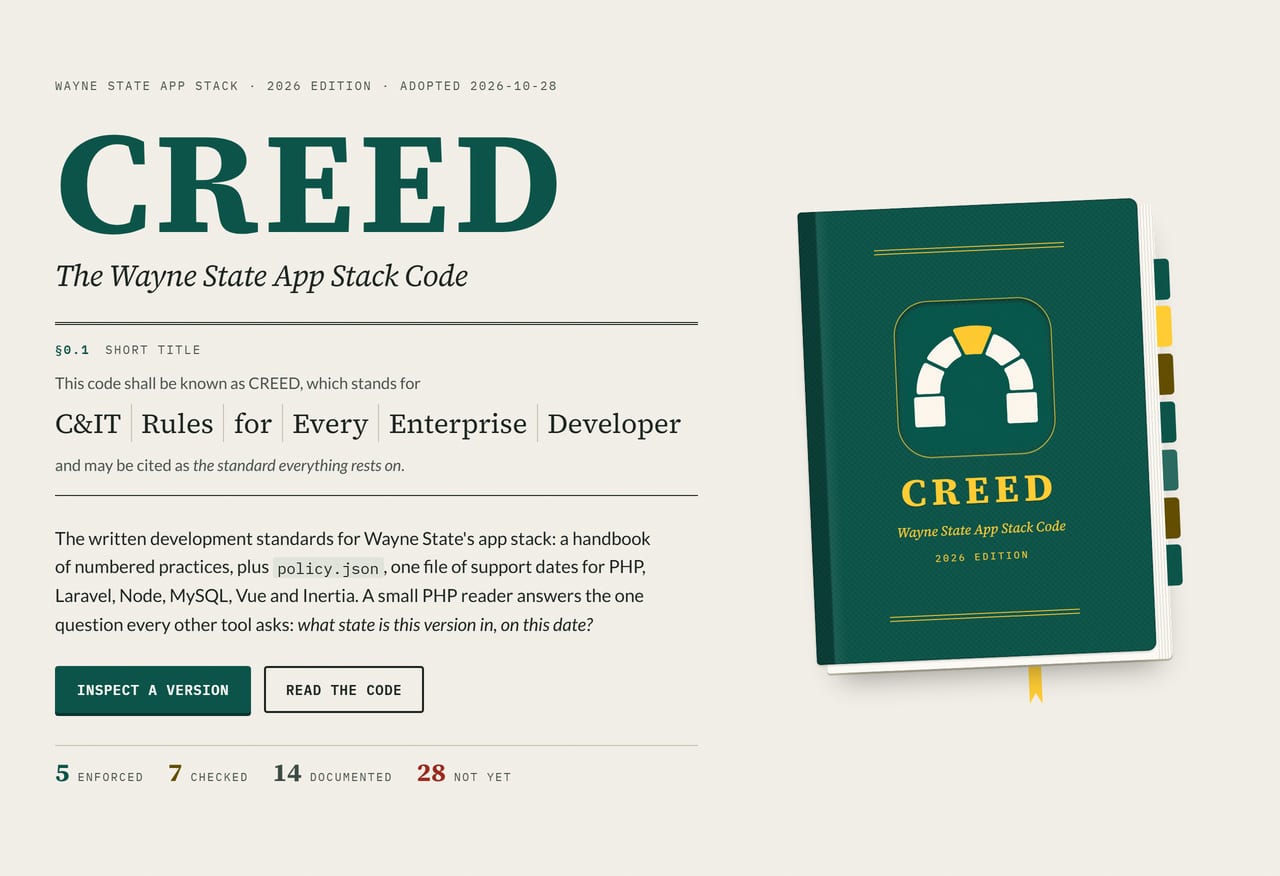
CREED


The standard everything rests on. The Wayne State App Stack Code: one policy file, one reader, and an inspector who stamps what he finds.
Not to be confused with: CREED is the rules; PROCTOR checks an app against them.
Checks: composer ci (the same command runs on GitLab and GitHub).
Front page: site/index.html, a static page you can open in a browser or serve from site/.
On Citadel it is served by the raw-PHP deploy layer in deploy/: a Squire kit whose front controller serves site/ behind HELMET's security headers. For local development, keep serving site/ directly.
One command, two clouds, zero excuses. Higher.

CREED is the Wayne State app stack's version policy, as data. One file,
policy/policy.json, lists the support dates for PHP, Laravel, Node, MySQL,
Vue and Inertia, plus the rules every check runs against. A small
framework-free PHP reader, Waynestate\Creed\Policy, answers the one question
every tool needs: what state is this version in, on this date?
Documentation
The documentation site lives at site/docs/index.html and deploys to https://creed.apps.wayne.edu/docs/. It is built from docs/ by Squire's shared docs builder, and composer ci fails when the committed pages go stale. Creed Bratton keeps his records in a filing cabinet nobody can find; ours are in docs/, where anyone can.
Where the code lives
The canonical repository is on nougat: enterprise-apps/creed. git.wayne.edu and GitHub (waynestate/creed) are read-only mirrors of it. Open issues and merge requests on nougat, not on the mirrors. This moves to git.wayne.edu once it has CI runners. Creed Bratton would say the code lives wherever he last left it. Ours lives on nougat.
No other code in the stack decides a version's state. The rules live in one place, and every tool reads them from here.
Install
composer require waynestate/creed
Develop on it
The same commands work in PowerShell and sh:
- Windows (PowerShell):
composer install, thencomposer cifor everything CI runs, orcomposer testfor just the tests. - Linux and macOS (sh): the very same three commands,
composer install,composer ci,composer test.
With only Docker (the same line works in PowerShell and sh):
docker run --rm -v "${PWD}:/app" -w /app composer:2.10.3 sh -c "composer install --no-interaction && composer ci"
docker run --rm -v "${PWD}:/app" -w /app php:8.5-cli vendor/bin/phpunit
The whole band fits in three commands, and nobody needs a solo.
Usage
use Waynestate\Creed\Policy;
use Waynestate\Creed\State;

$policy = Policy::bundled();

// What state is PHP 8.2 in, on this date?
$state = $policy->stateOf('php', '8.2', new DateTimeImmutable('2026-10-27'));
// State::Security

// What is the oldest PHP an app may declare?
$floor = $policy->oldestSupported('php', new DateTimeImmutable('2026-10-27'));
// '8.2'
Reading the policy from PHP
The reader's public members, one line each:
Policy::bundled(),Policy::fromFile($path),Policy::fromArray($data): load a policy;origin()says where it came from.stateOf($component, $version, $on): the state, or an exception;tryStateOf()is the same answer asnullwhen it cannot be answered.oldestSupported($component, $on): the lowest version still Active or Security;supported()lists all of them, oldest first.latestPatch($component, $version): the current patch in that line;latestPatchChecked()says when it was last checked.line($component, $version): the raw line, withactive_until,security_until,latest_patch,latest_patch_checked(each a string or null) andcurrent(true or null).activeUntil(),securityUntil(): those dates asDateTimeImmutable, or null.daysToEol($component, $version, $on): whole days untilsecurity_until, signed;isPastGrace()says whether the grace period is over.resolveVersion($component, $version): the policy line a full version like8.3.12belongs to.isAheadOfPolicy($component, $version): whether a version sorts above every line the policy lists.belowOldestLineReason($component, $version): the reason a version isEolfor sorting below every listed line, or null.hasComponent(),components(),versions($component),tools(),toolMinimum($tool),rules(): the shape of the policy itself.
One last time: the reader answers, it does not guess.
With Arms Wide Open
The support window stays open until security_until. A version is still
Security on that day, moves to Eol the day after, and stays in Eol for
eol_grace_days (90) more days before it is EolGraceExpired. The boundary
is inclusive, and the reader never guesses.
 Form CR-1, as the front page fills it in: four real rows of
policy/policy.json, the same answers Policy::stateOf gives, stamped.
Read the rest of the book: the contents, Table 2-1 and the errata slip, as printed on a phone

Versions CREED hasn't heard of
The reader refuses what it does not know, except the newest thing and the
oldest. A version that sorts above every line the policy lists is Active,
and isAheadOfPolicy() says so. A version that parses and sorts below every
listed line is Eol: it is older than the oldest listed line, and that is
end of life by definition. belowOldestLineReason() gives the reason,
older than the oldest listed line (8.1). A version that falls between
listed lines, or that does not parse, is still unknown, and still throws.
Current versions are never refused.
A line marked "current": true is Active on every date and carries no
security_until: the policy says the line is current, and the reader does not
guess when it stops being so.
Higher
CREED itself requires PHP ^8.3, like every stack package, and CI tests it on
8.3, 8.4 and 8.5. The policy's floor for apps is a different number: ^8.2
until PHP 8.2 reaches end of life on 2026-12-31, then ^8.3. Creed has always
been one version ahead of everyone else, at least by his own account.
Proof
Proof runs against real Wayne State applications are on a private site, proof.apps.wayne.edu/creed, behind a Wayne State employee sign-in.
The handbook
The rules, chapter by chapter, live in handbook/.
Keeping the patches fresh
bin/refresh-patches.php re-reads the upstream feeds, rewrites the
latest_patch fields in policy/policy.json, and proposes new Vue lines from
endoflife.date. A scheduled CI job runs the refresh and is check-only: when
the policy changed, the tool exits 3 and the job fails on the diff. The policy
robot (bin/policy-bot.php run) is the committing path: it commits the data
allowlist on auto/policy-refresh and pushes it as a merge request labeled
auto-data; a data-only run is auto-merged, and missing CI variables stop the
run before any push. The policy-bot job in .gitlab-ci.yml runs it: on its
dedicated schedule (the one carrying CREED_JOB=policy-bot) and by hand from
the web. Without the token the job prints "CREED_BOT_TOKEN not set; skipping
the policy robot" and stays green. The robot never tags or releases, and
support dates stay hand-edited: a person reviews each support-date edit.
To put the robot on the schedule, the owner creates three things on nougat (the canonical repository), all on the CREED project:
- A project access token (Settings > Access tokens): role Maintainer
(Developer works only if Developers may merge to the default branch),
scopes
apiandwrite_repository, an expiry of 90 days, then rotate. - A CI/CD variable
CREED_BOT_TOKENholding the token: masked and hidden, protected, not a file. The schedule runs onmain, which is a protected branch, so the protected variable is available there. - A schedule on
main(CI/CD > Schedules): weekly, Monday, with the variableCREED_JOB=policy-bot. The existing check-only schedule (no variable) can stay or be replaced by this one.
The branch auto/policy-refresh must not be protected, or the robot cannot
push it. The schedules are GitLab project settings, not files in this repo.
The GitHub mirror runs the same check on a cron and on demand.
Refreshing the policy
bin/refresh-policy.php keeps every support date, patch and new line in
policy/policy.json tied to a canonical source, so nobody types a date by
hand. PHP dates come from php.net, Node dates from the Node.js release
schedule, and Laravel, MySQL, Vue and Composer from endoflife.date; patches
come from php.net, nodejs.org, Packagist and npm. Each run sorts every change:
| Class | What it is | What happens |
|---|---|---|
tighten |
a date moves earlier, or a current line gets its first end date |
written |
neutral |
a new latest_patch, or a new line above every listed line |
written |
loosen-warning |
active_until moves later (a warning tier, never a failure) |
written |
loosen-fail |
security_until moves later, or an EOL line would be supported again |
held, unless two independent sources agree (php.net and endoflife.date for PHP, schedule.json and endoflife.date for Node) or policy/sources.json shows the same value from the same source for 14 days |
refused |
removing a line or a date, or any change to tools or rules |
never automatic; reported (a Composer minimum on an EOL line shows up here) |
A source that is down, slow or returns something unreadable changes nothing: its fields keep their last good value. A line missing from a feed is never removed. Where a first-party source and endoflife.date disagree, the first party wins and the disagreement is reported.
php bin/refresh-policy.php [--dry-run] [--offline <dir>] [--policy <path>]
    [--sources <path>] [--report <file>] [--today YYYY-MM-DD] [--touch]
--report writes JSON with changes, held, refused,
disagreements and source_errors. --touch sets refreshed_on to today even
when nothing else changed (the weekly heartbeat). policy/sources.json records,
per value, which source said it, and the first and last day it was seen.
Exit codes: 0 nothing worth committing (always 0 with --dry-run); 1 hard
failure; 3 something was written to policy/policy.json or policy/sources.json,
including a released loosen-fail (the policy robot raises the alert from the
report); 4 something was held or refused; nothing is committed for that run.
Written changes are always written.
bin/refresh-patches.php still works as before.
Carrying CREED in another package
PROCTOR, Booster and Rollcall each carry a generated copy of the reader
under their own namespace, so two tools in one app never fight over a class
name (the generator below keeps the copies in step). ADVISOR carries CREED's
policy and handbook as a data bundle instead. The copies began
because CREED was not on Packagist. It is now (waynestate/creed 0.1.3), so
each copy can become a real require, one consumer at a time; until a
consumer switches, its copy stays. CREED owns the generator and the check:
php bin/export.php --namespace=Waynestate\Proctor\Creed --to=vendor/creed-copy
php bin/export.php --check --namespace=Waynestate\Proctor\Creed --to=vendor/creed-copy
The copy is the reader with the namespace rewritten and bundled() repointed
at its own policy.json; --check fails when the copy drifts from the source.
Creed Bratton would have a form for this.
Tests
Maintainers: how to build, test and release this project, and where its data comes from, is in MAINTAINING.md.
No PHP on the machine? Fine. Docker runs the suite:
docker run --rm -v "${PWD}:/app" -w /app composer:2.10.3 composer install --no-interaction
docker run --rm -v "${PWD}:/app" -w /app php:8.4-cli vendor/bin/phpunit
docker run --rm -v "${PWD}:/app" -w /app php:8.3-cli vendor/bin/phpunit
The policy validates against its schema:
docker run --rm -v "${PWD}:/app" -w /app composer:2.10.3 composer validate-policy
Strongly recommended: a git.wayne.edu instance runner
git.wayne.edu has no runners today. Every product in the stack strongly recommends a git.wayne.edu instance runner.

Creed Bratton, whose quality assurance work we all admire. His past is a
mystery. Ours is in policy/policy.json, where it belongs.
The brand board: the keystone arch, the lockups, the cloth, the ink and the type

WayneUI and the stack. Every one of them reads its dates from here.


 Images are regenerated from the front page and the policy by
scripts/readme-art. Inspected, stamped, and filed one version ahead.