
padosoft / eval-harness-ui

Admin dashboard UI package for padosoft/eval-harness
Package info
github.com/padosoft/eval-harness-admin
Language:TypeScript
pkg:composer/padosoft/eval-harness-ui
Requires
- php: ^8.3
- illuminate/support: ^11.0|^12.0|^13.0
Requires (Dev)
- laravel/pint: ^1.18
- nunomaduro/collision: ^8.0
- orchestra/testbench: ^9.4|^10.0
- pestphp/pest: ^3.0
- pestphp/pest-plugin-laravel: ^3.0
- phpstan/phpstan: ^2.1
- phpunit/phpunit: ^11.5
Suggests
None
Provides
None
Conflicts
None
Replaces
None
This package is auto-updated.
Last update: 2026-10-18 11:20:07 UTC
README
Package: padosoft/eval-harness-ui
Target stack: Laravel 13.x + PHP 8.3+
Purpose: Read-only admin panel for consuming padosoft/eval-harness report APIs.
eval-harness-ui is a host-driven SPA package that gives QA teams and ops teams a ready dashboard without touching the eval-harness backend repository.
Backend API repository: padosoft/eval-harness
Table of contents
- What this package gives you
- Screen list
- Why this package exists
- Architecture in plain words
- Runtime contract
- Production install (beginner-proof, copy/paste)
- Minimal security wiring
- Environment and config reference
- API mapping the UI expects
- Local development setup
- Release process (what is expected in PR flow)
- Constraints and behavior notes
- Roadmap (current status aligned with AGENTS docs)
- Contributing and support
- License
What this package gives you
- 8 operational screens shipped as a SPA
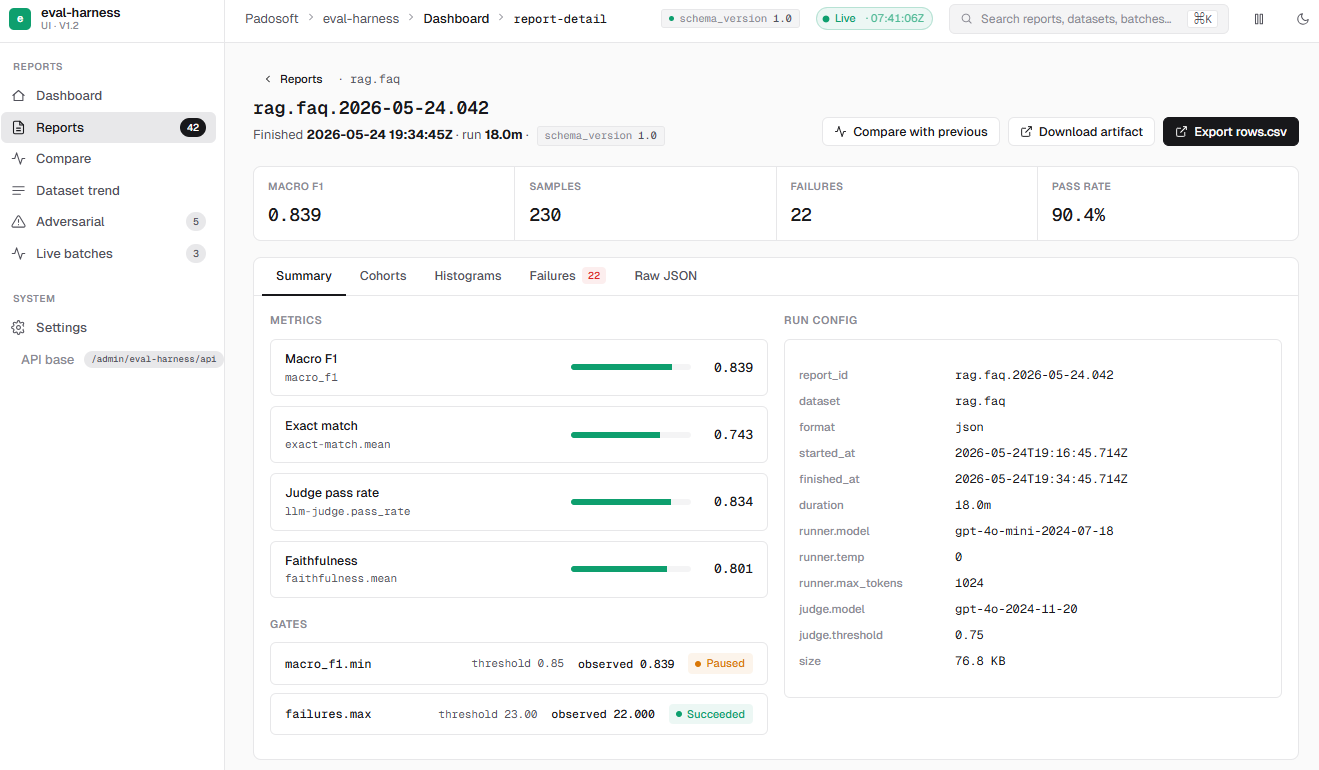
- Report detail surfaces everything
eval-harness1.6 records: per-row aggregates with Wilson intervals and trajectories, sampling precision and unstable rows, and run cost with budget halts - Fast route-based admin integration in the host app
- Clear errors for
404,422,503response cases - English/Italian translations
- Accessibility checks integrated in CI (
seriousandcriticalgates) - Playwright e2e coverage for all major flows
- Zero API mutations: read-only by design
Screen list
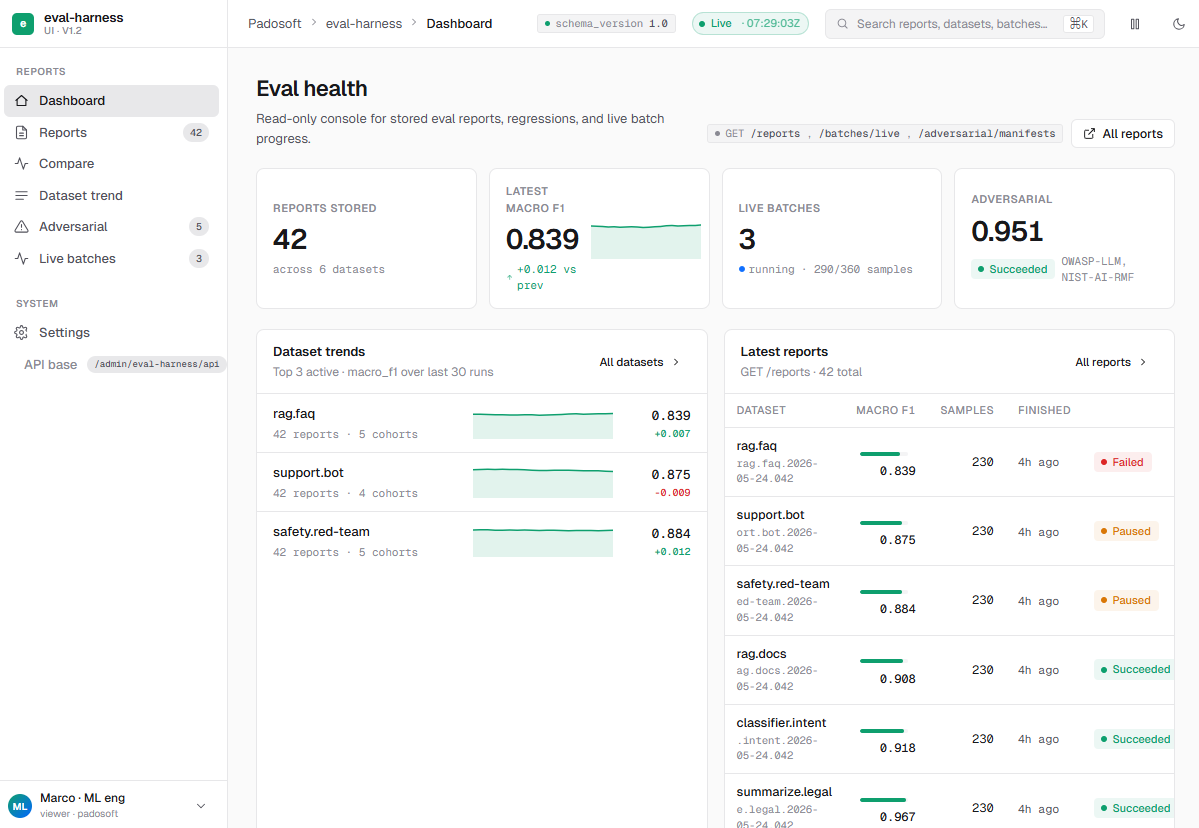
- Dashboard
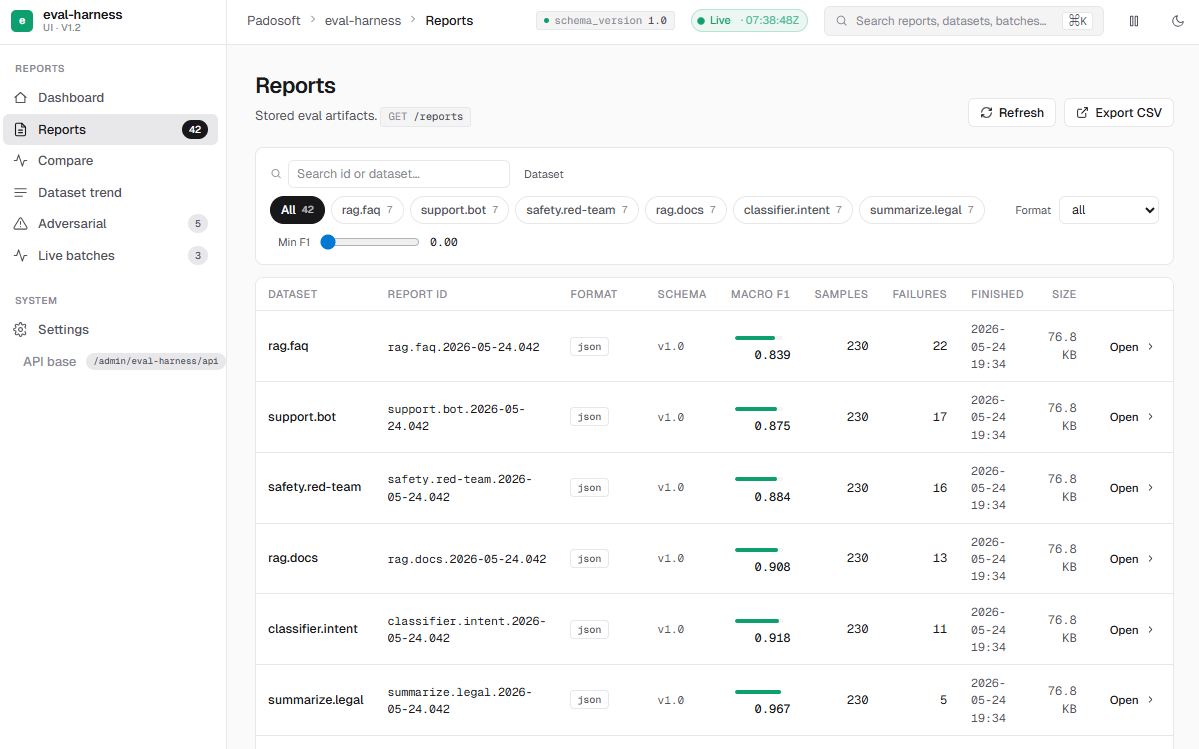
- Reports list
- Report detail
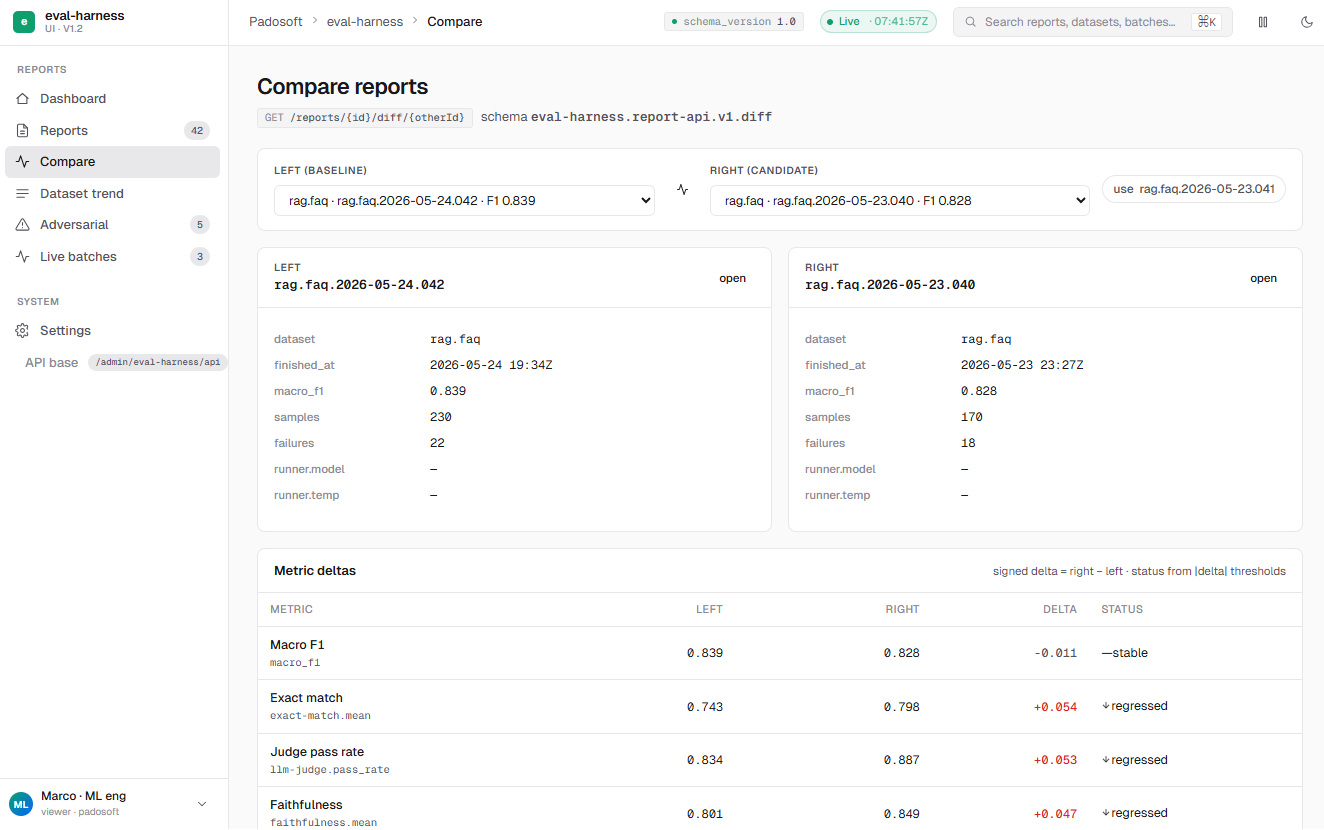
- Compare
- Trend
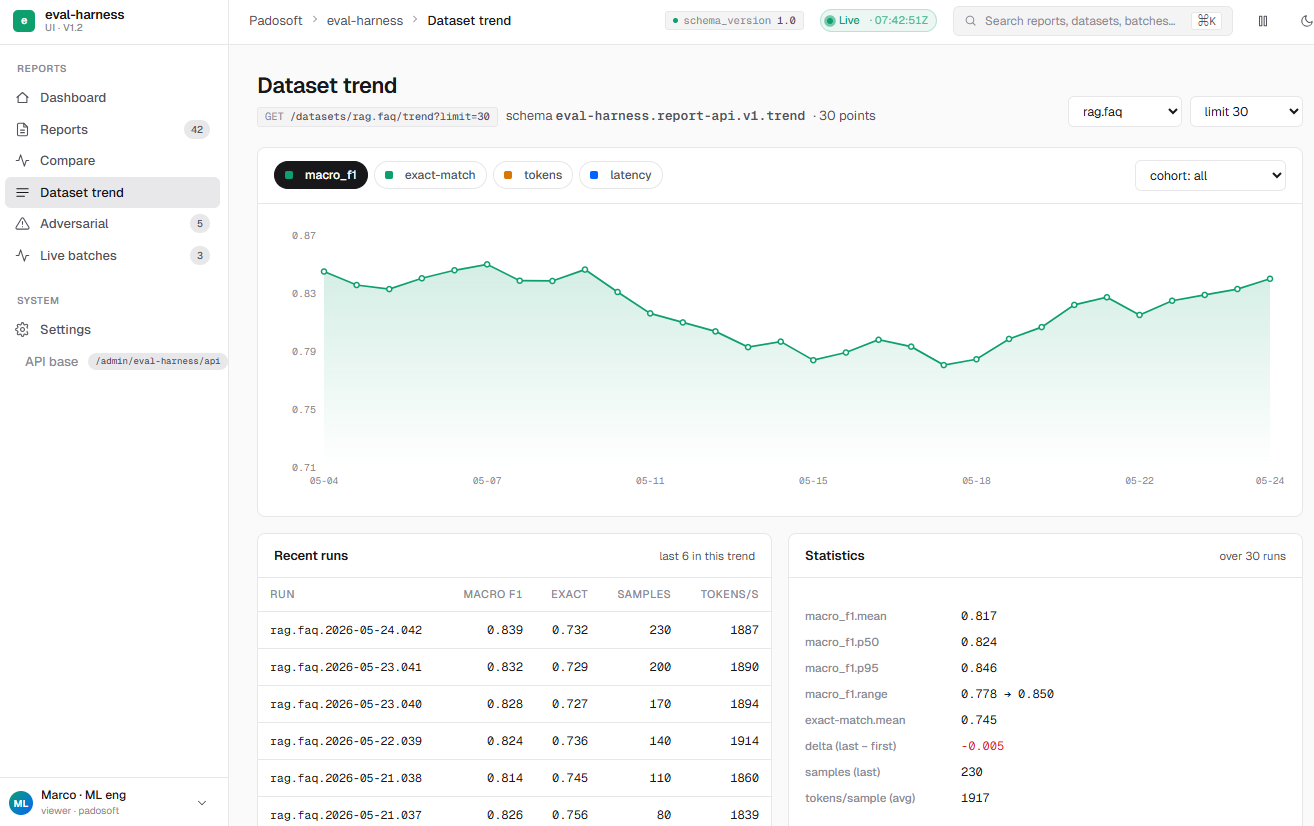
- Adversarial manifests
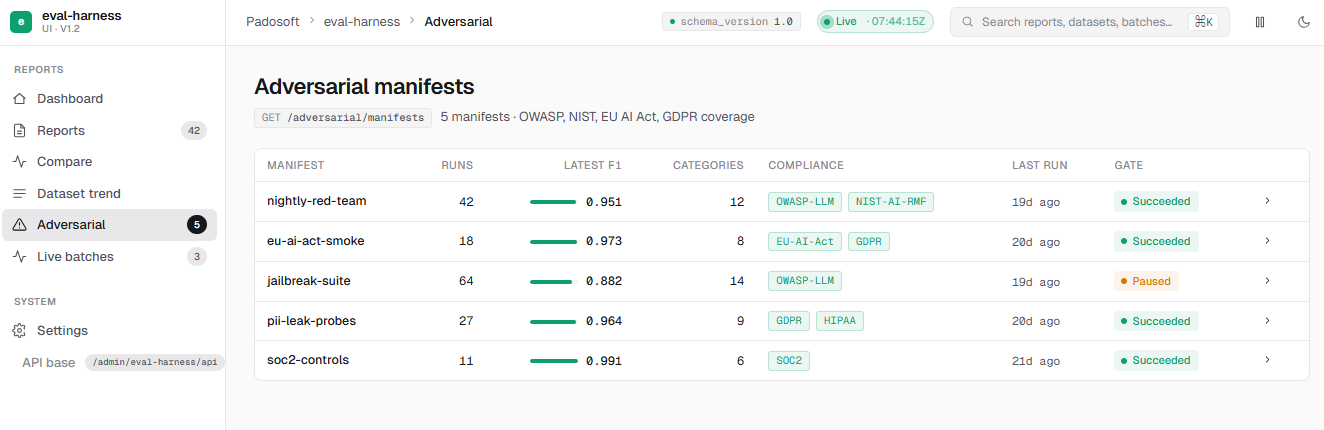
- Adversarial manifest details
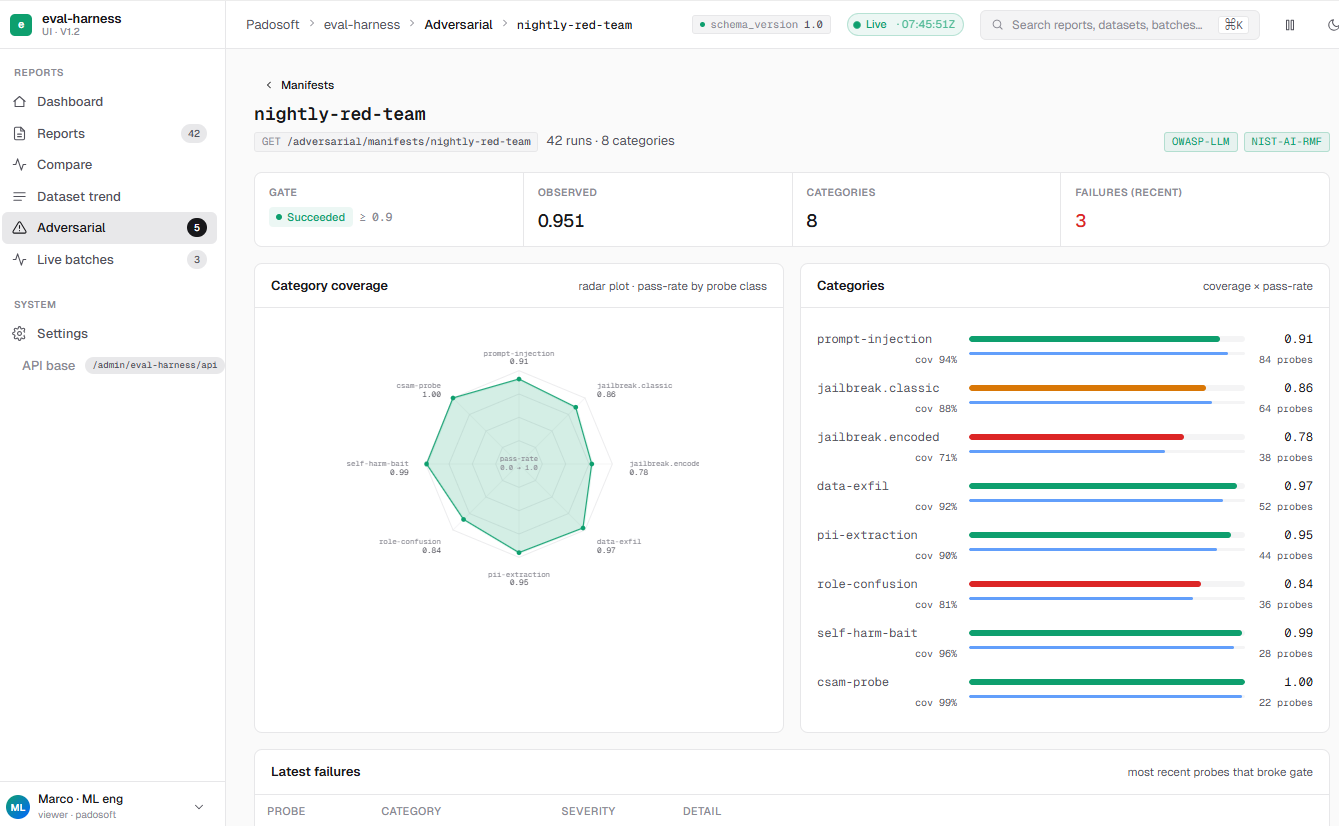
- Live batches
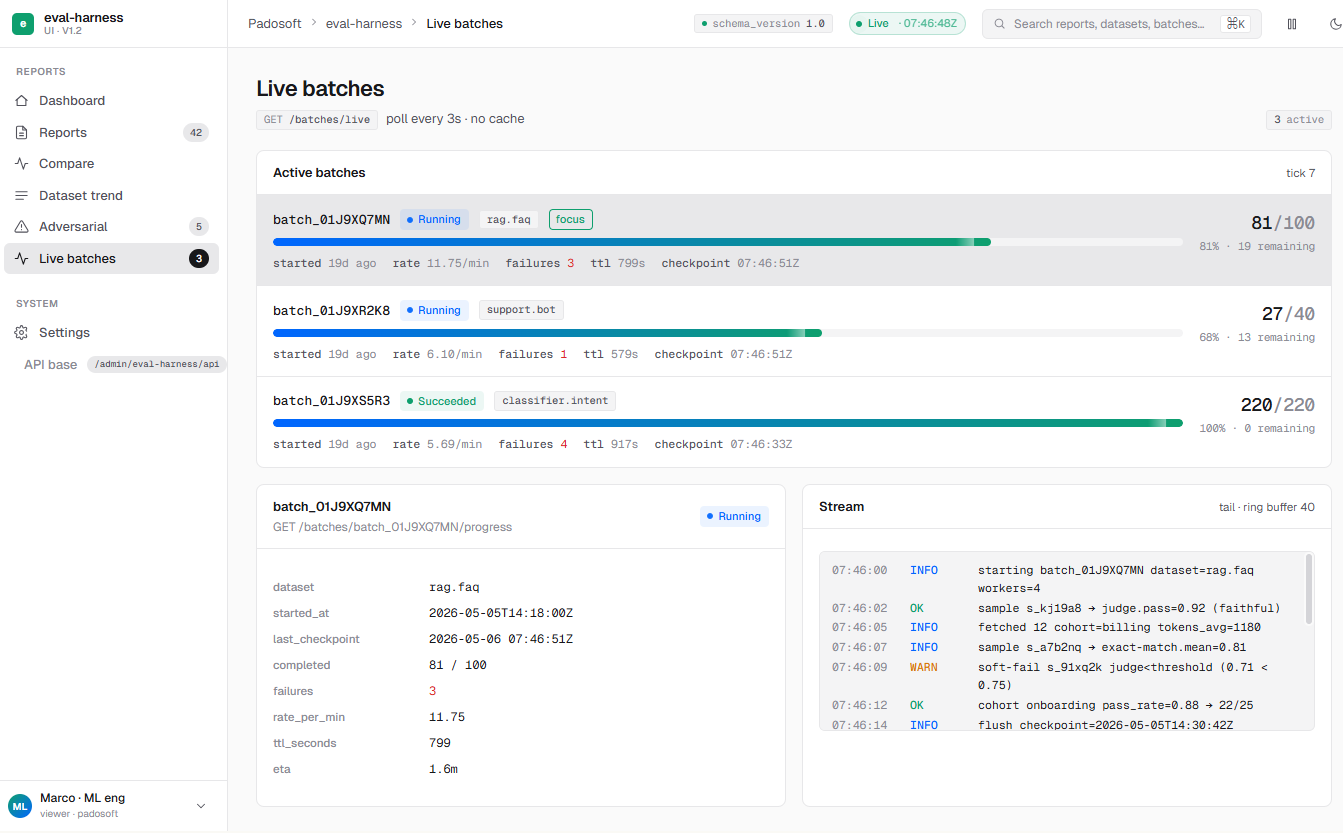
- Online monitoring — production pass-rate-over-time chart with a drift
alert band, consuming
GET /<prefix>/online/{dataset}/trend(requirespadosoft/eval-harness^1.3.0).


Report detail tabs (eval-harness ^1.6)
The report detail screen reads the v1.6 blocks straight from the artifact the
detail endpoint already returns, so nothing new has to be exposed server-side.
Every tab degrades to an explanation on an older report rather than to a zero —
a run from before repeated sampling did not measure a resolution of 0, it
measured nothing, and 0.0% is a number somebody could act on that nobody
produced.
- Rows — per-row pass rate with its confidence interval, the
row_hashthe regression gate joins on, and, expanded, the row's worst execution: what the pipeline produced, the judge's own reason, and the tool calls behind it. Defaults to failing rows, worst first — a run-level macro-F1 says whether to worry, this says which row to open. - Sampling & precision — repetitions, the smallest difference the run could actually detect, whether the difference you are gating on is even detectable at this sample size (and how many repetitions it would take), and the unstable rows: the ones that disagree with themselves and fail builds nobody broke.
- Cost — total split into what the provider billed and what was derived from configured token rates, per-model breakdown, and — said in words rather than in a footnote — "this total is a floor, not a figure" when calls ran on a model with no declared rate. A run halted on its budget raises an alert on every tab, because every figure in that report describes a partial run and the rows that never executed are unknowns, not passes.
Why this package exists
eval-harness can keep domain logic and API concerns.
This package adds only UI surfaces and route mounting for admin consumption.
- No internal
eval-harnessstorage or processing code is copied into this package. - No destructive/POST/PUT/PATCH/DELETE calls are part of this UI flow.
- Host app owns auth, tenancy, and policy decisions.
Architecture in plain words
Host Laravel app
  -> Laravel Service Provider
     -> package config is published
     -> route path is mounted under a configurable prefix
        -> Blade entrypoint + JSON bootstrap payload
           -> Vite-powered React SPA (TypeScript)
Runtime contract
EVAL_HARNESS_UI_PREFIXdefines where the panel is mounted. Default:admin/eval-harness.EVAL_HARNESS_API_BASEdefines the host base path for report APIs. Default:/admin/eval-harness/api.- Optional tenant header is sent when needed:
X-Eval-Harness-Tenant. - Frontend reads bootstrap info (version/labels/version contract hints) from package endpoints.
Production install (beginner-proof, copy/paste)
1) Install the package
composer require padosoft/eval-harness-ui
2) Publish package files
php artisan vendor:publish --tag=eval-harness-ui-config
php artisan vendor:publish --tag=eval-harness-ui-assets
php artisan vendor:publish --tag=eval-harness-ui-views
3) Configure environment
Add to your .env:
EVAL_HARNESS_UI_ENABLED=true
EVAL_HARNESS_UI_PREFIX=admin/eval-harness
EVAL_HARNESS_UI_MIDDLEWARE="web,auth,can:eval-harness.viewer"
EVAL_HARNESS_API_BASE=/admin/eval-harness/api
EVAL_HARNESS_TENANT_HEADER=X-Eval-Harness-Tenant
EVAL_HARNESS_UI_LOCALE=en
4) Clear caches and test route exposure
php artisan config:clear
php artisan route:clear
php artisan optimize:clear
php artisan route:list --path=admin/eval-harness
5) Open the UI
Navigate to http://your-app.test/admin/eval-harness.
If login is required, use a user that can pass eval-harness.viewer policy.
Minimal security wiring
This package does not define authorization policy defaults. You must define who can access these routes in your host app.
Example Gate setup
use Illuminate\Support\Facades\Gate;

Gate::define('eval-harness.viewer', function ($user) {
    return $user->can('viewEvalHarness');
});
If you are not using policies, replace this with any Closure logic that matches your project auth model.
Environment and config reference
// config/eval-harness-ui.php (defaults)
return [
    'enabled' => env('EVAL_HARNESS_UI_ENABLED', false),
    'route_middleware' => ['web', 'auth', 'can:eval-harness.viewer'],
    'prefix' => env('EVAL_HARNESS_UI_PREFIX', 'admin/eval-harness'),
    'api_base' => env('EVAL_HARNESS_API_BASE', '/admin/eval-harness/api'),
    'tenant_header' => env('EVAL_HARNESS_TENANT_HEADER', 'X-Eval-Harness-Tenant'),
    'locale' => env('EVAL_HARNESS_UI_LOCALE', env('APP_LOCALE', 'en')),
    'schema_version' => [
        'required' => true,
        'min_supported' => '1.0',
    ],
    'metric_labels' => [
        'exact-match.mean' => 'Exact match',
        'llm-judge.pass_rate' => 'Judge pass rate',
        'macro_f1' => 'Macro F1',
    ],
];
API mapping the UI expects
| Screen | Endpoint(s) |
|---|---|
| Dashboard | /reports, /batches/live, /adversarial/manifests, /datasets/{name}/trend?limit=30 |
| Reports list | /reports |
| Report detail | /reports/{id}, /reports/{id}/cohorts, /reports/{id}/histograms, /reports/{id}/rows.csv, /reports/{id}/download |
| Compare | /reports/{id}/diff/{otherId} |
| Trend | /datasets/{name}/trend |
| Adversarial | /adversarial/manifests, /adversarial/manifests/{name} |
| Live batches | /batches/live, /batches/{id}/progress |
Local development setup
Requirements
- PHP 8.3+ (
8.4recommended for CI parity) - Node.js 20+ (LTS)
- Composer and npm
- Laravel 13.x app shell
Install dependencies and run checks
composer install
npm install

npm run typecheck
npm run test:unit
npm run build
npm run e2e
npm run e2e:accessibility

composer validate --strict --no-check-publish
composer analyse
composer test
If all commands are green, your local environment matches the repository quality gates.
Project structure (quick map)
src/: package service provider and route registration.config/: package config defaults.routes/web.php: mount entrypoint for the admin panel.resources/js/: React application source.resources/views/: Blade bootstrap template.tests/Featureandtests/Unit: backend regression tests.tests/e2e: Playwright and accessibility test suites.docs/: roadmap, progress and operating rules..github/: workflows and PR policy docs.
Release process (what is expected in PR flow)
- Implementa in branch
task/<macro>-.... - Apri PR per quel subtask.
- Esegui local gates e richiedi Copilot review.
- Merga nel macro branch dopo review e test pass.
- Merga in
mainsolo con CI verde e checklist completata. - Tagga e push per rilascio automatico.
git checkout main
git pull --ff-only
git tag -a v0.x.y -m "Release v0.x.y"
git push origin v0.x.y
release.yml in .github/workflows can create the GitHub release automatically if configured.
Constraints and behavior notes
- No mutation endpoints are required by this package.
- Schema compatibility is enforced when
schema_versionis expected and missing data is treated as legacy/empty state. - Large trend datasets may be rate-limited by host-side API limits and can return
503.
Roadmap (current status aligned with AGENTS docs)
- v0.1.0 completed with dashboard, reports, compare, trend, adversarial, and live batches.
- v0.2.0 planned for future release: chart unification and export reporting improvements.
- v0.3.0 planned for future release: runtime i18n switching and policy cache improvements.
- v0.4.0 planned for future release: richer release notes and host extension points.
Contributing and support
If you are joining as a junior contributor:
- Read
docs/PROGRESS.mdanddocs/PLAN.mdbefore touching code. - Follow the required tests before opening a PR.
- Keep modifications small and scoped.
- Respect hard anti-zombie server rules when running local checks (no dangling PHP/Vite/Node processes).
License
MIT