
digit7s / filament-seo

Polymorphic SEO metadata rendering and Filament components for Laravel.
Requires
- php: ^8.4
- filament/filament: ^5.0
- illuminate/database: ^13.0
- illuminate/support: ^13.0
Requires (Dev)
- laravel/pint: ^1.27
- orchestra/testbench: ^11.3
- pestphp/pest: ^4.7
- pestphp/pest-plugin-laravel: ^4.1
Suggests
None
Provides
None
Conflicts
None
Replaces
None
README
Reusable SEO metadata forms, editorial status, metadata quality scoring, and infolist components for Laravel and Filament.

Introduction
Filament SEO provides a reusable polymorphic metadata model, an explicitly placed Blade head component, and native Filament components for managing and reviewing metadata alongside application content. It leaves page layout, authorization, and storage policy with the host application.
Features
- Relationship-bound SEO fields, with grouped sections or optional tabs.
- Configurable owner and site fallbacks with safe canonical and image URL resolution.
- Completeness status and translated issue tooltips.
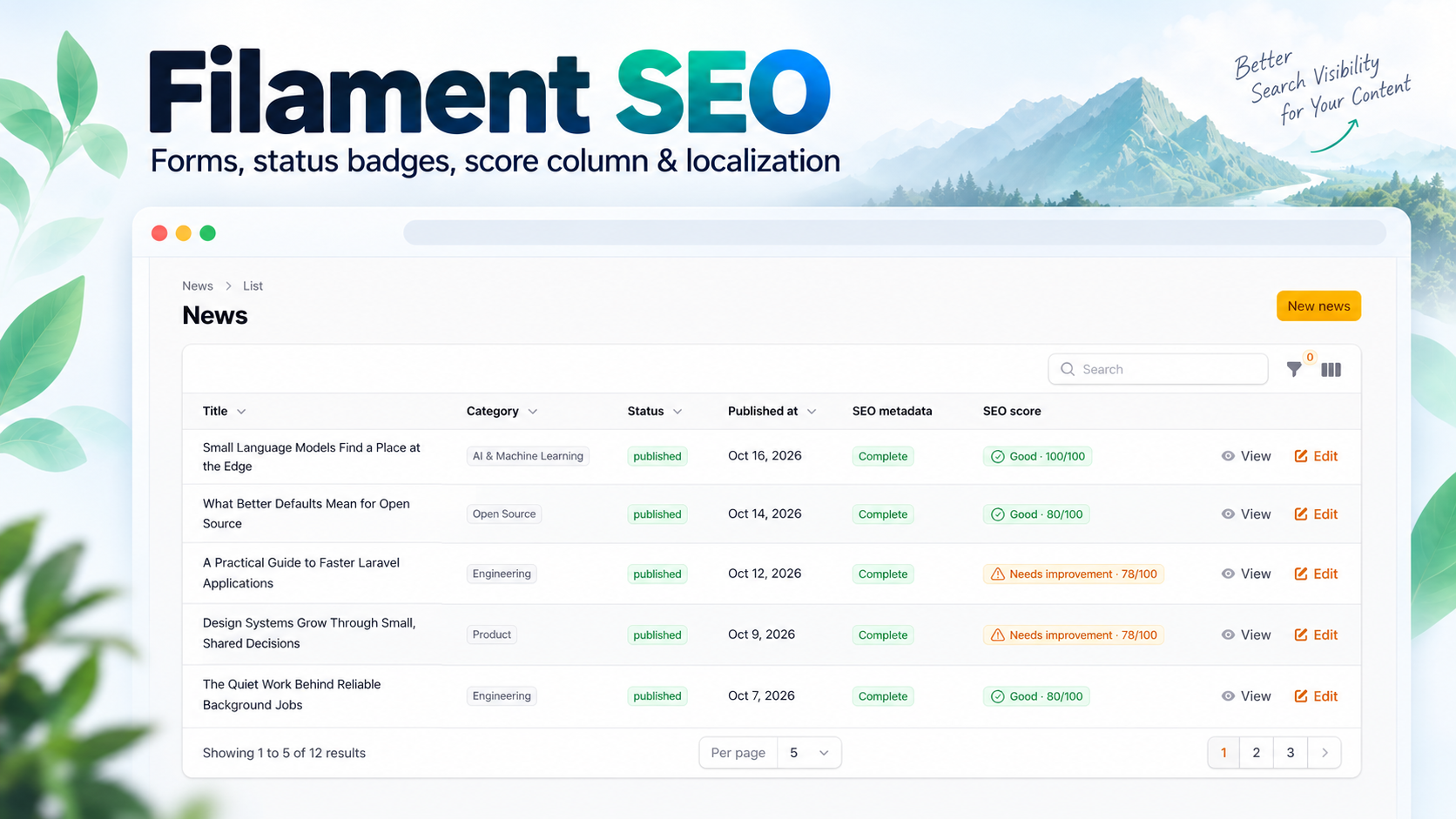
- A metadata quality score with native Filament badge, color, icon, and findings tooltip.
- Infolist section for stored and optionally resolved metadata.
- English, Myanmar, and Thai package UI translations.
The score is an editorial metadata quality indicator. It does not measure search rankings, traffic, or crawl results.
Requirements
- PHP
^8.4 - Laravel
^13.0 - Filament
^5.0
The package declares Filament 5.0 as its minimum; local integration has been exercised with newer Filament 5 releases.
Installation
composer require digit7s/filament-seo:^0.1
Laravel discovers Digit7s\FilamentSeo\FilamentSeoServiceProvider through Composer. No Filament panel plugin registration is required or provided.
Publish configuration only when you need to customize the metadata model, fallbacks, defaults, or image settings:
php artisan vendor:publish --tag=filament-seo-config
For a new application without a compatible seo_metadata table, publish and review the package migration before running your normal migration command:
php artisan vendor:publish --tag=filament-seo-migrations
php artisan migrate
Do not publish or run the package migration if your application already owns a compatible seo_metadata table. The package does not run migrations automatically.
Model integration
Add HasSeoMetadata to an Eloquent model. It defines a MorphOne relationship named seoMetadata() using the configured metadata model:
use Digit7s\FilamentSeo\Concerns\HasSeoMetadata;
use Illuminate\Database\Eloquent\Model;

class Article extends Model
{
    use HasSeoMetadata;
}
Create or update metadata through the relationship:
$article->seoMetadata()->updateOrCreate([], [
    'meta_title' => 'A title for search results',
    'meta_description' => 'A concise description of this article.',
    'robots_index' => true,
    'robots_follow' => true,
]);
The package does not create metadata when the relationship is read. The default table uses a polymorphic seoable relationship; it does not duplicate metadata columns on the owner table.
SEO form
Add SeoFields to a Filament resource schema. By default it returns a relationship-bound Section containing the Basic SEO, Social Metadata, and Robots Directives groups:
use Digit7s\FilamentSeo\Filament\Forms\SeoFields;
use Filament\Schemas\Schema;

public static function form(Schema $schema): Schema
{
    return $schema->components([
        SeoFields::make(relationship: 'seoMetadata'),
    ]);
}
To present the same groups in native Filament schema tabs, opt in with tabbed: true:
SeoFields::make(
    relationship: 'seoMetadata',
    groups: ['basic', 'social', 'robots'],
    tabbed: true,
)
Basic SEO is the first tab by default. The factory also accepts options for selected groups and fields, custom labels, defaults, required/visible/disabled state, image upload settings, length guidance, and collapsibility. Consumer-provided labels and recommendation text remain under the consumer's control.
SEO status column
Use SeoStatusColumn to show completeness and optional translated issue details. Eager-load the relationship in the resource query; the column intentionally does not lazy-load it:
use Digit7s\FilamentSeo\Filament\Tables\SeoStatusColumn;
use Filament\Tables\Table;
use Illuminate\Database\Eloquent\Builder;

public static function getEloquentQuery(): Builder
{
    return parent::getEloquentQuery()->with('seoMetadata');
}

public static function table(Table $table): Table
{
    return $table->columns([
        SeoStatusColumn::make(
            relationship: 'seoMetadata',
            issuesTooltip: true,
            showCompleteness: true,
        ),
    ]);
}
Statuses are complete, needs_attention, no_stored_metadata, and not_loaded. Intentional noindex and nofollow directives do not create completeness issues.
SEO score column
SeoScoreColumn returns a native Filament TextColumn. It uses the package resolver and scoring rules, and renders its native badge styling and findings tooltip:
use Digit7s\FilamentSeo\Filament\Tables\SeoScoreColumn;
use Filament\Tables\Table;

public static function table(Table $table): Table
{
    return $table->columns([
        SeoScoreColumn::make(),
    ]);
}
The calculated score is not persisted and is not database-sortable or searchable. The column shares the eager-loaded relationship shown above. A custom relationship can be passed as SeoScoreColumn::make(relationship: 'searchMetadata').
SEO infolist
Use SeoMetadataInfolistSection on a record view. Eager-load the metadata relation in the page's record query so the section can show stored and resolved values without issuing queries from entries:
use Digit7s\FilamentSeo\Filament\Infolists\SeoMetadataInfolistSection;
use Filament\Schemas\Schema;

public static function infolist(Schema $schema): Schema
{
    return $schema->components([
        SeoMetadataInfolistSection::make(
            relationship: 'seoMetadata',
            groups: ['basic', 'social', 'robots'],
            showResolvedValues: true,
            showCompleteness: true,
        ),
    ]);
}
The section distinguishes an unloaded relation, a missing metadata row, and an empty stored value. Image previews are optional and use only URLs accepted by the package resolver.
Frontend metadata rendering
Place the package component explicitly inside the document <head> of a Blade layout. The package does not inject tags into every response or register frontend middleware:
<head>
    <meta charset="utf-8">
    <meta name="viewport" content="width=device-width, initial-scale=1">
    <x-filament-seo::meta :record="$article" />
</head>
The component resolves the configured SEO relationship for that record and renders only meaningful values. It loads the relation when needed; page queries can eager-load it with with('seoMetadata'). Consumer fallback values are optional and are applied after stored metadata and package-configured fallbacks:
$seoFallbacks = [
    'title' => fn (Article $record): string => $record->title,
    'description' => fn (Article $record): ?string => $record->excerpt,
];
<x-filament-seo::meta :record="$article" :fallbacks="$seoFallbacks" />
The output can contain <title>, description and keywords, an HTTPS canonical URL, robots directives, Open Graph title/description/URL/image/alt, and Twitter card/title/description/image/alt. The renderer does not invent an Open Graph type or Twitter account handle. It escapes values, omits invalid canonical URLs, and never renders robots defaults without a stored metadata row. An intentional stored noindex or nofollow remains intact.
Keep the host layout's metadata ownership clear: do not render duplicate title, description, canonical, robots, Open Graph, or Twitter tags from another head manager. If Laravel Head or an Inertia head component is present, choose one renderer for the tags managed by this component. This package does not provide a dedicated Laravel Head or Inertia adapter.
Image URL policy
Absolute image URLs must use HTTPS by default; HTTP can be allowed through filament-seo.images.allow_http. Relative image paths are emitted only when the configured disk is explicitly listed in filament-seo.images.public_disks, and the file exists on that disk. Private disks and missing files are omitted. Direct remote URLs and a configured images.url_resolver are trusted host inputs after scheme validation; the package does not make network requests to verify remote reachability. The host remains responsible for public access and external URL availability.
UI localization
Package UI labels and messages are available in English (en), Myanmar (my), and Thai (th). Laravel's active application locale selects the translation; set it using your normal application or request locale handling. The package does not add a locale switcher.
Publish translations to customize the package's default wording:
php artisan vendor:publish --tag=filament-seo-translations
Published files are placed under lang/vendor/filament-seo. Laravel's normal fallback locale applies when a translation is unavailable. To contribute a language, copy the full key structure from resources/lang/en/filament-seo.php to resources/lang/{locale}/filament-seo.php, translate the UI copy, and preserve key parity.
Localization applies to package UI only. It does not translate or localize stored SEO metadata, create locale-specific rows, or change canonical and hreflang behavior.
Screenshots
The following captures come from the consumer News demo and show the actual package components:


No infolist or translated-locale capture is included yet. The promotional thumbnail above is a composed product graphic; these screenshots are the feature evidence.
Testing and development
composer install
composer test
composer lint
composer validate --strict
The package test suite uses Orchestra Testbench and an in-memory SQLite database. It does not use a consumer application's database.
Limitations and responsibilities
- This package renders supported HTML metadata through an explicit Blade component; it does not generate JSON-LD or sitemaps, crawl websites, or report search rankings.
- It does not automatically translate article content or SEO metadata, or implement multilingual canonical/hreflang strategies.
- The host application owns authorization, public page rendering, locale routing, storage access policy, and orphaned upload cleanup.
- Relationship-backed table and infolist components expect the configured metadata relationship to be eager-loaded.
- The frontend component is Blade-only; no Inertia adapter, frontend route, or automatic tag injection is provided.
- The package migration is optional and should not be run against an application that already has a compatible table.
Changelog
See CHANGELOG.md.
Security
Please follow the private reporting instructions in SECURITY.md. Do not report vulnerabilities in a public issue.
Contributing
Contributions should include focused tests for behavior changes and preserve compatibility with the declared PHP, Laravel, and Filament requirements. Before opening a change, run composer test, composer lint, and composer validate --strict.
License
This package is open-sourced under the MIT License.
Credits
Maintained by Digit7s.