
likyly / sdk

Product recommendations for your PHP site ("You may also like", "Recommended for you"), learned from what your visitors do. Official LIKYLY SDK.
Requires
- php: ^8.1
- ext-json: *
- guzzlehttp/guzzle: ^7.8 || ^8.0
Requires (Dev)
- phpstan/phpstan: ^1.11
- phpunit/phpunit: ^10.5 || ^11.0
- squizlabs/php_codesniffer: ^3.10
Suggests
None
Provides
None
Conflicts
None
Replaces
None
README
LIKYLY shows each visitor of your site the products they are most likely to want: "You may also like" on a product page, "Recommended for you" on the home page, "Complete your order" in the cart. It learns from what visitors actually do, and gets better as they do it.
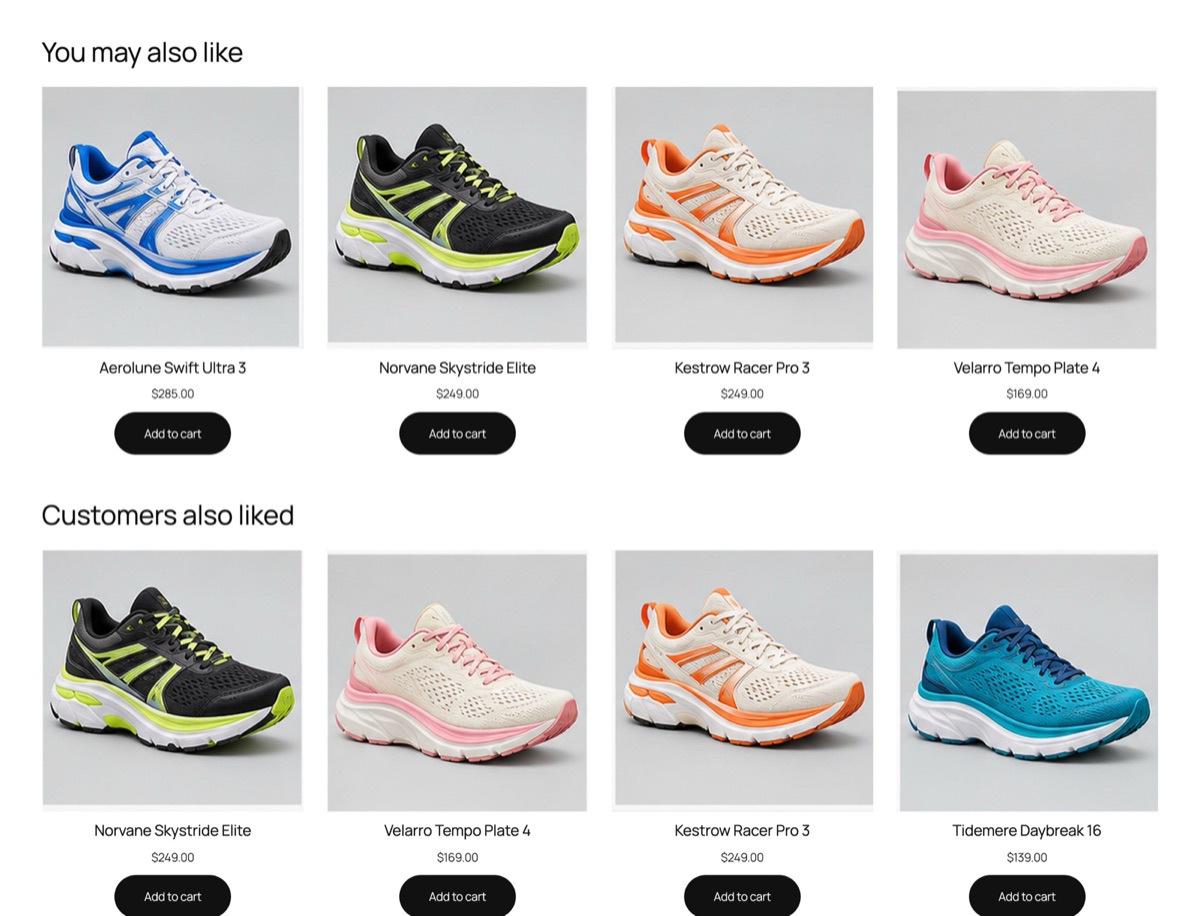
This is the official PHP client for the LIKYLY API. Your code uses it to:
- Send your catalog: the products, articles or films you want recommended.
- Report what visitors do: they view a product, add it to their cart, sometimes buy it. Browsing alone is useful: a visitor who never buys still teaches LIKYLY what goes together, and still gets recommendations.
- Ask what to show: the products to recommend on a page, for a visitor, or both.
- Report what happened to the recommendations: which ones were shown and which were clicked. LIKYLY learns which recommendations work, and you can measure what they bring in.
Install
composer require likyly/sdk
PHP 8.1 or later. Depends on Guzzle 7 (guzzlehttp/guzzle); works in any framework, or none.
Quick start
Initialize
Create one client and reuse it. Use your secret key on your server (see Which key?).
<?php

require __DIR__ . '/vendor/autoload.php'; // Composer's autoloader

use Likyly\Exception\NotFoundException;
use Likyly\Exception\RateLimitException;
use Likyly\LikylyClient;

// Backend only: the secret key gives access to your catalog and your users.
$likyly = new LikylyClient(
    apiKey: getenv('LIKYLY_SECRET_KEY'),
);
Send your catalog
// Send your catalog once (and whenever it changes). Ids are YOUR ids: SKUs, UUIDs, Shopify gids...
$likyly->items()->upsertMany([
    ['itemId' => 'SKU-1', 'title' => 'Nike Air Max', 'description' => 'Running shoe with air cushioning', 'properties' => ['category' => 'shoes', 'brand' => 'Nike', 'price' => 129.9]],
    ['itemId' => 'SKU-2', 'title' => 'Adidas Ultraboost', 'description' => 'Responsive running shoe', 'properties' => ['category' => 'shoes', 'brand' => 'Adidas', 'price' => 149]],
    ['itemId' => 'SKU-3', 'title' => 'Nike Pegasus', 'description' => 'Everyday running shoe', 'properties' => ['category' => 'shoes', 'brand' => 'Nike', 'price' => 119]],
]);

// Users are optional: describe them if you want the profile to travel with their events.
$likyly->users()->upsert('user_123', properties: ['country' => 'FR', 'segment' => 'premium']);
Ids are your own: any string (SKU-123, a UUID, gid://shopify/Product/123). properties is free-form; category and description improve similarity, everything else is stored as is.
Track events
// Tell LIKYLY what your visitors do.
$likyly->events()->view(userId: 'user_123', itemId: 'SKU-1');

// Purchases carry an eventId: replaying the call can never count the sale twice.
$likyly->events()->purchase(
    eventId: 'purchase_order_9281_SKU-1',
    userId: 'user_123',
    itemId: 'SKU-1',
    quantity: 1,
    properties: ['price' => 129.9, 'currency' => 'EUR', 'orderId' => 'order_9281'],
);
Get recommendations
// Ask what to show. You never pick an algorithm: LIKYLY chooses the best strategy for what it knows.
$recs = $likyly->recommendations()->get(userId: 'user_123', placement: 'homepage', limit: 3);

echo "strategy: {$recs->strategy}\n";
foreach ($recs->items as $item) {
    echo $item->itemId, ' ', $item->title, "\n";
}
You never choose an algorithm: LIKYLY picks the best strategy for what it knows about the visitor and tells you which one it used (strategy: hybrid, content, collaborative, session or popular). With no user, no session and no item you still get a useful answer: what is popular.
Placements: the recommended way
// The recommended way: a placement ("pdp-related"...) is configured once in LIKYLY - strategy,
// fallback, filters - and your page only says where it is and what it knows.
$related = $likyly->placements()->recommend('pdp-related', context: ['itemId' => 'SKU-123', 'sessionId' => 'sess_abc'], limit: 4);
echo "strategy used: {$related->strategyUsed}\n";

// When an anonymous visitor signs in, attach their session's history to their account.
$linked = $likyly->events()->identify(userId: 'user_123', sessionId: 'sess_abc');
echo "linked: {$linked->linkedInteractions}\n";
A placement (pdp-related, home-for-you, cart-cross-sell...) is configured once in LIKYLY, by your coding assistant through the MCP server or in the console: strategy, fallback, filters, how many items. Your code only names it and passes what it knows (itemId, userId, sessionId, ...); change the configuration later without redeploying. identify attaches an anonymous visitor's history to their account the moment they sign in, so their recommendations stay personal.
Close the loop
// Send the recommendationId back: LIKYLY measures which recommendations get seen, clicked and bought.
$likyly->events()->impression(userId: 'user_123', itemId: $recs->items[0]->itemId, recommendationId: $recs->recommendationId, placement: 'homepage');
$likyly->events()->click(userId: 'user_123', itemId: $recs->items[0]->itemId, recommendationId: $recs->recommendationId, placement: 'homepage');
Send the recommendation id back on the events that follow (impression when it is displayed, click, add_to_cart, purchase) and LIKYLY can measure which recommendations actually convert.
Which key?
| Secret key | Public key | |
|---|---|---|
| Where | your server only | anywhere, including a web page |
| Recommendations | yes | yes |
| Record events | yes | yes |
| Items and users (create, read, delete) | yes | no (PermissionDeniedException) |
debug explanations |
yes | no |
The public key can only read recommendations and write events, so it is safe to expose. Never put the secret key in code that ships to a browser or a mobile app.
// Where the code is exposed to visitors, use the PUBLIC key: it can only read recommendations and record events.
$front = new LikylyClient(
    apiKey: getenv('LIKYLY_PUBLIC_KEY'),
);

// A visitor who is not logged in: use an anonymous session id (any string you generate and keep in a cookie).
$front->events()->view(sessionId: 'sess_abc', itemId: 'SKU-2');
$forVisitor = $front->recommendations()->get(sessionId: 'sess_abc', viewedItemIds: ['SKU-2'], placement: 'product_page', limit: 3);
Events
track is the one mechanism; impression, view, click, add_to_cart, remove_from_cart and purchase are shortcuts that call it with the matching type. Event types are open strings: use your own (favorite, share, video_played, ...) as freely as the official ones.
// Any string is a valid event type: track what matters to your business.
$likyly->events()->track('favorite', itemId: 'SKU-2', userId: 'user_123', properties: ['list' => 'wishlist']);

// Up to 1000 events per call, each with its own type.
$likyly->events()->trackMany([
    ['type' => 'view', 'userId' => 'user_123', 'itemId' => 'SKU-3'],
    ['type' => 'add_to_cart', 'userId' => 'user_123', 'itemId' => 'SKU-3', 'quantity' => 1],
]);
- An event needs an item and a user, a session, or both (both ties the anonymous session to the user once they log in).
- Anonymous visitors: generate a session id (any string) and keep it in a cookie; no login needed.
propertiesis a free-form object (price, currency, order id, ...). Its keys are stored exactly as you send them and are never renamed by the SDK.event_id(idempotency key): replaying an event with the same id records nothing and returnsduplicate: true. Set it on purchases, for examplepurchase_<orderId>_<itemId>.placementis a free-form label of where something happened or will be displayed (homepage,product_page,cart, ...).
Advanced recommendations
recommendations.get is the normal way. When you want to pick the strategy yourself:
// Advanced Recommendations: one strategy at a time, when you want to choose.
$similar = $likyly->recommendations()->similar(itemId: 'SKU-1', limit: 3);
$hybrid = $likyly->recommendations()->hybrid(userId: 'user_123', itemId: 'SKU-1', alpha: 0.7, limit: 3);
$session = $likyly->recommendations()->session(viewedItemIds: ['SKU-1', 'SKU-2'], limit: 3);
| Strategy | What it does |
|---|---|
popular |
The most popular items: the fallback for a visitor with no history |
similar |
Items similar to one item (content similarity), no user needed |
collaborative |
What users with similar histories liked. Needs a trained model, otherwise a not-found error |
hybrid |
Similar items personalised for a user; alpha (0 to 1) weighs collaborative against content |
session |
Recency-weighted, from viewed item ids or from a user's own view history (exactly one) |
These endpoints carry ids in the URL path, so ids containing / (such as gid://shopify/Product/1) or, for the session list, , are refused with a validation error: use recommendations.get, which takes ids in the request body.
Errors
Errors are typed (every one is a LikylyException). Catch the specific ones you care about:
| Error | When |
|---|---|
ValidationException |
The request is invalid: caught by the SDK before anything is sent, or a 422 from the API (the message names the offending fields) |
AuthenticationException |
401: missing, invalid or revoked API key |
PermissionDeniedException |
403: for example a public key used for a secret-key operation, or a plan limit |
NotFoundException |
404 |
RateLimitException |
429: see the retry-after value |
ApiException |
Any other error status from the API (the four rows above are its subtypes) |
NetworkException |
No HTTP response: DNS, connection reset, TLS |
TimeoutException |
The request timed out |
Errors that come from the API carry $statusCode, $requestId, $retryAfter (seconds), $body. Quote the request id when you contact support.
try {
    $likyly->items()->get('does-not-exist');
} catch (NotFoundException $e) {
    echo 'no such item, request ', $e->requestId, "\n";
} catch (RateLimitException $e) {
    echo 'slow down, retry in ', $e->retryAfter, " s\n";
}
Retries and timeouts
The SDK retries transient failures for you (2 retries by default, exponential backoff from 0.5 s capped at 8 s, with full jitter):
- 429: always retried, honouring
Retry-After. ARetry-Afterlonger than 60 s is not waited for: the rate-limit error is returned instead. - 502, 503, 504, dropped connections and timeouts: retried only when replaying the call is harmless: reads, upserts, deletes, events that carry an
event_id, and batches where every event has one. - An event without an
event_idis never retried after an ambiguous failure, so a flaky network can never record a purchase twice. Setevent_idon events you care about and they become safe to retry. - Other 4xx errors are never retried.
Configuration
| Setting | Option | Default |
|---|---|---|
| API key | apiKey |
required |
| Base URL | baseUrl |
https://api.likyly.com |
| Catalog | catalog |
your only catalog |
| Timeout | timeout (seconds) |
10 |
| Retries | maxRetries |
2 |
| User-Agent suffix | userAgent |
none |
| Custom HTTP | httpClient (a Guzzle ClientInterface) |
a new Guzzle client |
$tuned = new LikylyClient(
    apiKey: getenv('LIKYLY_SECRET_KEY'),
    timeout: 5.0, // seconds per attempt (default 10)
    maxRetries: 3, // automatic retries on 429 / 502 / 503 / 504 / network errors (default 2, 0 disables)
    userAgent: 'my-shop/1.4', // appended to the SDK's User-Agent
);
Every method takes a last array $options = [] argument: ['timeout' => 2.0, 'maxRetries' => 0].
API reference
key says which API key may call it: S = secret key only, P = public or secret key.
| Method | What it does | Key |
|---|---|---|
$likyly->items()->get |
One item by your own id | S |
$likyly->items()->list |
One page of the catalog (limit / offset), with the catalog's total |
S |
$likyly->items()->upsert |
Create or replace an item (idempotent) | S |
$likyly->items()->delete |
Remove an item (events already recorded for it are kept) | S |
$likyly->items()->upsertMany |
Batch upsert, 1 to 1000 items | S |
$likyly->items()->import |
Alias of the batch upsert above (JSON batch) | S |
$likyly->items()->deleteMany |
Batch delete, 1 to 1000 ids; unknown ids are reported, not raised | S |
$likyly->users()->get |
One user profile | S |
$likyly->users()->list |
One page of users (limit / offset) |
S |
$likyly->users()->upsert |
Create or replace a profile (free-form properties) |
S |
$likyly->users()->delete |
Erase the profile and every event recorded for that user | S |
$likyly->users()->import |
Batch upsert of users, 1 to 1000 | S |
$likyly->events()->track |
Record an event of any type (open string) | P |
$likyly->events()->trackMany |
Up to 1000 events in one call, each with its own type | P |
$likyly->events()->impression |
The item was displayed to the visitor | P |
$likyly->events()->view |
The visitor looked at the item | P |
$likyly->events()->click |
The visitor clicked the item | P |
$likyly->events()->addToCart |
The visitor added the item to their cart | P |
$likyly->events()->removeFromCart |
The visitor removed the item from their cart | P |
$likyly->events()->purchase |
The visitor bought the item (set an event id) | P |
$likyly->events()->identify |
An anonymous visitor signed in: attach their session's history to their user id | P |
$likyly->placements()->recommend |
Recommendations for a named placement configured in LIKYLY (the recommended way) | P |
$likyly->recommendations()->get |
Recommendations with the automatic strategy: user, session, item or viewed items | P |
$likyly->recommendations()->popular |
Advanced: the most popular items | P |
$likyly->recommendations()->similar |
Advanced: items similar to one item | P |
$likyly->recommendations()->collaborative |
Advanced: what similar users liked (needs a trained model) | P |
$likyly->recommendations()->hybrid |
Advanced: similar items personalised for a user (alpha) |
P |
$likyly->recommendations()->session |
Advanced: from viewed items or a user's view history | P |
Lists are paginated with limit and offset (the API's default page is 100 items); the total is reported next to the page. Users have a batch import but no batch delete: the API has no such endpoint. import on items is an alias of the batch upsert (the CSV import is a dashboard feature).
Notes for PHP
- Use named arguments (PHP 8):
events()->view(userId: 'user_123', itemId: 'SKU-1'). Identifiers are strings and are never coerced: withdeclare(strict_types=1)an integer is aTypeError. - Batch methods (
upsertMany,trackMany,users()->import) take arrays of arrays with the samecamelCasekeys as the named arguments. The keys insidepropertiesare yours and are never renamed.
Documentation and support
- Documentation: https://likyly.com/docs/sdk/php
- REST API reference (OpenAPI): https://api.likyly.com/docs
- Package: likyly/sdk on Packagist
MIT licensed.