
asignua / filament-notification-preferences

Let every Filament user choose which notifications they get and on which channels, without touching the notification classes.
Package info
github.com/asignua/filament-notification-preferences
pkg:composer/asignua/filament-notification-preferences
Requires
- php: ^8.3
- filament/filament: ^5.11.2
- illuminate/contracts: ^12.0|^13.0
- spatie/laravel-package-tools: ^1.16
Requires (Dev)
- larastan/larastan: ^3.0
- laravel/pint: ^1.18
- orchestra/testbench: ^10.0|^11.0
- phpunit/phpunit: ^11.5|^12.0|^13.0
Suggests
None
Provides
None
Conflicts
None
Replaces
None
README

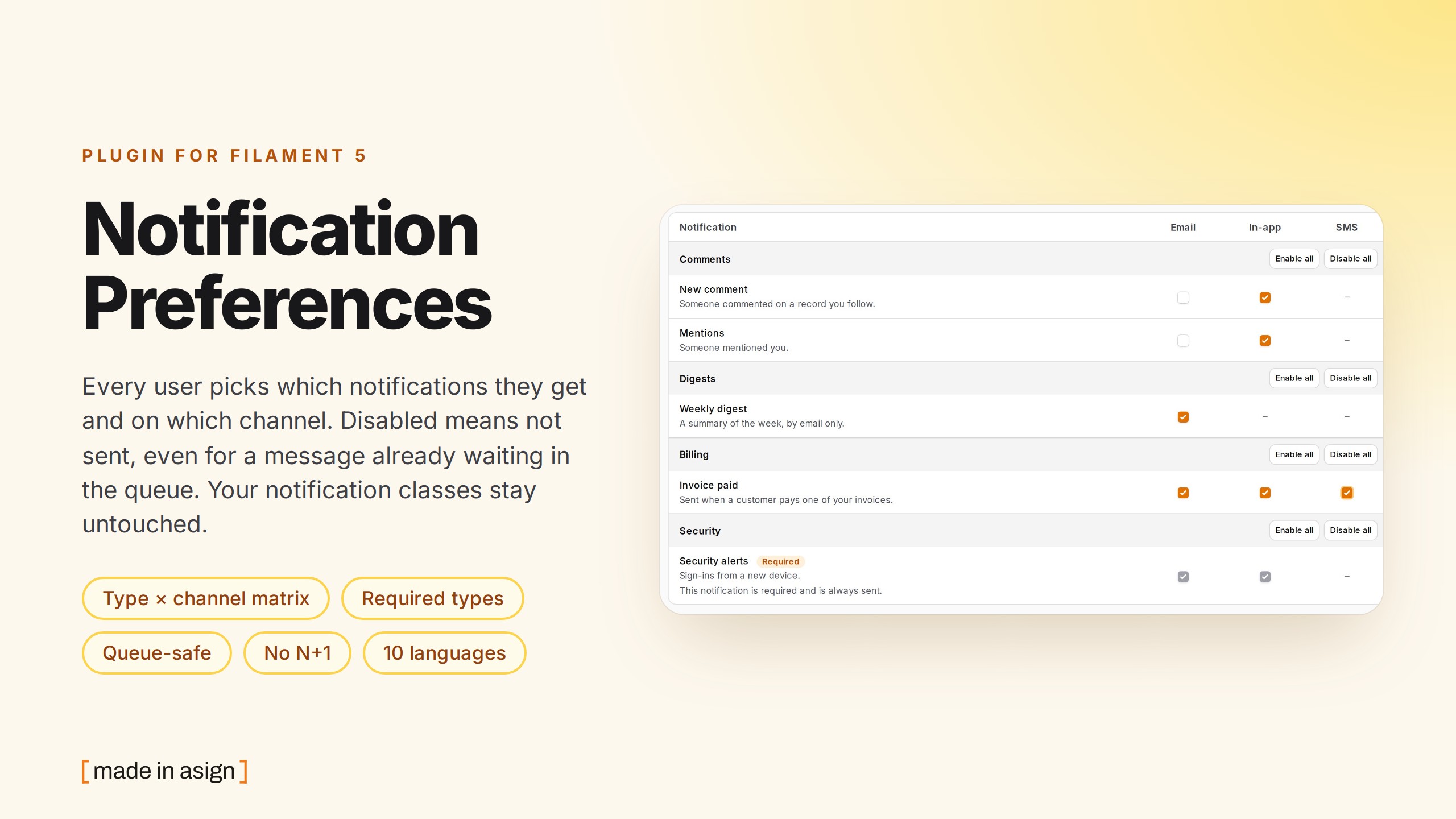
Panel users get mails and notifications they cannot switch off, and ask the developer. This plugin adds a page where
every user picks, per notification type and per channel, what they receive - without changing a single notification class.
You declare the types once (class, label, description, group, channels, default, optionally locked); a listener on
Laravel's NotificationSending event then cancels what the recipient turned off.
- A type x channel matrix on a panel page (and in the user menu), grouped, with "Enable all" / "Disable all" per group.
- Works for queued notifications: the choice is read when the notification is sent, so turning something off also stops
a message that was queued yesterday. Covered by a test that starts a real
queue:workprocess. - Required types (
locked): always delivered, shown as such, and untouchable even by a forged request. - Your classes and third-party ones are not modified. A subclass of a declared notification follows its parent's choice.
- Fails open: an undeclared notification, an anonymous
Notification::route()recipient, a channel the type does not offer and an error while reading the choices all mean "send". - Only deviations from the default are stored, so changing a default in code reaches everyone who never touched the page.
- One query per recipient on a mass send, an invalidated cache, Octane-safe.
- Integer, UUID and ULID recipients, tested on SQLite, MariaDB 11.4 and PostgreSQL 16. Ten languages.
Screenshots
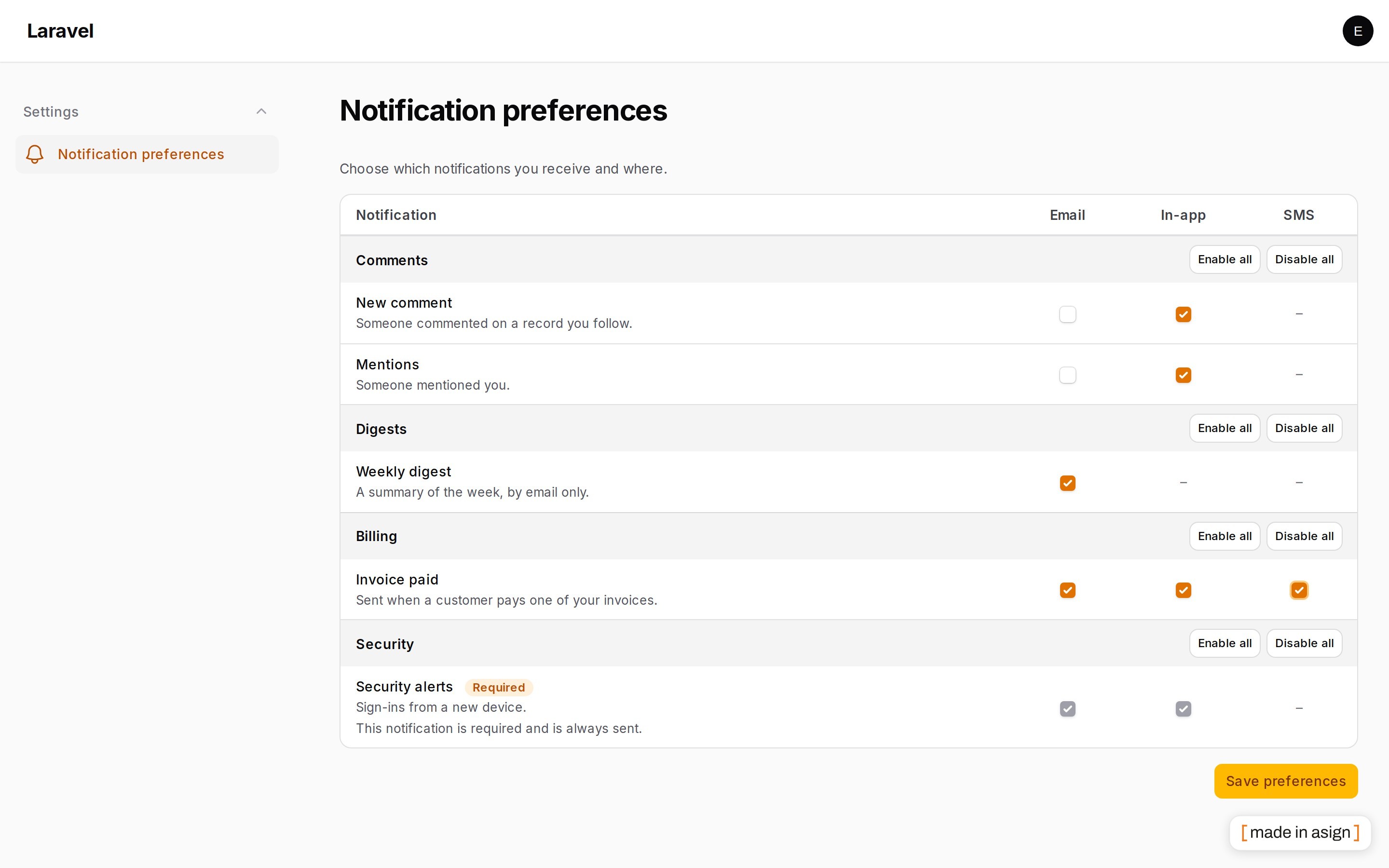
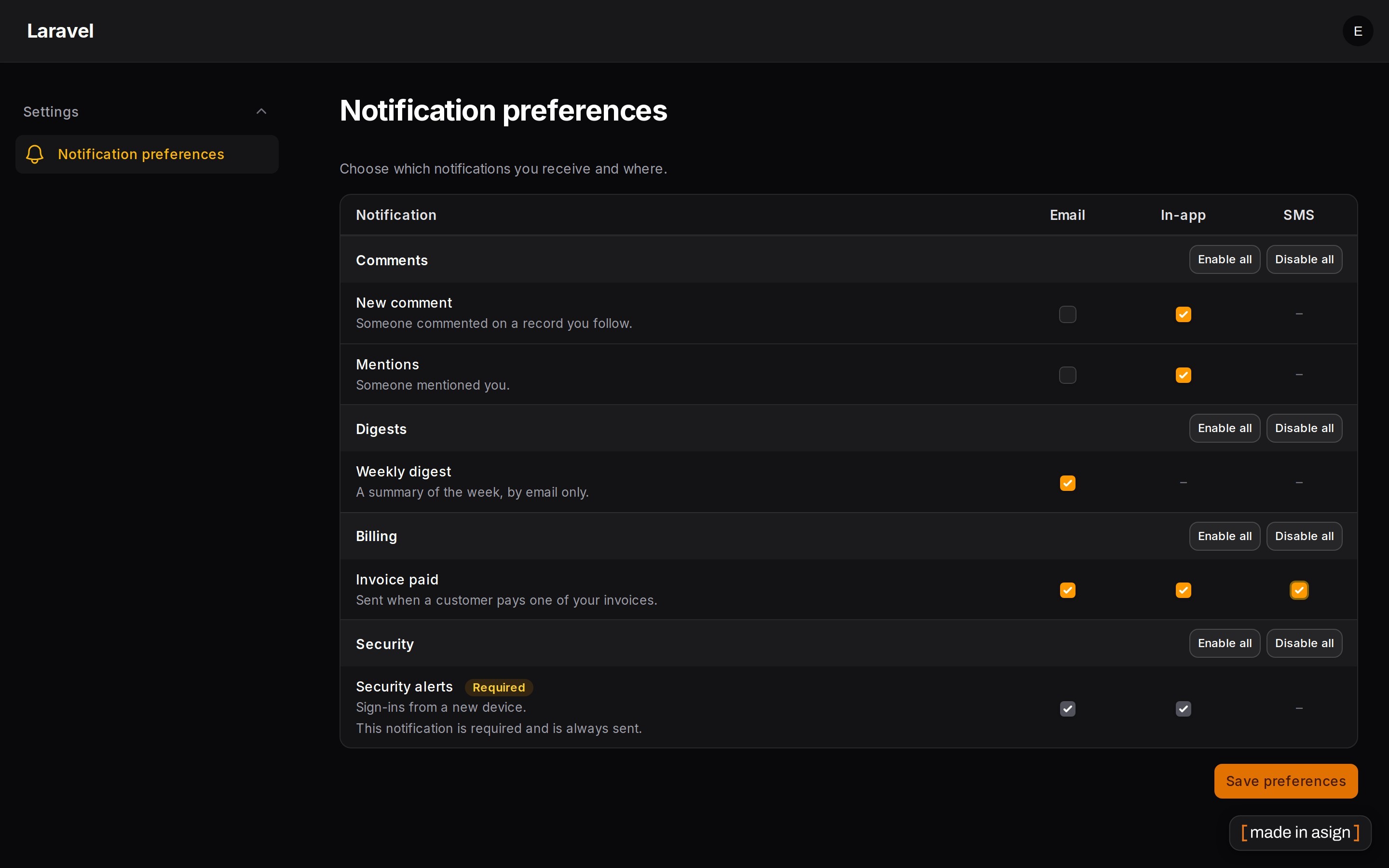
On a phone every row becomes a card whose checkboxes are labelled with their channel.
Requirements
- PHP 8.3+
- Laravel 12 or 13
- Filament 5
Installation
composer require asignua/filament-notification-preferences
php artisan vendor:publish --tag=filament-notification-preferences-migrations
php artisan migrate
php artisan filament:assets
The migration is a publishable stub, it is not loaded automatically. Optionally publish the config
(--tag=filament-notification-preferences-config) and the translations (--tag=filament-notification-preferences-translations).
Register the plugin on the panel:
use Asignua\FilamentNotificationPreferences\NotificationPreferencesPlugin;

$panel->plugin(
    NotificationPreferencesPlugin::make()
        ->navigationGroup('Settings')
        ->userMenu(),
);
Declaring the types
Do it in a service provider, so it also runs in a queue worker (which has no panel):
use Asignua\FilamentNotificationPreferences\NotificationPreferences;
use Asignua\FilamentNotificationPreferences\Support\NotificationType;

public function boot(): void
{
    NotificationPreferences::register(
        NotificationType::make(InvoicePaid::class)
            ->key('billing.invoice-paid')          // stable id stored in the database; defaults to the class name
            ->label(fn () => __('Invoice paid'))   // a string or a closure, resolved when the page renders
            ->description('Sent when a customer pays one of your invoices.')
            ->group('Billing')
            ->channels(['mail', 'database', SmsChannel::class => 'SMS'])
            ->default([SmsChannel::class => false]),  // true / false, or per channel (a channel left out stays on)

        NotificationType::make(SecurityAlert::class)->group('Security')->locked(),
    );
}
(NotificationPreferencesPlugin::make()->types([...]) does the same from the panel provider.)
- Key. The choices are stored under the key. Without
->key()it is the class name, which stops matching the day the class is renamed: give long-lived types a key (a key or class name must fit 150 characters). - Channels are what the notification's
via()returns:mail,database,broadcast, or a custom channel class with a label. A channel the type does not offer shows as an empty cell and is never blocked. - Inheritance.
class UrgentInvoice extends InvoicePaidis covered by theInvoicePaidentry (the nearest declared parent wins). - Locked types are always sent. The page shows them checked and disabled with a "Required" badge, the server ignores any attempt to change them, and the listener never blocks them - even if a stale row says otherwise.
Asking from code
NotificationPreferences::for($user)->allows(InvoicePaid::class, 'mail');   // also accepts the key or a notification instance
NotificationPreferences::for($user)->matrix();                              // what the user gets now
NotificationPreferences::for($user)->save(['billing.invoice-paid' => ['mail' => false]]);
allows() fails open (see above). save() ignores undeclared keys, locked types, channels the type lacks and non-boolean values.
Who may open the page
By default any signed-in user - and the page only ever reads and writes the signed-in user's own choices; the recipient is never
a request parameter. To narrow it, define the gate canManageNotificationPreferences and/or use ->visible(fn ($user) => ...) on
the plugin (it can only narrow what the gate allows). The check is repeated on every Livewire action, not only on mount.
To put the matrix into your own profile page instead: ->withoutPage() and render
@livewire(\Asignua\FilamentNotificationPreferences\Livewire\PreferencesMatrix::class).
Configuration
config/filament-notification-preferences.php: connection, table, model, and cache (enabled, store, ttl).
Plugin methods: navigationGroup(), navigationLabel(), navigationIcon(), navigationSort(), slug(), navigation(false),
userMenu(bool|string), visible(), withoutPage(), types().
Recipes
filament-chat. Its notifications are plain classes:
NotificationPreferences::register(
    NotificationType::make(\Asignua\FilamentChat\Notifications\NewMessageNotification::class)->key('chat.message')->label('New chat message')->group('Chat')->channels(['database']),
    NotificationType::make(\Asignua\FilamentChat\Notifications\MentionNotification::class)->key('chat.mention')->label('Mentions in chat')->group('Chat')->channels(['database']),
    NotificationType::make(\Asignua\FilamentChatPro\Notifications\DigestNotification::class)->key('chat.digest')->label('Chat digest')->group('Chat')->channels(['mail']),
);
filament-kanban-pro and filament-mail-log send their messages with Filament's Notification::...->sendToDatabase(). That method
wraps every message in the same class (Filament\Notifications\DatabaseNotification), so there is nothing to tell the kanban notify
step from a bounce alert by type, and they cannot be governed one by one. The only handle is the class itself, which switches all
sendToDatabase() messages of the application on or off together:
NotificationType::make(\Filament\Notifications\DatabaseNotification::class)->key('panel.messages')->label('Panel messages')->group('Panel')->channels(['database']);
Use that only when "all in-app panel messages" is a choice you want to give. Otherwise leave them out: unknown means sent.
Gotchas
Notification::make()->sendToDatabase()is not governed by type (explained above).- Cache. A recipient's stored choices are cached in the default cache store for an hour and dropped when the page saves. Editing the
table by hand takes up to the TTL to show up; call
NotificationPreferences::for($user)->forget()after a script does it. Thearray,null,apc,octaneandsessionstores are never used: they are not shared with the queue worker, which would keep an old answer. Use redis, memcached, database or file. - Two panels, one
->types([...]). Declaring the same type (same class, key, channels, defaults andlocked) twice is fine, the first declaration wins (labels are not compared). Two different declarations under one key stop the boot with an explicit message. - Other
NotificationSendinglisteners. Laravel stops at the first listener that returns a non-null value. A listener registered before ours that returnstrue/falsemeans ours never runs; register this plugin's provider first, or returnnullfrom yours. - Octane and queue workers. The per-request memory is a scoped container binding, which Octane and the worker reset between requests and jobs. The type registry is filled at boot and only read afterwards.
- Transactions. On PostgreSQL a failed query aborts the surrounding transaction; the listener fails open for the notification, but whatever else you do in that transaction is still aborted by the database.
- Case-insensitive collations (MariaDB/MySQL default) treat the keys
Billing.Paidandbilling.paidas one: keep keys lower-case. - Deleted users leave their rows behind (there is no foreign key, the recipient table is yours); they are tiny and harmless. The same goes
for rows of a type you stopped declaring: they are ignored (an undeclared type is sent) and never shown. Delete them yourself if you want
a clean table, e.g.
NotificationPreference::query()->where('type_key', 'old.key')->delete(); if you re-declare the key later, they apply again. - Digests, quiet hours, frequency, one-click unsubscribe and tenant-wide settings are out of scope.
Translations
The interface ships in English, Ukrainian, German, Spanish, French, Italian, Dutch, Polish, Brazilian Portuguese and Turkish
under the filament-notification-preferences::filament-notification-preferences namespace. English and Ukrainian are written by
hand; the other eight are machine translations - corrections are welcome. A test keeps every language in step with the English keys
and placeholders. Override a string by publishing the translations and editing the copy in lang/vendor/filament-notification-preferences.
AI agents
The package ships Laravel Boost guidelines (resources/boost/guidelines/core.blade.php) so a
coding agent wires it up correctly.
Testing
composer install
vendor/bin/phpunit
vendor/bin/phpstan analyse --memory-limit=1G
vendor/bin/pint --test
NPREF_DB=mariadb|pgsql (with NPREF_DB_HOST, NPREF_DB_PORT; database/user npref, password secret) runs the same suite against
a real server. One test starts a separate queue:work process against the same database.
Changelog
See CHANGELOG.md.
More plugins by asign
- Record Lock - one editor per record
- Mail Log - every message your app sends
- Activity Log Plus - an audit trail for resources
- XLSX Export - typed
.xlsxdownloads of what is on the screen - Redirects - redirects and the 404 log
All plugins: https://filamentphp.com/plugins?q=asign
License
The MIT License (MIT). See LICENSE.md.