
asignua / filament-mail-log

Read-only log of every outgoing Laravel mail for Filament 5: status tracking across the queue, secrets redacted before storing, sandboxed preview.
Requires
- php: ^8.3
- filament/filament: ^5.0
- illuminate/contracts: ^12.0|^13.0
- spatie/laravel-package-tools: ^1.16
Requires (Dev)
- larastan/larastan: ^3.0
- laravel/pint: ^1.18
- orchestra/testbench: ^10.0|^11.0
- phpunit/phpunit: ^11.5|^12.0
Suggests
None
Provides
None
Conflicts
None
Replaces
None
README

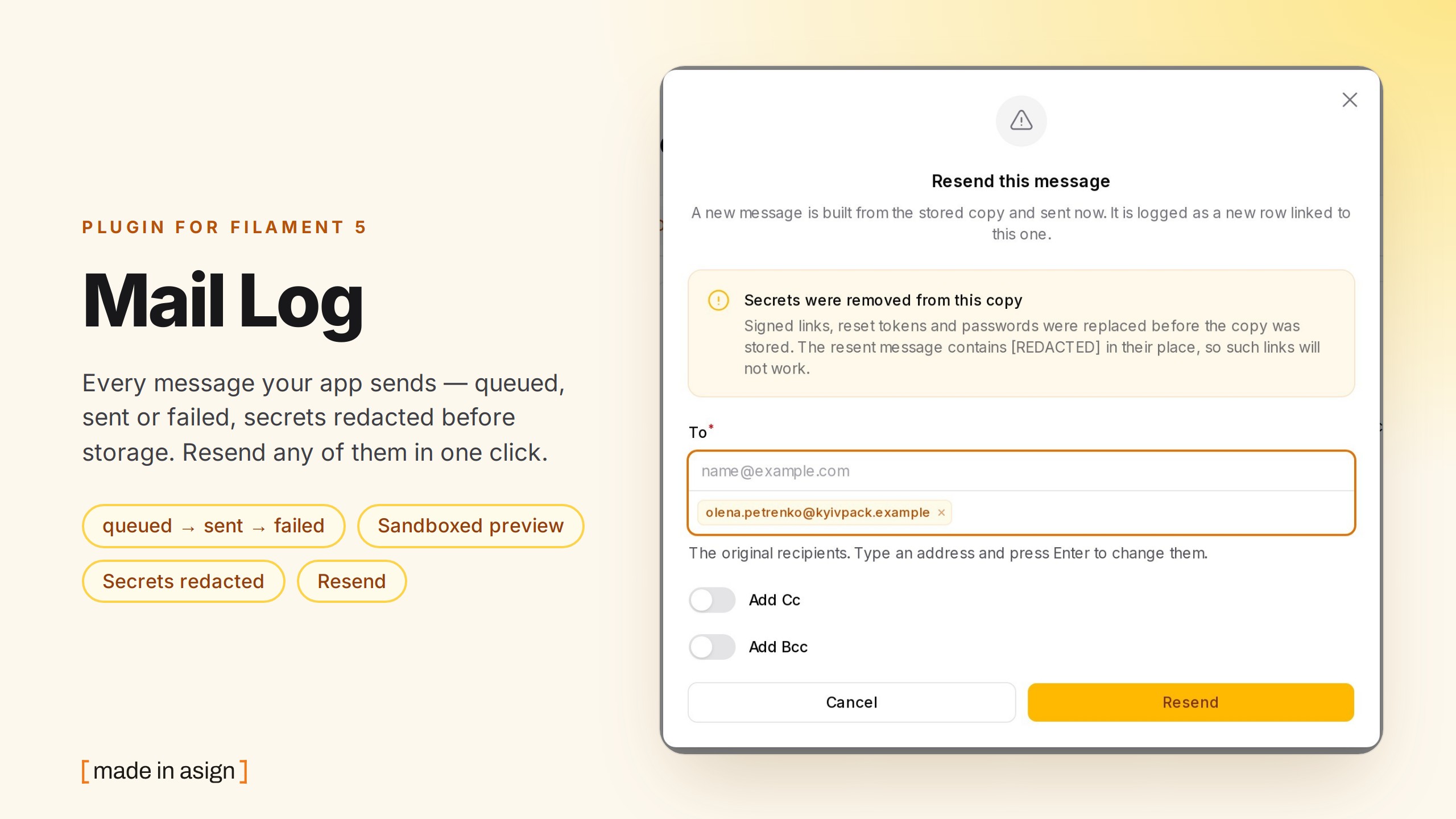
A log of every message your Laravel application sends, inside a Filament 5 panel. It answers "did the
customer get the email, and what did it say?" without a third-party service: each message is followed from the
queue to the transport (queued, sending, sent, failed), stored with its recipients, headers, bodies and
attachment names, and shown in a sandboxed preview.
Secrets never reach the table: signed-link signatures, tokens, password-reset URLs and "Password: ..." lines are redacted before the copy is stored.
Screenshots
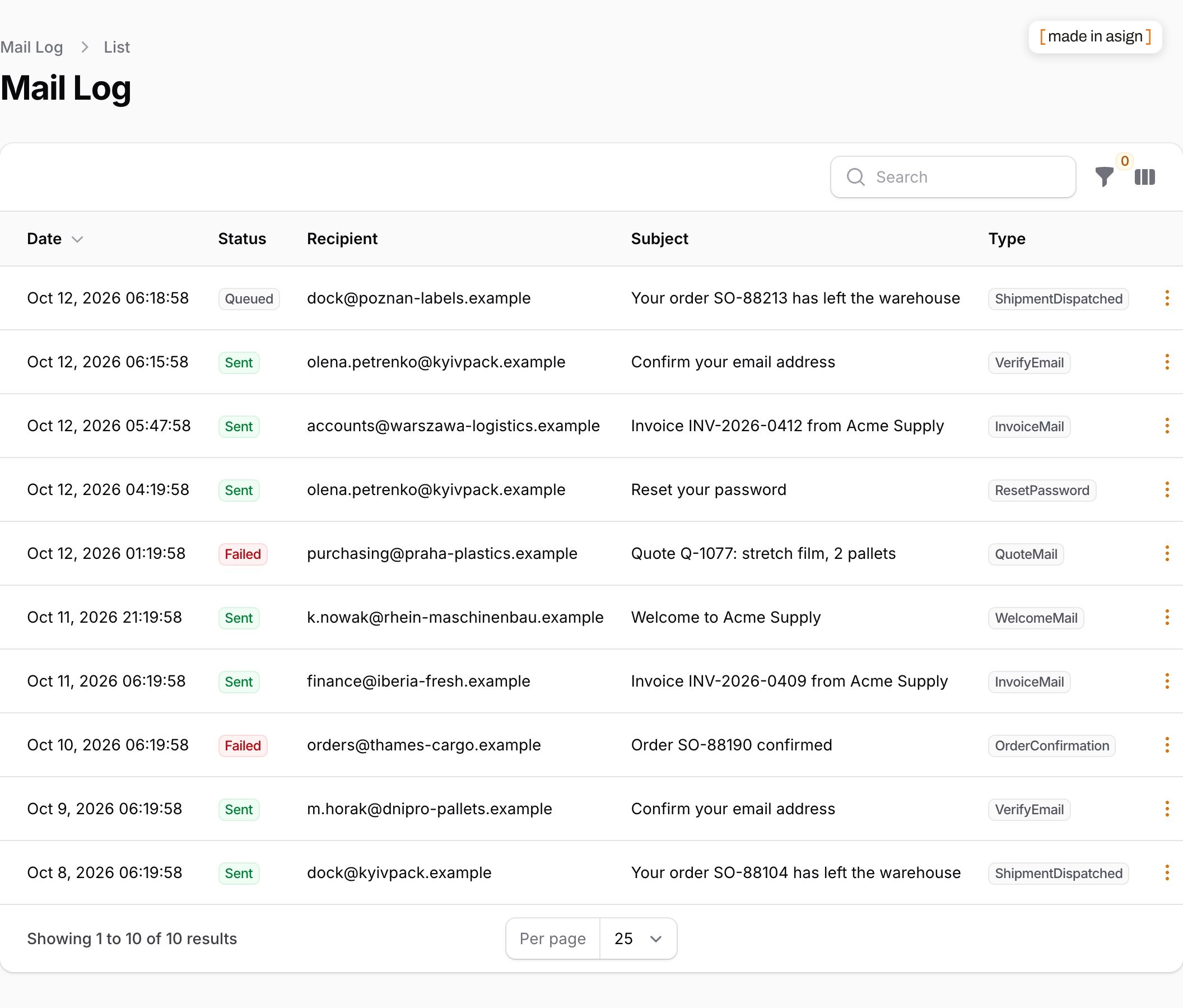
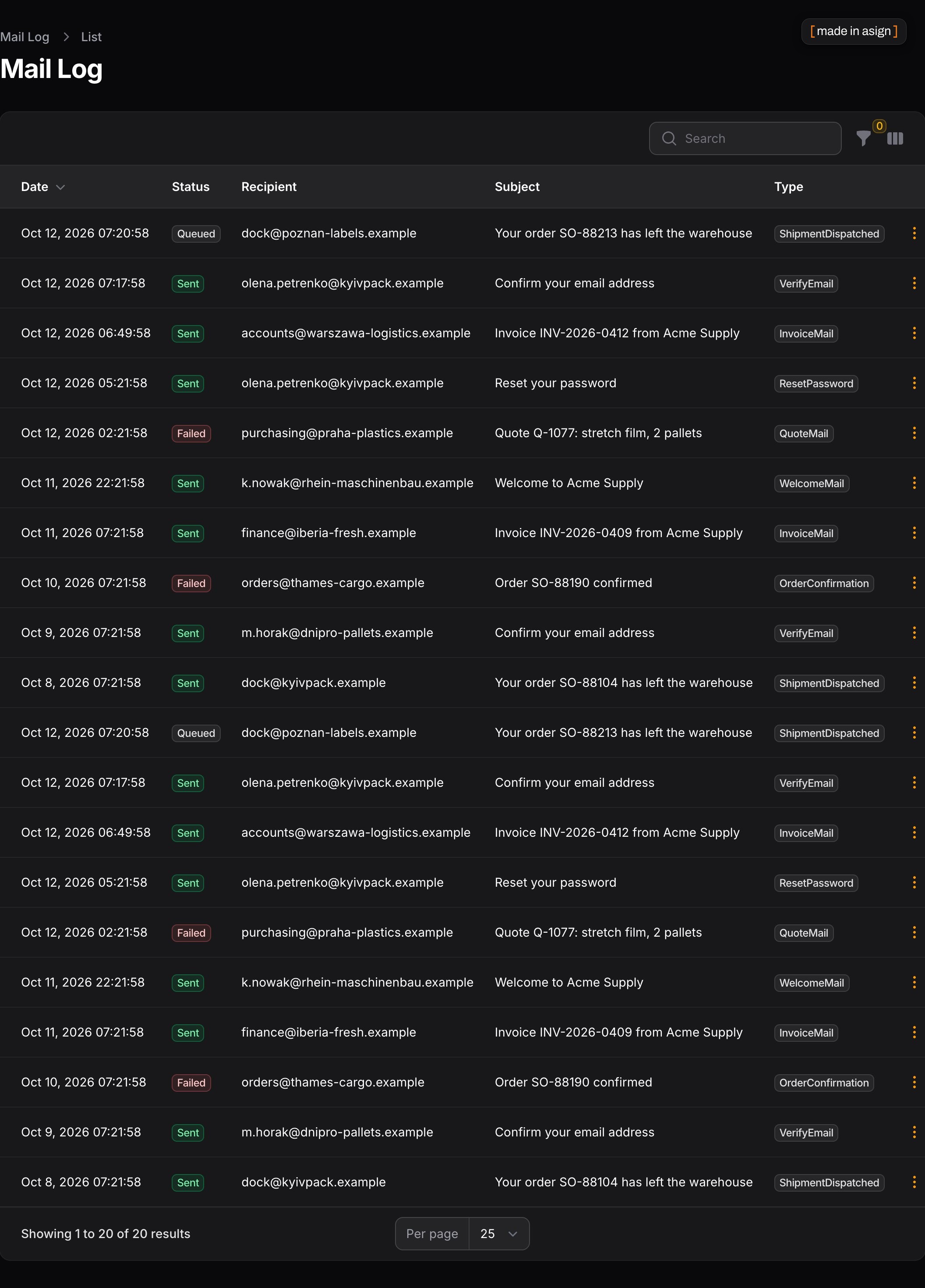
Every message with its status (queued, sent or failed), recipient, subject and type:
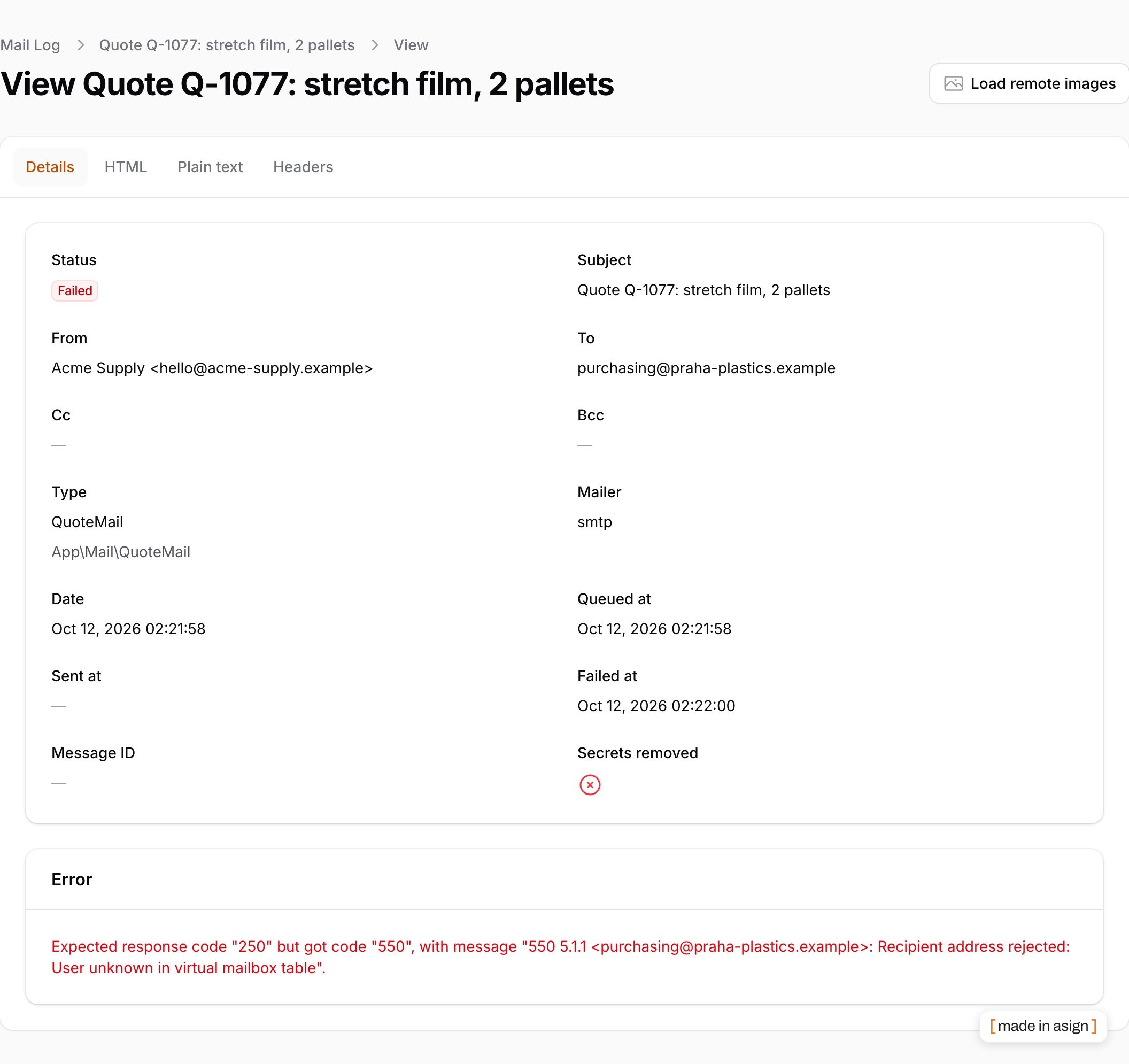
A failed message keeps the transport error, the recipients and the timeline:
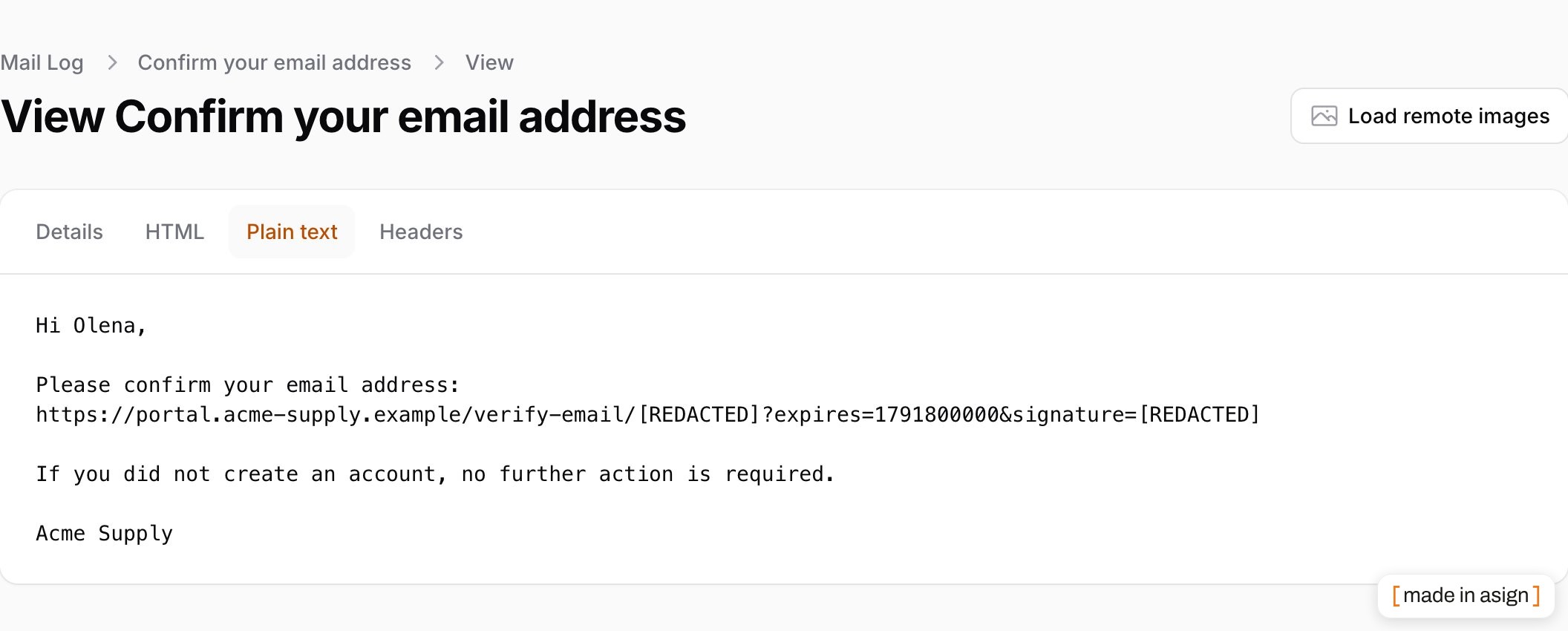
Signed-link signatures and reset tokens are replaced before the copy is stored:
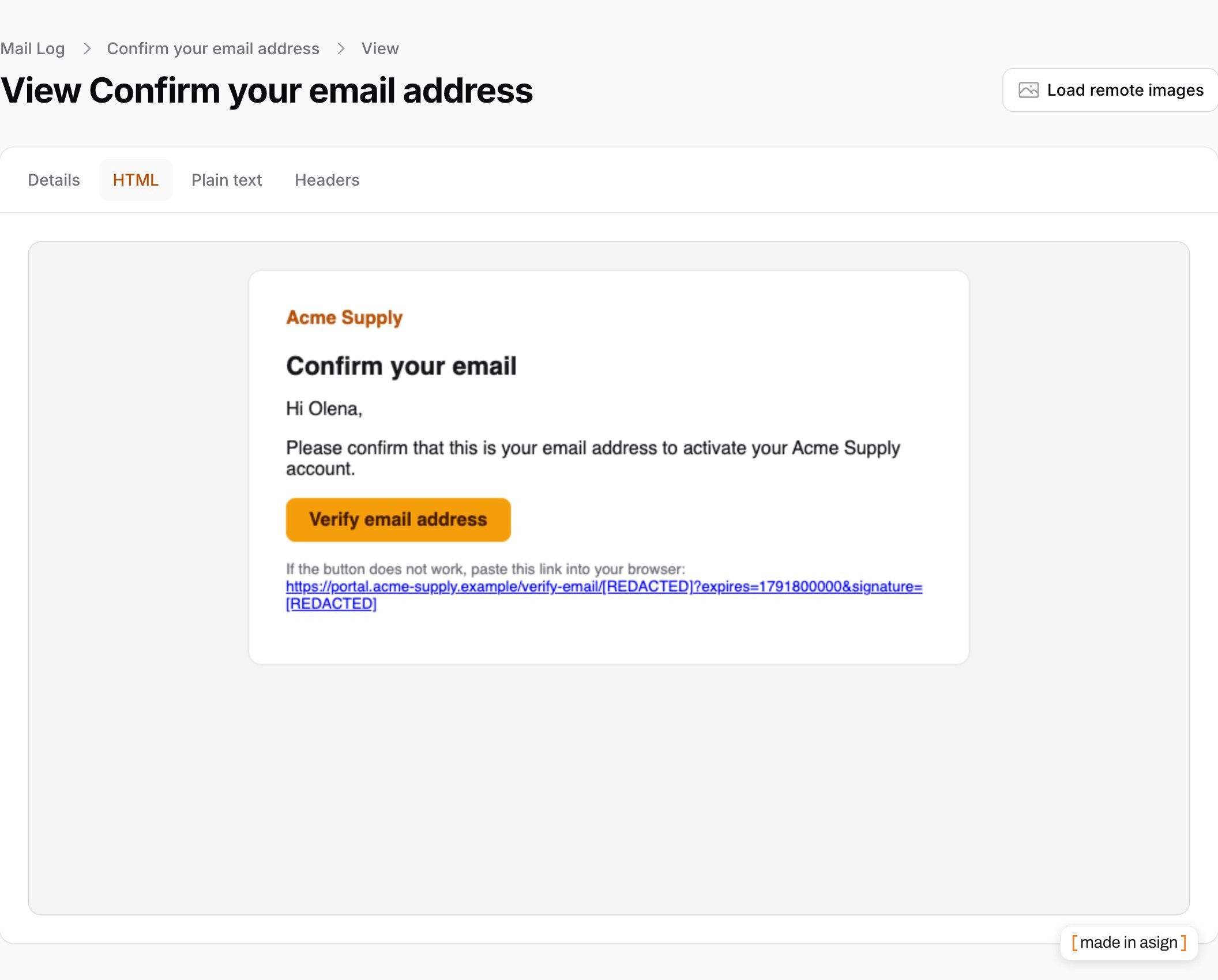
The HTML tab renders the stored body in a sandboxed frame (no scripts, remote images off until you ask):
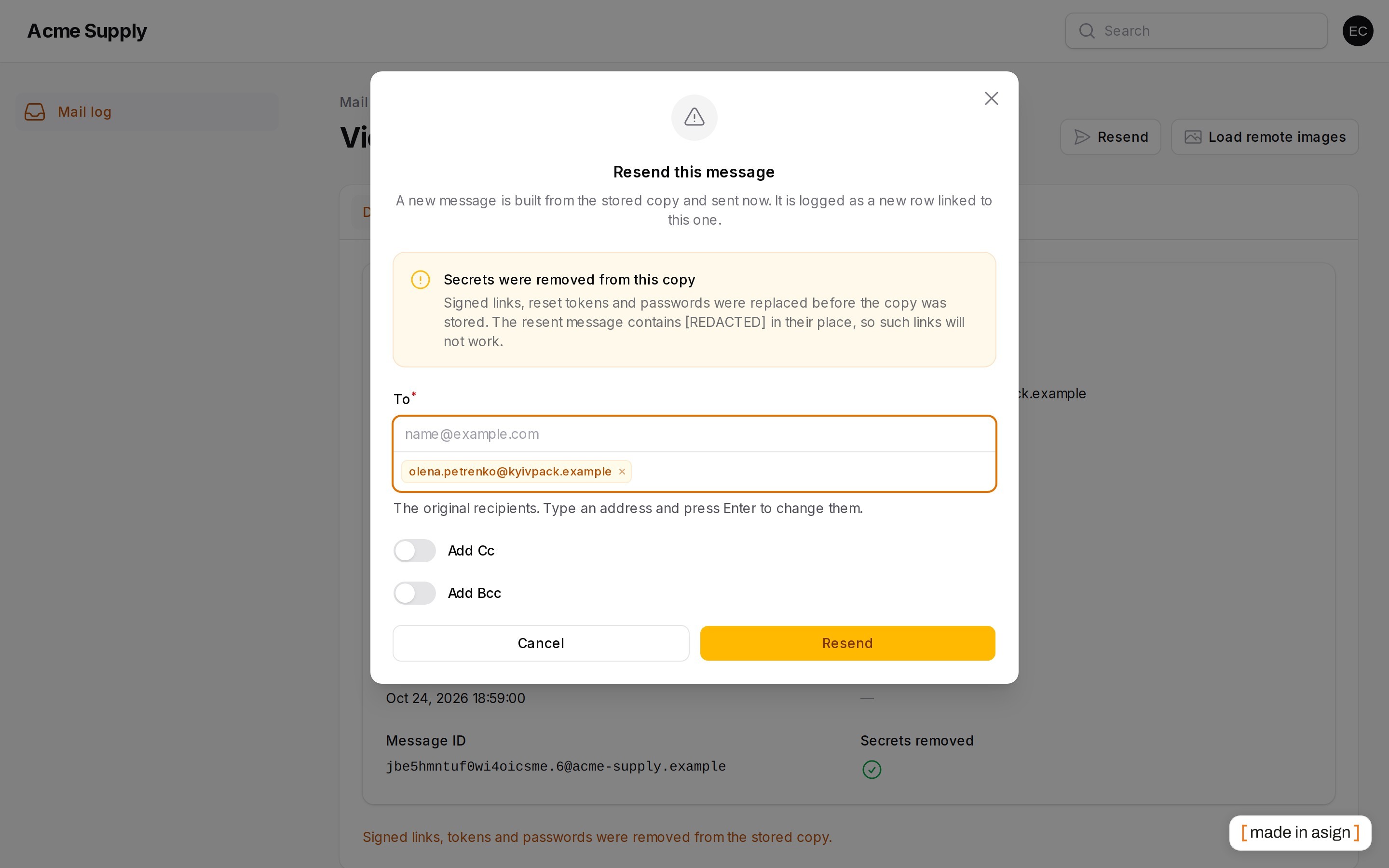
Resend a stored message to the same or other recipients (separate permission, with a warning when secrets were removed):
Dark mode:
Requirements
- PHP 8.3+
- Laravel 12 or 13
- Filament 5
Installation
composer require asignua/filament-mail-log
Register the plugin on your panel:
use Asignua\FilamentMailLog\MailLogPlugin;

$panel->plugin(MailLogPlugin::make());
Publish and run the migration (the table name and connection come from the config, so decide before migrating):
php artisan vendor:publish --tag=filament-mail-log-migrations
php artisan migrate
Access is closed until you open it. A stored mail can hold a one-time code or a private conversation, so with no setup nobody sees the log. Either define the gate ability:
Gate::define('viewMailLog', fn (User $user): bool => $user->isAdmin());
or pass a callback to the plugin (it wins over the gate):
MailLogPlugin::make()->authorize(fn (): bool => auth()->user()?->isAdmin() === true);
To let people resend messages, open the second, separate permission (see Resend):
Gate::define('resendMailLog', fn (User $user): bool => $user->isAdmin());
Usage
Logging starts as soon as the package is installed; no code changes. Every Mail::send(), queued mailable and
mail notification is recorded.
| Status | Meaning |
|---|---|
queued |
pushed to a queue (database, redis, ...), no worker took it yet |
sending |
handed to the mailer, the transport has not answered |
sent |
the transport accepted it (stores the message id) |
failed |
the job threw, or the transport threw; the error is stored |
suppressed |
every recipient is on the suppression list; nothing was sent |
The list filters by status, type, recipient (To/Cc/Bcc), period and text in the body. The view page has Details, HTML (sandboxed iframe), Plain text and Headers tabs.
Resend
The Resend action (message page header and the row menu of the table) mails a stored message again, to the same or to other recipients. It opens a confirmation modal with the original To addresses as editable tags (validated as e-mail addresses), and optional Cc / Bcc toggles that are off by default.
- Closed by default, and separate from viewing. Resending mails a third party, so seeing the log does not allow it.
The permission comes from
->authorizeResend(fn () => ...)on the plugin (wins), else from theresendMailLoggate ability, else from nobody. The user must also be allowed to open the log. The permission is checked again when the modal is submitted, not only when the button is drawn. - It sends the stored copy. If secrets were removed from it (
Secrets removedis on), the modal shows a warning: signed links, reset tokens and passwords are[REDACTED]in the resent message, so those links will not work. Resending is still allowed (a notification, an invoice or a failed delivery is a legitimate case). The same goes for a body cut atbody.max_bytes. If no body was stored (body.store=false), the action is hidden. - Attachments are not resent. Only their names and sizes are stored, never the contents; the modal says so when the original had attachments.
- What is copied: subject, html and plain-text body, the sender,
Reply-To,X-PriorityandImportance. Other stored headers (ids, dates, tracking,List-Unsubscribewith a redacted link) are not copied. - The resend is logged as a new row, linked to the original: the message page shows "Resent from #12" and "Resent 2 times", and the list has a "Resent from" column (hidden by default).
- Sent through
resend.mailer(default: the application's default mailer) and, withresend.queue, through the queue (the row then starts asqueued).
Upgrading from 1.0: the link lives in a new resent_from_id column, added by a new migration. vendor:publish --tag=filament-mail-log-migrations publishes both stubs, so delete the new copy of create_mail_logs_table (the table
exists) and keep add_resent_from_id_to_mail_logs_table, then php artisan migrate. Until it ran, logging keeps working
and the Resend action stays hidden.
Delivery tracking (provider webhooks)
sent only means the transport accepted the message. With a provider webhook the log also learns what happened
afterwards: delivered, bounced (hard / soft), complained, opened, clicked, rejected, deferred. Each event is
stored in mail_log_events and the newest meaningful one is copied to the message as delivery_status
(a badge column and a filter in the table, a "Delivery events" timeline on the message page).
Providers: Postmark, Mailgun, Amazon SES (through SNS), Resend, SendGrid. Everything is off until you switch a
provider on and give it its secret. A webhook for a provider that is off answers 404; a missing, wrong or stale
signature answers 403.
- Publish and run the three new migrations (
add_delivery_status_to_mail_logs_table,create_mail_log_events_table,create_mail_log_suppressions_table). Until they ran, logging and the panel work as before and the new UI is hidden. - Enable the provider (
.envor thewebhooks.providersconfig) and point the provider's webhook athttps://your-app.test/mail-log/webhooks/{provider}(webhooks.path; an empty path does not register the route). The route has no session and no CSRF; add a rate limit withwebhooks.middleware, e.g.['throttle:600,1'](generous: providers send bursts and retry on a 429). Refused requests are logged atdebuglevel only.
| Provider | URL ends with | Env | Where to paste what |
|---|---|---|---|
| Postmark | /postmark |
MAIL_LOG_POSTMARK_ENABLED, _USERNAME, _PASSWORD |
Server > Webhooks: URL https://USER:PASSWORD@your-app.test/mail-log/webhooks/postmark (Postmark does not sign, it sends Basic auth). Tick Delivery, Bounce, Spam complaint, Open, Click |
| Mailgun | /mailgun |
MAIL_LOG_MAILGUN_ENABLED, _SIGNING_KEY |
Sending > Webhooks: add the URL for each event; the key is the "HTTP webhook signing key". JSON webhooks only |
| Amazon SES | /ses |
MAIL_LOG_SES_ENABLED, MAIL_LOG_SES_TOPIC_ARNS |
SES > Configuration set > Event destination > SNS topic; SNS > create an HTTPS subscription to the URL. The plugin confirms the subscription itself. TOPIC_ARNS (comma separated) is required: a valid SNS signature only proves the message came from some SNS topic |
| Resend | /resend |
MAIL_LOG_RESEND_WEBHOOK_ENABLED, _SECRET |
Webhooks > Add endpoint; the secret is the "Signing secret" (whsec_...) |
| SendGrid | /sendgrid |
MAIL_LOG_SENDGRID_ENABLED, _PUBLIC_KEY |
Settings > Mail Settings > Event Webhook, switch on Signature Verification and paste the "Verification key" |
How a webhook finds its message. When a provider is on, every outgoing message gets X-Metadata-mail_log_id
(a Symfony MetadataHeader carrying the row's ULID) next to the usual X-Mail-Log-Id, and the plugin stores the
transport's message id after sending. An event is matched by the ULID first (Postmark Metadata, Mailgun user-variables,
SendGrid custom args, Resend tags, SES mail.tags or the echoed header), then by the provider message id
(Postmark MessageID, Mailgun message-id, SES mail.messageId, Resend email_id, SendGrid sg_message_id / smtp-id).
Mail sent through the provider's API mailer (the Symfony Postmark / Mailgun / SendGrid / Resend / SES bridges) is matched
both ways. Over plain SMTP the metadata header is not turned into provider metadata, so only the message id can match,
and not every provider echoes the SMTP Message-ID; some relays read their own header, list it in
webhooks.stamp_headers (e.g. ['X-PM-Metadata-mail_log_id'] for Postmark SMTP). webhooks.stamp_metadata=false turns the
extra header off. An event nobody can match is answered with 503 when it is less than webhooks.retry_unmatched_seconds (60) old, because it often arrives before the row has its message id, so the provider retries; older ones get 200 and are dropped.
Status precedence. Webhooks arrive late, twice and out of order, so the stored status only moves forward:
deferred < soft bounce < delivered < opened < clicked < rejected < hard bounce < complaint. A "delivered" that arrives after a
hard bounce does not hide it; a soft bounce followed by a successful retry becomes "delivered". The mail log status
(queued / sending / sent / failed) is not touched. A retried webhook is stored once (unique provider + provider event id).
Security notes. Mailgun signs only timestamp and token, so each token is bound to the first body it arrived with (a different body with a seen token is refused). SNS: the signing certificate must come from a real regional sns.<region>.amazonaws.com host and be Amazon's sns.amazonaws.com certificate; the SNS timestamp window is 1 hour (providers.ses.tolerance) because SNS retries late, and a message that SNS delivers after its retry policy outlasts that window is refused with 403 and lost, so keep the policy's retry period under an hour or raise the tolerance. Mailgun failed events suppress only for reasons bounce, hardfail, suppress-bounce; Postmark SpamNotification and SES not-spam complaints never suppress. A misconfigured SendGrid key or a bad certificate is refused with 403 and one log warning, not a server error.
Webhooks are handled in the request, not queued: a few indexed queries, the provider retries on any non-2xx, and tracking
should not depend on a queue worker. Stored payloads are cleaned: signatures, tokens, SNS URLs, the recipient's IP / user agent / client / geolocation (webhooks.keep_client_info) and ignored headers are dropped, lists are cut at 20 items, SES keeps only the id and time of its mail object, and signed links
are redacted (webhooks.store_payload=false keeps no payload). Events go with their message when mail-log:prune deletes it.
Suppression list
A hard bounce or a complaint puts the address in mail_log_suppressions (even when the message is not in this log:
the provider confirmed the address is dead). Recording is on by default (suppression.record) and visible in the
Suppressions resource. Nothing is blocked until you opt in:
// .env: MAIL_LOG_SUPPRESSION=true
With suppression.enabled, a MessageSending listener removes suppressed addresses from To / Cc / Bcc, and a message left
with nobody is not sent: its row gets the status suppressed. (A partly cleaned message is logged as sent with its
original recipients.) If the lookup itself fails the mail is sent. Removing an address (single or bulk) is closed by default and has
its own permission: Gate::define('manageMailSuppressions', ...) or MailLogPlugin::make()->authorizeSuppressions(fn () => ...).
->suppressionResource(false) hides the resource.
Mail preview for designers
Register the messages and the page appears (same access rule as the log):
MailLogPlugin::make()
    ->previews([
        'Welcome' => fn () => new WelcomeMail(User::factory()->make()),
        'Invoice' => InvoiceMail::class,           // built by the container
    ])
    ->previewLocales(['en', 'uk']);                // default: app locale + fallback
Only registered keys can be rendered. The locale is switched for the render and restored afterwards.
Retention
mail-log:prune deletes records older than retention_days (default 90, 0 = keep forever) in small chunks and
marks sending rows nobody confirmed for stale_after_minutes as failed. It is scheduled daily at 03:40; set
MAIL_LOG_SCHEDULE=false to schedule it yourself.
Configuration
Fluent setters on MailLogPlugin: authorize(), authorizeResend(), authorizeSuppressions(), suppressionResource(), resource(), previews(), previewPage(), previewLocales(),
navigationGroup(), navigationSort(), navigationIcon().
Everything else is in the config (php artisan vendor:publish --tag=filament-mail-log-config):
| Key | Default | |
|---|---|---|
enabled |
true (MAIL_LOG_ENABLED) |
master switch for logging |
connection, table |
default connection, mail_logs |
where the log lives |
retention_days |
90 |
used by mail-log:prune |
schedule.enabled, schedule.time |
true, 03:40 |
the prune schedule |
body.store, body.max_bytes |
true, 200000 |
keep bodies; cut at this many bytes (before redaction) |
headers.store, headers.ignore |
true, auth-like headers |
the Headers tab |
attachments.sizes |
true |
store attachment sizes (reads the attachment once more) |
redaction.* |
see below | what is removed from stored text |
types |
[] |
[WelcomeMail::class => 'Welcome mail'] labels; subclasses inherit |
preview.csp |
restrictive | Content-Security-Policy inside the preview iframe (no remote images) |
preview.csp_remote_images |
allows https: images |
policy after "Load remote images" |
resend.enabled |
true (MAIL_LOG_RESEND) |
master switch for the Resend action (it is still closed until the gate or authorizeResend() opens it) |
resend.mailer |
null (MAIL_LOG_RESEND_MAILER) |
mailer for a resend; null = the default mailer |
resend.queue |
false (MAIL_LOG_RESEND_QUEUE) |
queue the resend instead of sending it in the request (needs a worker) |
isolate_connection |
true |
write the log on a separate connection (see Gotchas) |
webhooks.path, webhooks.middleware |
mail-log/webhooks, [] |
the webhook route (POST {path}/{provider}); empty path = no route |
webhooks.providers.* |
all off | enabled + secret per provider; add your own driver class |
webhooks.tolerance, webhooks.store_payload |
300, true |
replay window of signed timestamps; keep cleaned payloads |
webhooks.stamp_metadata, webhooks.stamp_headers |
true, [] |
correlation headers added while a provider is on |
webhooks.events_table, suppression.table |
mail_log_events, mail_log_suppressions |
table names |
suppression.record, suppression.enabled |
true, false |
record bounces / complaints; actually drop suppressed recipients |
Redaction
Applied to the bodies, the subject, the header values and the error text:
redaction.query_parameters: the value ofsignature,token,code,api_key, ... in any URL becomes[REDACTED](also inside HTML, where&separates parameters).redaction.path_prefixes:/reset-password/{token}becomes/reset-password/[REDACTED](alsoverify-email,magic-link,invitation, ...). Every segment after the prefix is removed, so/email/verify/{id}/{hash}becomes/email/verify/[REDACTED]; the query string is handled byquery_parameters.redaction.credential_labels:Password: hunter2keeps the label and drops the value.redaction.patterns: your own regexes (the whole match is replaced). Add theuflag (~…~iu) to anything that touches non-ASCII text: without it\band/ido not see UTF-8 letters. The built-in rules andcredential_labels(en, uk/ru, de, pl, es) are already UTF-8 safe.
It fails closed: a pattern that breaks at run time (PCRE backtrack limit, an invalid regex) replaces the whole text
with [redaction failed]. Add the parameters of your own signed links to the list; the defaults can not know them.
Gotchas
- A mail is missing from the log. The log lives in the process that sends: a message built with a custom
transport that bypasses
Illuminate\Mail\Mailer(raw Symfony mailer) fires no events. CheckMAIL_LOG_ENABLEDand that the migration ran: a missing table is swallowed on purpose, because the log must never stop the mail (look forfilament-mail-log: could not recordin your log). - A row stays
sending. The transport threw outside a queue job and the process was killed, or a worker was killed by its timeout.mail-log:prunefails such rows afterstale_after_minutes. - The recipient sees an
X-Mail-Log-Idheader (and, while a webhook provider is on and the transport does not turn it into provider metadata,X-Metadata-mail_log_id). It is howMessageSendingis tied toMessageSent(Symfony clones the message). It is a random ULID and carries nothing; rename it with theheaderconfig. - Stored mail is still personal data. Redaction removes secrets, not names or order contents. Use
body.store=falseor a shortretention_dayswhere that matters. - Mail sent inside a DB transaction keeps its log row. With
connection= null the log is written on a separate connection that clones the default one (isolate_connection), so a rollback does not erase the record of a mail that already left. In-memory SQLite stays on the default connection. Side effect: a host test wrapped in a transaction does not roll the log rows back. - A message cancelled by another
MessageSendinglistener (one that returnsfalse) is logged as failed with the text "cancelled by a listener, the transport threw an exception, or the process ended", because the log row is written before the other listeners run. - Supported databases: MySQL / MariaDB, PostgreSQL and SQLite (recipient and body searches use
LIKE ... ESCAPE, JSON columns are cast to text on PostgreSQL). - Queue correlation uses the queue connection together with the job id; a job that finishes without sending closes its
queuedrow as failed, and a job that will be retried keeps it for the next attempt. - Attachment sizes are read only from string and file bodies; a stream attachment is never read (that would consume it), so its size stays empty.
- The preview blocks remote images. Opening a message must not fire its open-tracking pixels (that would mark it as opened and leak the admin's IP), so the policy allows
data:images only. The "Load remote images" button on the message page switches topreview.csp_remote_imagesfor that view. - Search finds nothing in the body. The body is a long text column, so it has its own filter (not the global
search); it uses
LIKE, there is no full-text index.
Translations
The interface ships in English and Ukrainian (other locales fall back to English) under the filament-mail-log::filament-mail-log namespace. A test keeps every language in step with the English keys. Override a
string by publishing the translations (--tag=filament-mail-log-translations) and editing the copy in
lang/vendor/filament-mail-log.
AI agents
The package ships Laravel Boost guidelines (resources/boost/guidelines/core.blade.php) so a
coding agent wires it up correctly.
Testing
composer install
vendor/bin/phpunit
vendor/bin/phpstan analyse --memory-limit=1G
vendor/bin/pint --test
Changelog
See CHANGELOG.md.
License
The MIT License (MIT). See LICENSE.md.