
asignua / filament-gdpr-requests

Track GDPR data-subject requests in Filament 5: deadlines, a declared data map, exports, and previewed, four-eyes, idempotent erasure.
Requires
- php: ^8.3
- ext-zip: *
- filament/filament: ^5.11.2
- illuminate/contracts: ^12.0|^13.0
- spatie/laravel-package-tools: ^1.16
Requires (Dev)
- larastan/larastan: ^3.0
- laravel/pint: ^1.18
- orchestra/testbench: ^10.0|^11.0
- phpunit/phpunit: ^11.5|^12.0|^13.0
Suggests
- asignua/filament-activity-log-plus: Mirrors request actions (structure only) into the audit log under the name "gdpr".
Provides
None
Conflicts
None
Replaces
None
README

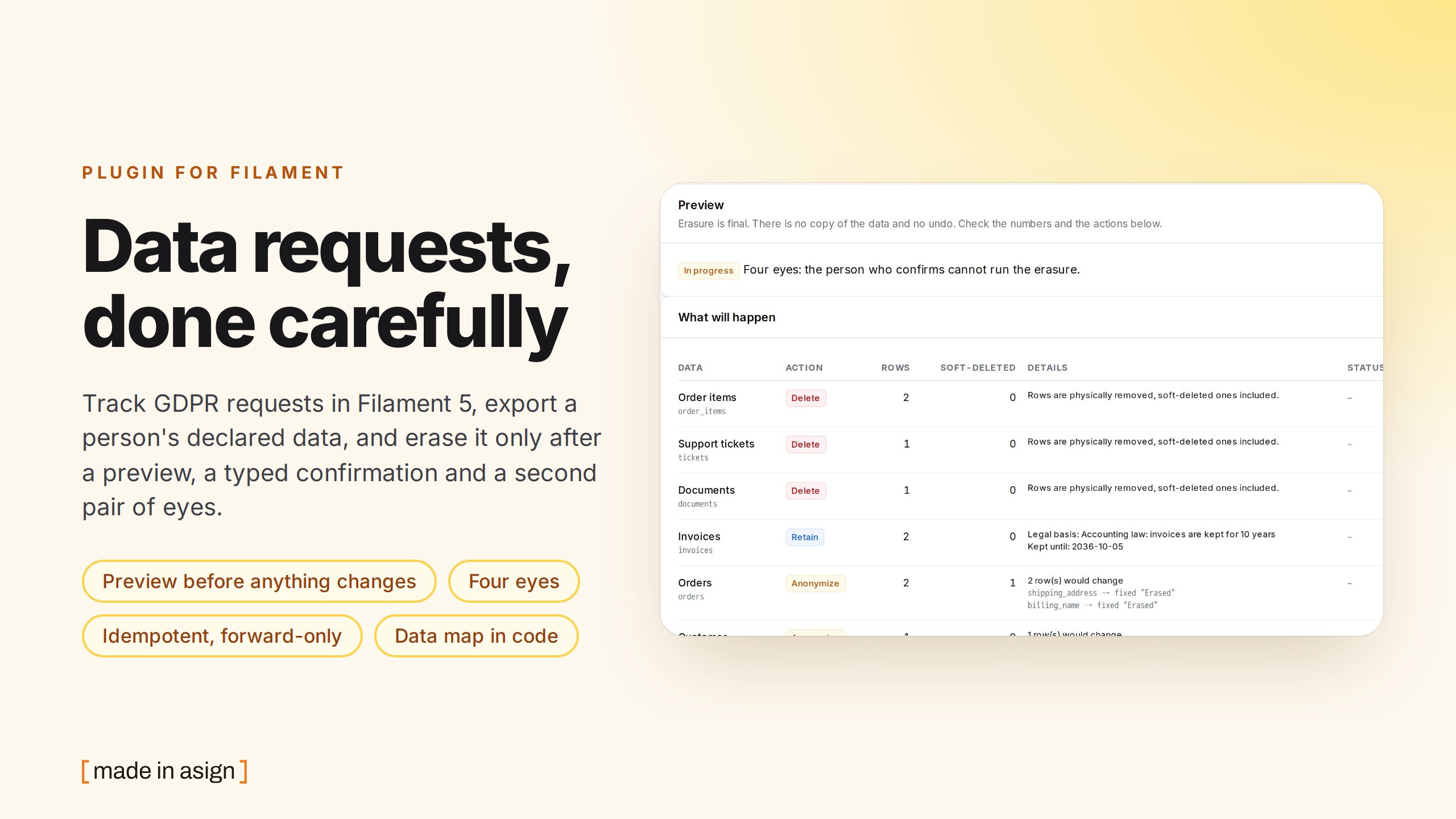
Somebody e-mails "please delete my data" or "send me a copy". This plugin gives your team a register for those requests and a careful way to carry them out: a deadline that is counted for you, a record of who did what, an export built from the data you declared, and an erasure that shows exactly what will happen before it happens.
This is a process tool, not legal advice, and it does not make you "GDPR compliant". It helps you run a procedure and keep evidence of it. What counts as personal data in your application, which of it must be erased, and which must be kept, is your decision, written down by you in the data map (below). The plugin never guesses.
What it does
- Register of requests (access, erasure, rectification, restriction, portability, objection) with channel, assignee, internal notes and an action log. Names, addresses and notes are wiped some time after a request is closed; only a keyed pseudonym stays.
- Deadline: one calendar month from receipt (31 January + 1 month = 28 February), extendable once, with a reason, by up to two further months (Art. 12(3)). Reminders for the assignee before the deadline and for your administrators after it.
- Data map in code: for every model you say how a person's rows are found, what goes into an export and what happens on erasure.
- Export: a zip with JSON files (Cyrillic and accents are not escaped) plus the files you name, on a private disk, behind a short-lived signed link that works only for the person it was issued to, deleted automatically after 30 days.
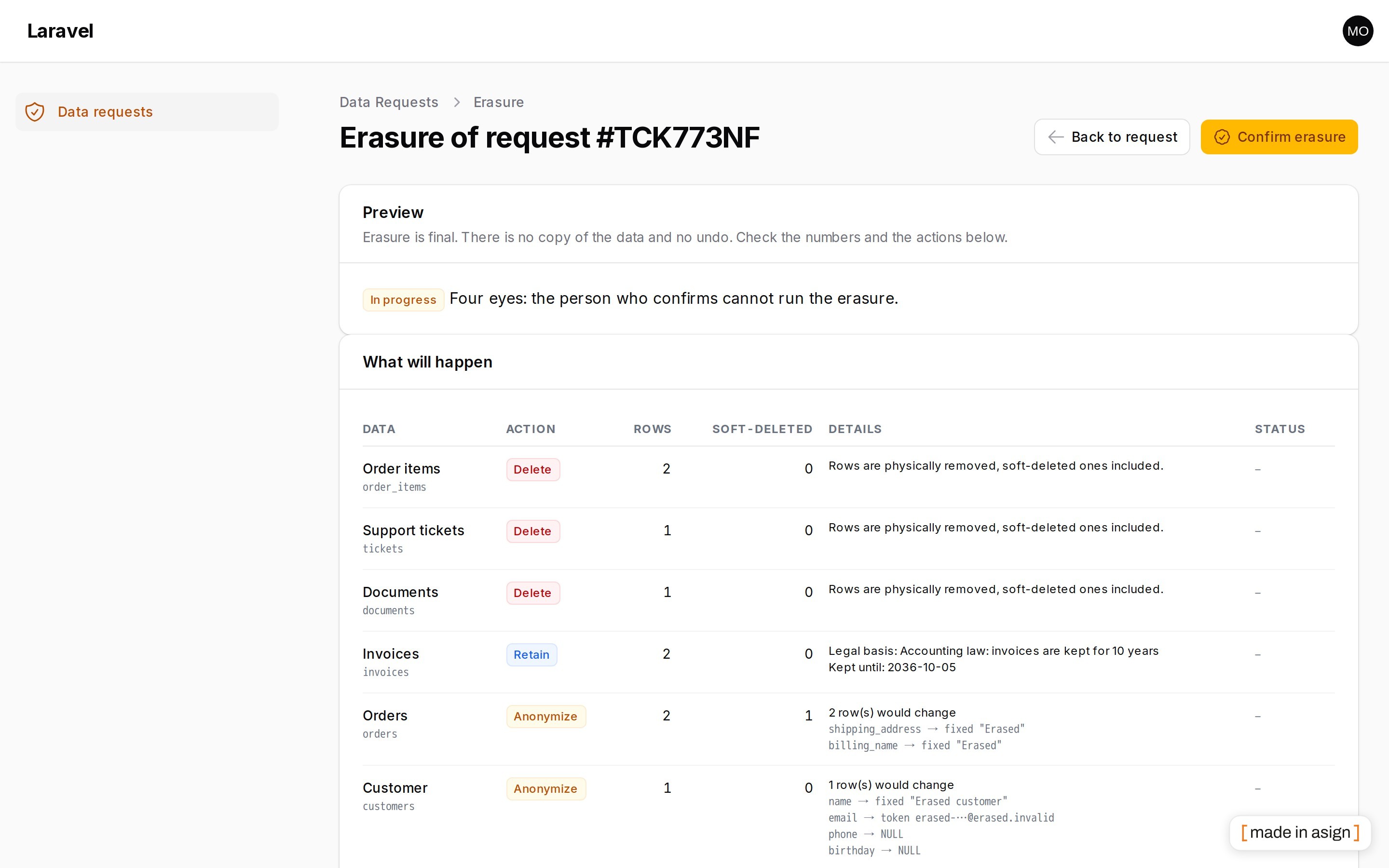
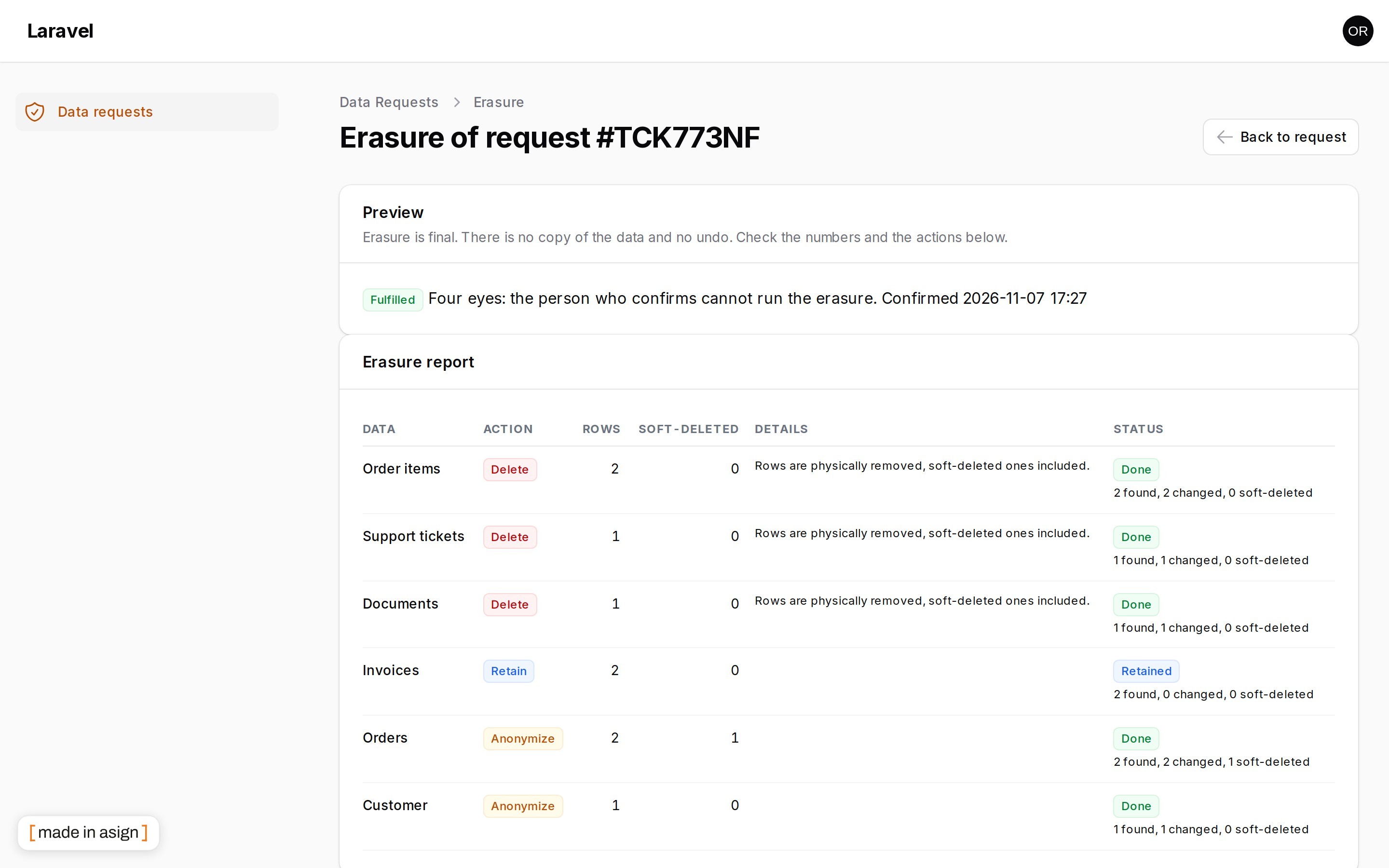
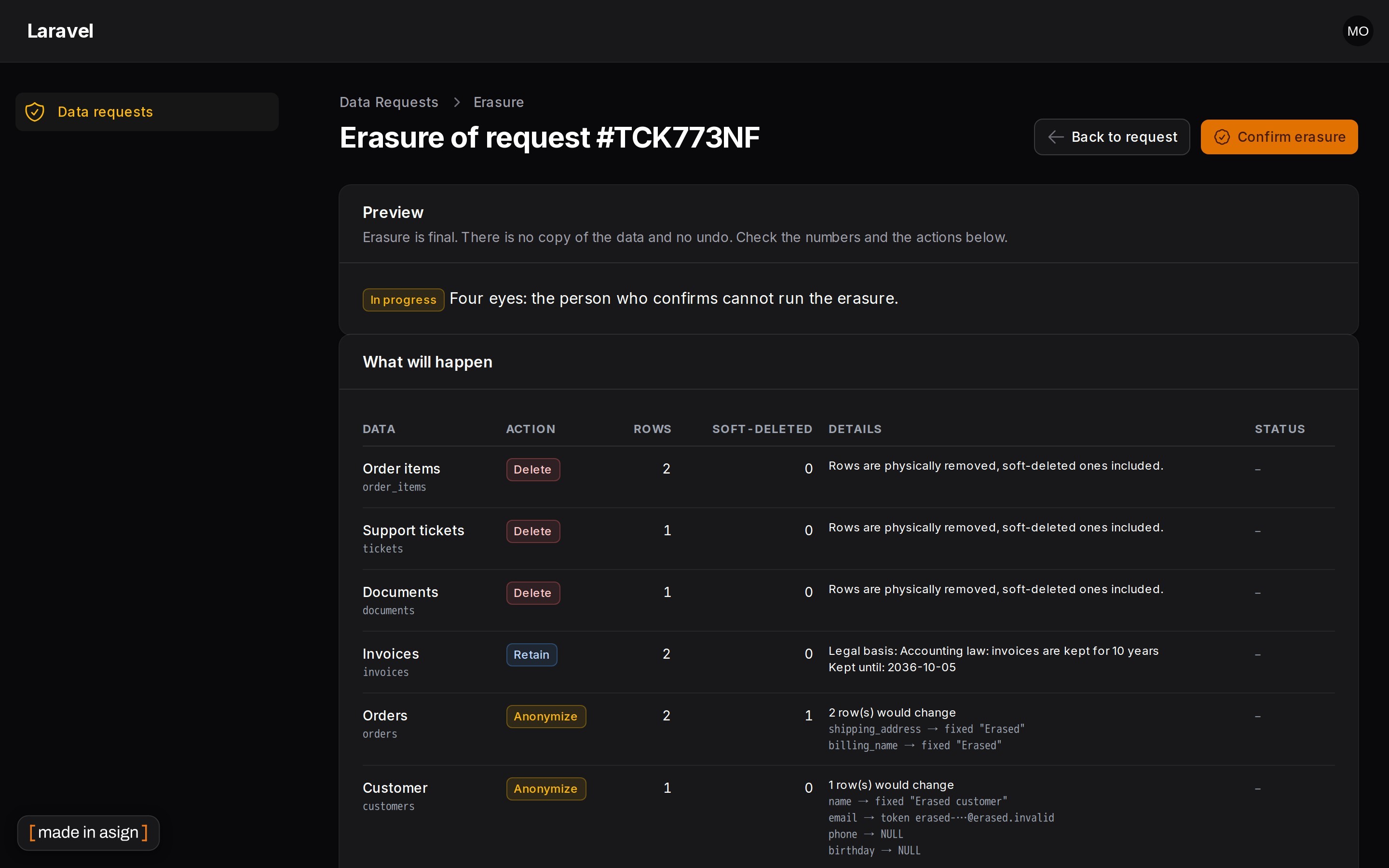
- Erasure: a mandatory preview (how many rows, which action, what would break), a typed confirmation, a different person to run it (four eyes), one queued job and one transaction per group, and a report per model.
- Retention policies:
gdpr:retention, a dry run unless you add--apply.
Screenshots
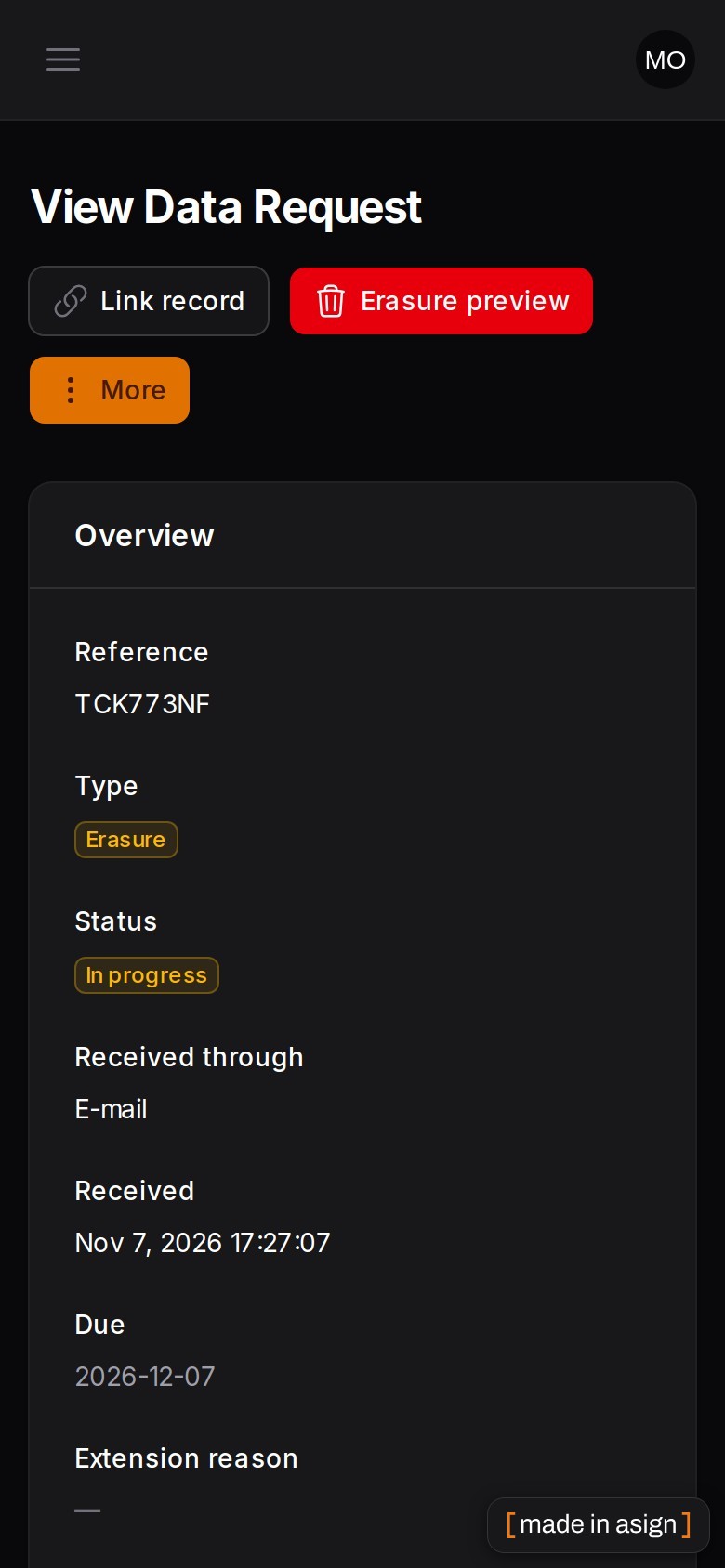
Requirements
- PHP 8.3+, Laravel 12 or 13, Filament 5,
ext-zip - SQLite, MariaDB 11.4 or PostgreSQL 16 (all three are tested)
- A queue worker. With
QUEUE_CONNECTION=synceverything runs inline, which is fine for small data and for development. - A single database connection: the plugin tables and every mapped table must be on the default connection (a transaction cannot span two).
- No tenancy: panels with tenancy are not supported in v1. The resource closes itself there and the services and commands refuse to run.
Installation
composer require asignua/filament-gdpr-requests
php artisan vendor:publish --tag=filament-gdpr-requests-migrations
php artisan migrate
Create a key for pseudonyms and put it in .env (at least 32 characters):
php -r "echo bin2hex(random_bytes(32)), PHP_EOL;"
GDPR_PSEUDONYM_KEY=...
Register the plugin:
use Asignua\FilamentGdprRequests\GdprRequestsPlugin;

$panel->plugin(GdprRequestsPlugin::make()->navigationGroup('Compliance'));
The four gates (denied until you define them)
Every ability is denied by default. Define them in a service provider:
Gate::define('gdpr.view',   fn (User $user) => $user->hasRole('compliance'));        // see the register
Gate::define('gdpr.manage', fn (User $user) => $user->hasRole('compliance'));        // create, link, verify, extend, refuse, close
Gate::define('gdpr.export', fn (User $user) => $user->hasRole('dpo'));               // prepare and download exports
Gate::define('gdpr.erase',  fn (User $user) => $user->hasRole('dpo'));               // confirm and run erasures
The services check the gates again themselves, so a custom page or a console script cannot reach an irreversible step
around the UI. A global Gate::before that returns true for super admins applies here as everywhere.
The data map
The map is the only way the plugin finds personal data. There is no search and no LIKE. Declare it in a service
provider's boot():
use Asignua\FilamentGdprRequests\DataMap\{Erase, PersonalData, Retention, Rule};
use Spatie\MediaLibrary\MediaCollections\Models\Media;

// The data subject itself (a user, a customer).
PersonalData::for(Customer::class)
    ->label('Customer')
    ->subject(email: 'email')                                  // found by primary key; the address e-mail groups match on
    ->export(['id', 'name', 'email', 'phone', 'created_at'])   // exactly these columns, nothing else
    ->erase(Erase::anonymize([
        'name'           => Rule::fixed('Erased customer'),
        'email'          => Rule::uniqueToken('erased-', '@erased.invalid'),
        'phone'          => Rule::null(),
        'password'       => Rule::fixed('!'),                  // no hash matches it: nobody can log in any more
        'remember_token' => Rule::null(),                      // otherwise an old "remember me" cookie still works
    ]));

// Files of spatie/laravel-medialibrary. Writes bypass model events, so the library does not clean up after itself:
// name the original and every conversion here, or they stay on the disk.
PersonalData::for(Media::class, 'customer-media')
    ->label('Uploaded files')
    ->of(Customer::class)
    ->matchedUsing(fn ($query, $subject) => $query->where('model_type', (new Customer)->getMorphClass())->where('model_id', $subject->keyValue()))
    ->export(['id', 'file_name', 'created_at'])
    ->files(fn (Media $media) => collect(['', ...array_keys(array_filter($media->generated_conversions ?? []))])
        ->map(fn (string $conversion) => ['disk' => $media->disk, 'path' => $media->getPathRelativeToRoot($conversion)]),
        // the path is not a column here: narrow to rows that may name one of the paths, PHP compares the rest
        lookup: fn ($query, array $paths) => $query->whereIn('file_name', array_map('basename', $paths)))
    ->erase(Erase::delete(files: true));

// Rows that belong to the subject.
PersonalData::for(Order::class)
    ->of(Customer::class)
    ->matchedBy('customer_id')
    ->export(['id', 'number', 'total', 'shipping_address'])
    ->erase(Erase::anonymize(['shipping_address' => Rule::fixed('Erased')]));

PersonalData::for(Ticket::class)
    ->of(Customer::class)
    ->matchedByEmail('customer_email')                         // exact match after trim (any white space) + lowercase
    ->erase(Erase::delete());

PersonalData::for(Invoice::class)
    ->of(Customer::class)
    ->matchedBy('customer_id')
    ->erase(Erase::retain('Accounting law: 10 years', days: 3650, from: 'issued_at'))
    ->retention(Retention::after(days: 3650, from: 'issued_at')->then(Erase::anonymize(['billed_to' => Rule::hash()])));

PersonalData::for(Document::class)                           // rows reached through another table
    ->of(Customer::class)
    ->matchedUsing(fn ($query, $subject) => $query->whereIn('order_id', Order::query()->withoutGlobalScopes()->where('customer_id', $subject->keyValue())->select('id')))
    ->files(fn (Document $d) => [['disk' => $d->disk, 'path' => $d->path]], columns: ['path']) // indexed column(s) the path is in
    ->erase(Erase::delete(files: true));

// A table that references a mapped table but holds nothing about the person:
GdprRequests::acknowledge('audit_notes', 'Internal notes, no personal data.');
Warning
Anything that is not in the map stays. A column without a rule keeps its value, a table without an entry keeps its rows, and a request can still read Fulfilled: the plugin finishes what you declared, not what you meant. Go through your schema before the first real erasure, and remember the columns that are easy to forget: password hashes, remember tokens, sessions, API tokens, notifications, media.
How to write it well:
- One entry per model that holds the person's data, and one root entry with
subject(). Declare every column you want anonymized: a column without a rule is not touched, and a model without rules is not anonymized. There are no defaults. - One declaration per group. A model is its own group; to map it twice give the second entry a name
(
PersonalData::for(Media::class, 'customer-media')). Declaring the same group again throws instead of quietly replacing the first entry (whose rows would then be left out). To replace one on purpose,app(PersonalDataRegistry::class)->forget($group)first. - Rules are
Rule::null(),Rule::fixed($v),Rule::hash()(keyed digest, recognises its own output),Rule::uniqueToken()(for unique columns: derived from table, column and row key, so a rerun gives the same value) andRule::using(fn)(yours; it must give the same result when applied to its own output; passunique: trueto vouch for a unique column). - The linked record decides who a request is about. E-mail groups match on the address of the root row, not on what
was typed on the request. Declare it with
subject(email: 'email'): without it, an entry usingmatchedByEmail()blocks the run. - Addresses are compared after trimming white space (invisible characters included) and PHP's
mb_strtolower. The database narrows the rows and PHP decides. Two letters lowercase differently in PHP and in SQL (İ, and a word-finalΣ); the query folds both so that it never misses such an address. For every other letter the query relies on the server's own lowercase tables (on SQLite PHP answers itself). Before any preview, run, export or command the plugin asks the server to lowercase capitals of Latin, Greek, Cyrillic and Armenian and refuses to work when the answer differs from PHP's: a Postgres database created withLC_CTYPE 'C'lowercases ASCII only and would missÄDA@…. Use a UnicodeLC_CTYPE(Postgres) or a Unicodeutf8mb4collation (MariaDB). An address in a script your server's version of Unicode does not know may still be missed, so check such rows by hand. - Soft-deleted rows are always included. Global scopes are removed from every query the plugin runs, including the
subqueries a
matchedUsing()closure builds through other models while it runs.deletereally removes rows, soft-deleted ones too. - Writes bypass model events (an observer must not send mail mid-erasure) and do not touch
updated_at. retainkeeps the row whole, shows the legal basis and the date up to which it is kept in the preview and the report, and after that date merely lists the row ingdpr:retention. It never changes anything by itself.- Third parties. An export contains only the columns you list. If a listed column (a message body, a note) mentions other people, that is your call when you write the map; the plugin does not read the content.
- Pseudonyms need the key.
GDPR_PSEUDONYM_KEYsigns subject and e-mail pseudonyms (HMAC-SHA256) and thehashanduniqueTokenrules. Without it the plugin refuses; it never falls back toAPP_KEY. The key version is stored with each request. To rotate: set a new key, raiseGDPR_PSEUDONYM_KEY_VERSION, and list the old one underpseudonym.previous_keys([1 => 'old key']) so older pseudonyms can still be recomputed. Losing the key means old pseudonyms can no longer be matched, so keep it with your other secrets.
What the preview blocks
Before anything can be confirmed, the preview reads your live schema and blocks the run when:
- a rule writes
NULLinto aNOT NULLcolumn, a value that is too long, or text into a number or date column; - a fixed value would go into a unique column of more than one row, or another row already holds it;
- a callback targets a unique column without
unique: true; - a rule targets the primary key, the column the rows are found by, a foreign-key column (other than
NULL) or a column another table references; - a file this run would remove is still named by a row that stays, of any entry with
files()in the whole map (two records sharing one path): the message names the tables, not the people. Paths are compared as Flysystem reads them (/docs/a.txt,./docs//a.txtanddocs/a.txtare one file) and disks by the storage they point at (ascopeddisk is its parent plus the prefix). Declare where the path is stored,files(..., columns: ['path'])on an indexed column orfiles(..., lookup: fn ($query, array $paths) => ...), and the rows that may name a file are found through the index. Withcolumns, one exact lookup asks for the normalised path on every disk over the same storage, and one scan per column reads the rows whose path is not in its normal form (a backslash, an empty,.or..segment, matched byLIKEand narrowed to rows that hold the file's last segment); PHP compares the files of both. A column whose text form is not the bytes it holds (a Postgresbytea, a NUL-padded MariaDBBINARY(n)) is read whole instead;BLOBandVARBINARYare fine. Without either, every row of the table is read: a million rows took 28 seconds per preview against 0.3 withcolumns, and the preview lists such tables under Slow checks; - another entry anonymizes or deletes rows that a
retainentry keeps: the report would call them kept; - a row you delete is still referenced by rows that are not deleted with it (soft-deleted ones counted);
- a row you delete names files through
files()and the strategy does not remove them: useErase::delete(files: true), because the row is the only thing that knows where its file is. The same holds for an anonymization that changes the columns a file is found by (a path set toNULLor a constant) withoutfiles: true; - a table that is not in this subject's map references a mapped table (add it, or
GdprRequests::acknowledge()it). A table mapped only for another subject does not count; - a callback changes its own output: the check after the run could never tell a finished row from an unfinished one;
- a
matchedUsing()(or retention) query uses a limit, an offset,DISTINCT,GROUP BY/HAVINGor aUNION: rows are read by key in chunks, and such a clause would apply per chunk. AnORDER BYof the closure is simply dropped; - a
matchedUsing()query reads a table this run changes and foreign keys force that table to go first. Otherwise such a closure simply runs before every other group that changes a table it reads, its own table included; - rows hold almost the person's key (other letter case, padding): the plugin matches exactly and does not guess whose they are. The export is refused for the same reason. Correct the rows;
- the linked record cannot be found, the address on the request differs from the record's, or an e-mail group has no address to match on, or several records share that address (soft-deleted ones too), since it could not tell whose rows are whose. The export is refused for the same reasons. A person settles a difference: link the right record, or use Accept the record's e-mail (which removes export archives and asks for the identity check again). On a partial erasure whose record changed its address before the record itself was erased, the same action is the way forward: the request stays partial and needs a new identity check and a new confirmation;
- an entry has no way to find rows, a table or column does not exist, a rule throws, or the pseudonym key is missing.
How a request goes
- New request: from the panel, or from your own form with
GdprRequests::submit(RequestType::Erasure, email: ..., ...). A submitted request is always unverified. - Link the record by explicit key (or by exact e-mail through the column your map declares).
- Verify the identity, outside the tool, and write down how in the note. Export and erasure are locked until you do; re-linking the record clears the verification and removes the archives made for the previous one. Once an erasure has changed data, the record can no longer be changed.
- Export (access and portability): a job builds the archive; Download issues a signed link (15 minutes) bound to your user.
- Erasure preview, Confirm (typing the request reference), then a different person runs it (typing the
reference again).
four_eyescan be switched off for a single administrator; every erasure run while it is off is written to the log. - Check: when the groups are done the plan is built again for the same person. Any row the plan said would go, any file that should be gone, or any difference between rows planned and handled keeps the request Partially erased, with the list on the erasure page and in the log. Retained rows do not count: the plan said they stay.
- Report: one line per entry (found, changed, soft-deleted) and the status of each group. When the check is clean, every export archive of that person is removed, from their other requests too; only then the request reads Fulfilled.
- Close: a fulfilled erasure closes itself: the link to the person's record is cut and the
request_retention_daysclock starts. Complete and Refuse start that clock too; close such a request by hand to cut the link and remove the archives the same way (closing later does not restart the clock).
Irreversible means irreversible
- There is no copy of the erased data (a copy would itself be personal data) and no rollback of a finished group.
- Each group is one transaction together with its own "done" mark, and the request row is locked first, so two workers on one request take turns. If a group fails, the request becomes Partially erased (never a success), the groups that finished stay finished, and Resume only goes forward. A rerun of a finished group changes nothing.
- A confirmation is bound to the data map's rules, to the person and to the row counts you saw. If any of them changed, or 72 hours passed, confirm again. A first run that finds fewer rows than you confirmed fails the group: rows that cannot be reached are no good news.
- New rows or a fixed map after a partial run: Resume refuses, and the way forward is a fresh preview and Confirm, four eyes included. Every group runs again under the new plan; what the earlier run did stays on the report and in the log. A partial erasure cannot be relinked or refused: its rows are gone.
- The check sees what the map can reach. A
matchedUsing()closure that reads a table the run erased finds nothing afterwards, so rows added to such a group after that table was erased stay out of sight. Match on a column where you can. - Files named by the entry are removed after the commit; if one cannot be removed the group stays failed and the list of what is left is kept. Resume retries them, and the group finishes when they are gone.
- A killed worker cannot leave a request stuck: a failed job moves it to Partially erased, and a run that has gone quiet
for
erasure.stale_run_minutes(30) offers Resume.
Housekeeping commands
Nothing is scheduled for you. Add what you want:
Schedule::command('gdpr:remind')->dailyAt('08:00');
Schedule::command('gdpr:prune')->dailyAt('03:30');
// Deliberately your decision, and the only place where --apply appears:
// Schedule::command('gdpr:retention --apply')->weeklyOn(1, '04:00');
| Command | What it does |
|---|---|
gdpr:retention |
Plans the retention policies of the map. Dry run by default; changes rows only with --apply. No config key turns it on. --only=<group or model>. |
gdpr:prune |
Removes expired export archives and wipes name, address, message and notes of requests that ended (fulfilled, refused or closed) longer than request_retention_days ago. --dry-run to look first. |
gdpr:remind |
Notifies the assignee reminders.days_before days before the deadline and your administrators when it is passed. Define who those are with GdprRequests::notifyAdminsUsing(fn () => User::...): without it nobody but the assignee hears about an overdue request, and the command warns you. |
Every run is recorded in gdpr_runs, dry runs included. A file or archive that cannot be deleted is reported, and
gdpr:prune and gdpr:retention --apply exit with a failure: an archive stays on record and is retried, and the paths of
files whose row is gone are in the run's summary. A reminder is marked as sent only if it reached somebody; otherwise the
next run tries again.
What this does NOT cover
- Backups. Erased data lives on in database dumps and snapshots. Agree a retention period for backups that fits your answer to the person, and document it. The plugin cannot reach them.
- Logs outside the database (web server, application, queue, mail), search indexes, caches, analytics.
- External systems (e-mail providers, CRMs, payment services). Map what is in your database; tell the others yourself.
- Data not in the map. If you forgot a table, it is not found. The schema checks above catch tables that reference a mapped table, nothing more.
- Finding the person beyond the explicit key and your declared e-mail column, verifying identity online, a
public request form, consent banners and the record of processing (Art. 30) are out of scope.
GdprRequests::submit()is there for your own form.
Configuration
Publish with php artisan vendor:publish --tag=filament-gdpr-requests-config. The ones you will touch:
| Key | Default | |
|---|---|---|
four_eyes (GDPR_FOUR_EYES) |
true |
The person who runs an erasure must not be the one who confirmed it. |
export.disk (GDPR_EXPORT_DISK) |
local |
Must be private; a disk with public visibility, or inside public/, is refused. |
export.retention_days |
30 |
Archive lifetime. |
request_retention_days |
90 |
Days after a request ended (fulfilled, refused or closed) before name, address and notes are wiped. |
extension_max_months |
2 |
Extra months allowed by one extension. |
requester_mail.enabled |
false |
Stage e-mails to the person (received, extended, completed, refused). |
erasure.stale_run_minutes |
30 |
A run with no sign of life for this long may be resumed. |
queue.connection / queue.name |
default | Where the jobs go. |
Tables are gdpr_requests, gdpr_request_events, gdpr_request_steps, gdpr_request_exports and gdpr_runs (no prefix).
The plugin's JSON columns are written without Unicode escaping.
Activity Log Plus (optional)
If asignua/filament-activity-log-plus (spatie activitylog) is
installed, every request action is mirrored there under the log name gdpr, with the request reference and counts only,
never names or addresses. This mirror is covered by a test against a stand-in for the activity() helper, not against
the real package, which needs PHP 8.4 and is not installed in this plugin's test suite.
Try it in the workbench
vendor/bin/testbench workbench:build
vendor/bin/testbench filament:assets
vendor/bin/testbench db:seed --class="Workbench\Database\Seeders\DatabaseSeeder"
vendor/bin/testbench serve
Everything in it is invented. Log in at /admin as marta@example.test (confirms erasures), oleh@example.test (runs
them: four eyes) or nina@example.test (a manager without export and erase rights), password password.
testbench.yaml uses the file cache on purpose: Filament 5.11 keeps notifications in the cache, and the array store
loses them between requests.
Translations
Ten languages: English and Ukrainian were written by the author, the other eight (pl, de, es, fr, it, nl, pt_BR, tr) are
machine translations that a native speaker has not reviewed. Please send corrections. A test keeps every language in step
with the English keys and checks that placeholders survive. Publish with --tag=filament-gdpr-requests-translations.
Testing
composer install
vendor/bin/phpunit
vendor/bin/phpstan analyse --memory-limit=1G --no-progress
vendor/bin/pint --test
The suite runs on SQLite. tests/Database holds scenarios that need a real server (a genuine unique violation in the
middle of a run, two processes on one request); they run when GDPR_TEST_DB=mariadb|pgsql points at a database
(GDPR_TEST_DB_HOST, _PORT, _NAME, _USER, _PASSWORD) and are skipped otherwise. GDPR_TEST_FOREIGN_DB names a
neighbouring database (a schema on Postgres) with the tables customers (one row, marker = 'sentinel'), foreign_only
and foreign_child, and adds the proof that the schema reader stays inside its own database. tests/Benchmark/LargeTableBenchmark.php (not part of the default
run; GDPR_BENCH=1, GDPR_BENCH_ROWS) times the preview, the confirmation and the run against a million rows.
AI agents
The package ships Laravel Boost guidelines (resources/boost/guidelines/core.blade.php).
More plugins by asign
- Activity Log Plus — audit trail and history for models
- Mail Log — every outgoing e-mail, with delivery status
- XLSX Export — spreadsheet exports for tables
- Record Lock — one editor per record
All plugins: https://filamentphp.com/plugins?q=asign
Changelog
See CHANGELOG.md.
License
The MIT License (MIT). See LICENSE.md.