
ahmedebead / laravel-settings

App & Models Settings for Laravel
Requires
- php: ^8.2
- ext-json: *
- illuminate/database: ^11.0 || ^12.0 || ^13.0
- illuminate/support: ^11.0 || ^12.0 || ^13.0
Requires (Dev)
- laravel/pint: ^1.13
- mockery/mockery: ^1.6
- orchestra/testbench: ^9.0
- phpunit/phpunit: ^12.0
Suggests
None
Provides
None
Conflicts
None
Replaces
None
README
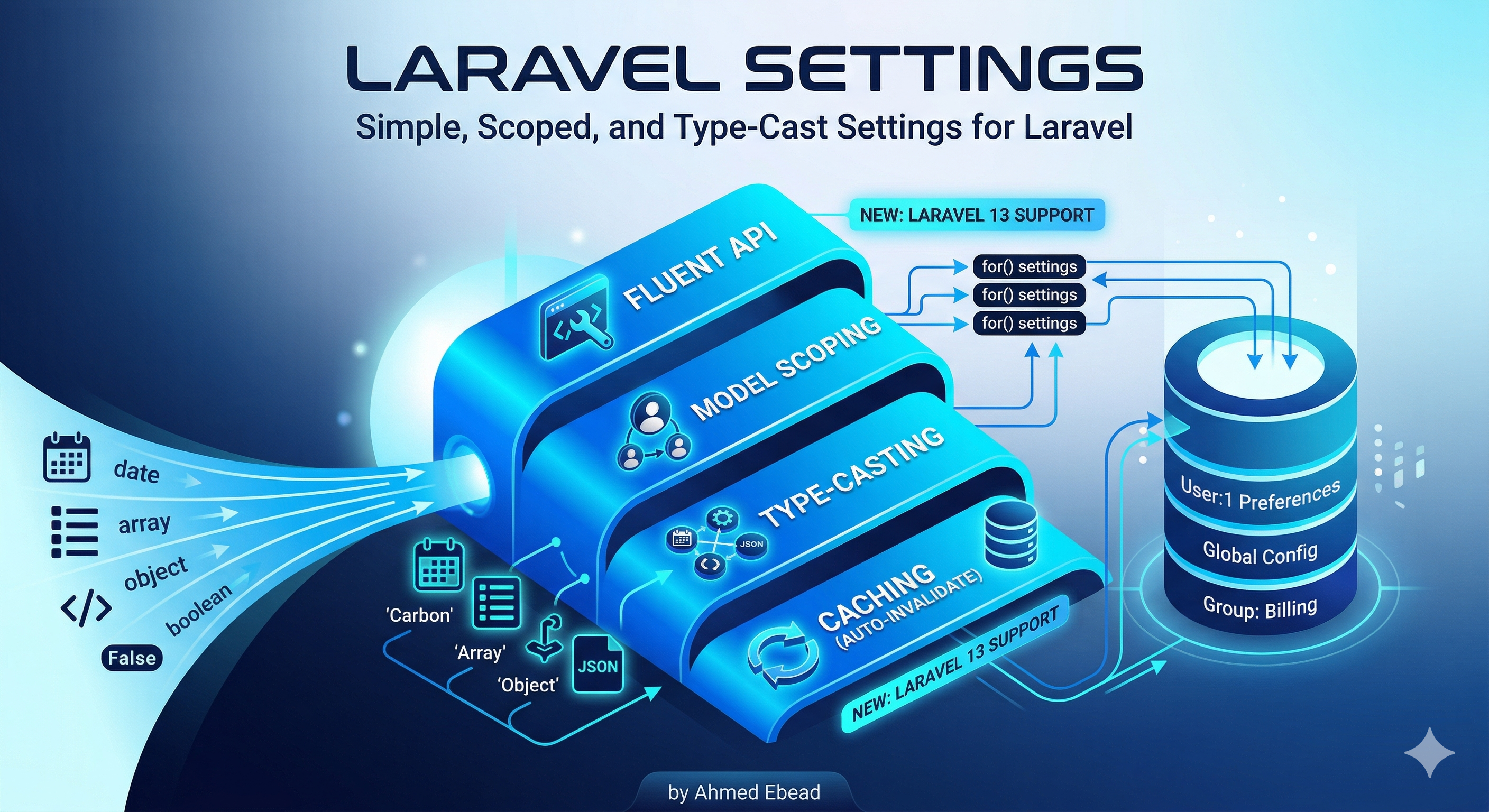
A simple, flexible settings package for Laravel. Store application-wide settings or settings scoped to any Eloquent model. Values are automatically type-cast when stored and restored when retrieved.
Requires: PHP 8.2+ · Laravel 11 / 12 / 13
Table of Contents
- Installation
- Configuration
- Basic Usage
- Scoping
- HasSettings trait
- The
settings()helper - Caching
- Type Casting
- Custom Repository
- Testing
Installation
composer require ahmedebead/laravel-settings
The service provider and Settings facade are registered automatically via package auto-discovery.
Publish the config file:
php artisan vendor:publish --provider="Ahmed3bead\Settings\SettingsServiceProvider" --tag="config"
Publish and run the migration:
php artisan vendor:publish --provider="Ahmed3bead\Settings\SettingsServiceProvider" --tag="migrations"
php artisan migrate
Running
vendor:publish --tag="migrations"a second time is safe — it will not create a duplicate migration file if one already exists.
Configuration
After publishing, the config file lives at config/settings.php.
return [

    // Which repository driver to use (default: database)
    'default' => env('SETTINGS_REPOSITORY_DEFAULT', 'database'),

    'repositories' => [
        'database' => [
            'handler'    => Ahmed3bead\Settings\Repositories\DatabaseRepository::class,
            'connection' => null,   // null = use the app's default DB connection
            'table'      => 'settings',
        ],
    ],

    'cache' => [
        'enabled' => env('SETTINGS_CACHE_ENABLED', false),
        'store'   => null,   // null = use the app's default cache store
        'prefix'  => null,
    ],

    'casts' => [
        Carbon\Carbon::class       => Ahmed3bead\Settings\Casts\CarbonCast::class,
        Carbon\CarbonPeriod::class => Ahmed3bead\Settings\Casts\CarbonPeriodCast::class,
    ],

];
Basic Usage
You can use the Settings facade, the settings() helper, or the HasSettings trait — all three give you the same API.
Storing settings
use Settings;

// Single key
Settings::set('timezone', 'UTC');

// Multiple keys at once
Settings::set([
    'timezone' => 'UTC',
    'language' => 'en',
    'per_page' => 25,
]);
Values can be any PHP type — strings, integers, booleans, arrays, and objects (see Type Casting):
use Carbon\Carbon;

Settings::set('launched_at', Carbon::now());   // stored and restored as Carbon
Settings::set('flags', ['feature_x' => true]); // plain arrays work too
Nested arrays are fully supported. Casts are applied recursively:
Settings::set('report', [
    'generated_at' => Carbon::now(),   // will be cast
    'filters' => [
        'from' => Carbon::yesterday(), // also cast, however deep
        'limit' => 100,
    ],
]);
Retrieving settings
// Single key — returns the value or null
$tz = Settings::get('timezone');

// With a default value when the key does not exist
$tz = Settings::get('timezone', 'UTC');

// Multiple keys at once — returns an associative array
$values = Settings::get(['timezone', 'language']);
// ['timezone' => 'UTC', 'language' => 'en']

// Multiple keys with a shared default for any missing ones
$values = Settings::get(['timezone', 'missing_key'], 'default');
// ['timezone' => 'UTC', 'missing_key' => 'default']

// All settings (global scope — no model, no group)
$all = Settings::all();
Checking existence
exists() performs a database count query, so it correctly reports true even when a key is stored with a null value.
if (Settings::exists('timezone')) {
    // key is in the database
}

// Returns false for keys that have never been set
Settings::exists('unknown_key'); // false

// Scoped to a model or group (see Scoping section)
Settings::for($user)->exists('theme');
Settings::group('billing')->exists('vat_rate');
Deleting settings
// Single key
Settings::forget('timezone');

// Multiple keys
Settings::forget(['timezone', 'language']);
Scoping
Every method (set, get, all, exists, forget) respects the active scope. Scopes are fluent and do not leak — each call is independent.
Model-specific settings
Attach settings to any Eloquent model with for(). Two users with the same key never interfere with each other.
$user1 = User::find(1);
$user2 = User::find(2);

Settings::for($user1)->set('theme', 'dark');
Settings::for($user2)->set('theme', 'light');

Settings::for($user1)->get('theme'); // 'dark'
Settings::for($user2)->get('theme'); // 'light'

Settings::for($user1)->all();
// ['theme' => 'dark']
Settings stored without
for()are global and separate from model-specific ones.
Groups
Use group() to namespace settings into logical categories.
Settings::group('email')->set('driver', 'smtp');
Settings::group('email')->set('from', 'hello@example.com');

Settings::group('billing')->set('vat_rate', 20);

Settings::group('email')->all();
// ['driver' => 'smtp', 'from' => 'hello@example.com']

Settings::group('billing')->all();
// ['vat_rate' => 20]

// Global settings (no group) are unaffected
Settings::all();
// []
Excluding keys
Use except() to skip one or more keys when calling all():
Settings::except('secret_key')->all();

Settings::except('k1', 'k2')->all();

Settings::except(['k1', 'k2'])->all();
Combining scopes
All scoping methods can be chained in any order:
// Model + group
Settings::for($user)->group('preferences')->set('lang', 'ar');

// Read it back
Settings::for($user)->group('preferences')->get('lang');

// All settings for a user in a group, excluding one key
Settings::for($user)->group('preferences')->except('lang')->all();

// forget is scoped too — only removes 'lang' from group 'preferences' for $user
Settings::for($user)->group('preferences')->forget('lang');
HasSettings Trait
Add the HasSettings trait to any Eloquent model to get a settings() method that automatically scopes to that model instance. It is equivalent to calling Settings::for($this).
use Ahmed3bead\Settings\HasSettings;
use Illuminate\Database\Eloquent\Model;

class User extends Model
{
    use HasSettings;
}
$user = User::find(1);

$user->settings()->set('theme', 'dark');
$user->settings()->set(['lang' => 'en', 'per_page' => 20]);

$user->settings()->get('theme');         // 'dark'
$user->settings()->all();               // ['theme' => 'dark', 'lang' => 'en', 'per_page' => 20]
$user->settings()->exists('theme');     // true
$user->settings()->forget('theme');

// Group scoping still works
$user->settings()->group('billing')->set('vat', 20);
$user->settings()->group('billing')->get('vat'); // 20
The settings() helper
A global settings() helper is included. It returns the same Settings instance as the facade.
settings()->set('key', 'value');
settings()->get('key');
settings()->for($user)->set('theme', 'dark');
Caching
Enable caching in config/settings.php or via an environment variable:
SETTINGS_CACHE_ENABLED=true
Or in the config file directly:
'cache' => [
    'enabled' => true,
    'store'   => 'redis',  // any cache store configured in config/cache.php
    'prefix'  => 'app',
],
How it works:
get()andall()cache results forever until the underlying data changes.set()andforget()automatically invalidate both the key-specific cache entry and theall()cache entry.- Cache keys include the model class, model primary key, group, and excluded keys — so two different users always get isolated cache entries.
Type Casting
When you store an object, the package looks up the matching cast handler and serializes the value. On retrieval, the original object type is restored transparently.
Built-in casts
| PHP type | Stored as | Restored as |
|---|---|---|
Carbon\Carbon |
ISO-8601 date string | Carbon\Carbon |
Carbon\CarbonPeriod |
{start, end} ISO strings |
Carbon\CarbonPeriod |
| Everything else | JSON-encoded as-is | Decoded as-is |
Custom casts
Step 1 — Create a cast class implementing Castable:
use Ahmed3bead\Settings\Contracts\Castable;

class MoneyCast implements Castable
{
    /**
     * Called when the value is being saved.
     * Return any JSON-serializable value.
     */
    public function set(mixed $payload): array
    {
        return [
            'amount'   => $payload->getAmount(),
            'currency' => $payload->getCurrency(),
        ];
    }

    /**
     * Called when the value is being loaded.
     * Reconstruct and return the original object.
     */
    public function get(mixed $payload): Money
    {
        return new Money($payload['amount'], $payload['currency']);
    }
}
Step 2 — Register it in config/settings.php:
'casts' => [
    Money::class => MoneyCast::class,
],
Step 3 — Use it normally:
Settings::set('price', new Money(1000, 'USD'));

$price = Settings::get('price'); // Money instance
Passing constructor arguments to a cast:
If your cast needs configuration, register an object instance instead of a class name:
'casts' => [
    MyType::class => new MyCast('some-parameter'),
],
Custom Repository
The database driver is the default, but you can replace it with any storage backend.
Step 1 — Create a repository class that extends the abstract base and implements all required methods:
use Ahmed3bead\Settings\Repositories\Repository;

class RedisRepository extends Repository
{
    public function get(string|array $key, mixed $default = null): mixed
    {
        // read from Redis using $this->entryFilter for scoping
    }

    public function set(string|array $key, mixed $value = null): void
    {
        // write to Redis
    }

    public function forget(string|array $key): void
    {
        // delete from Redis
    }

    public function all(): array
    {
        // return all entries matching $this->entryFilter
    }

    public function exists(string $key): bool
    {
        // return true if $key exists
    }
}
$this->entryFiltergives you the activeEntryFilterinstance withgetModel(),getGroup(), andgetExcepts().
Step 2 — Register it in config/settings.php:
'repositories' => [
    'database' => [ ... ],

    'redis' => [
        'handler' => App\Settings\RedisRepository::class,
    ],
],
Step 3 — Set it as default:
'default' => 'redis',
Testing
composer test
License
The MIT License (MIT). Please see LICENSE.md for more information.