
waynestate / squire

The Citadel kit: standard build.sh, release script and health check, and local parity on the Citadel images.
Requires
- php: ^8.3
- symfony/console: ^7.4
Requires (Dev)
- laravel/pint: ^1.32
- league/commonmark: ^2.10
- phpstan/phpstan: ^2.1
- phpunit/phpunit: ^11.5
- waynestate/advisor: ^0.1.2
- waynestate/pinstripe: ^0.1
Suggests
- waynestate/advisor: ADVISOR module: lets your coding agent run squire_doctor and squire_drift read-only.
Provides
None
Conflicts
None
Replaces
None
README
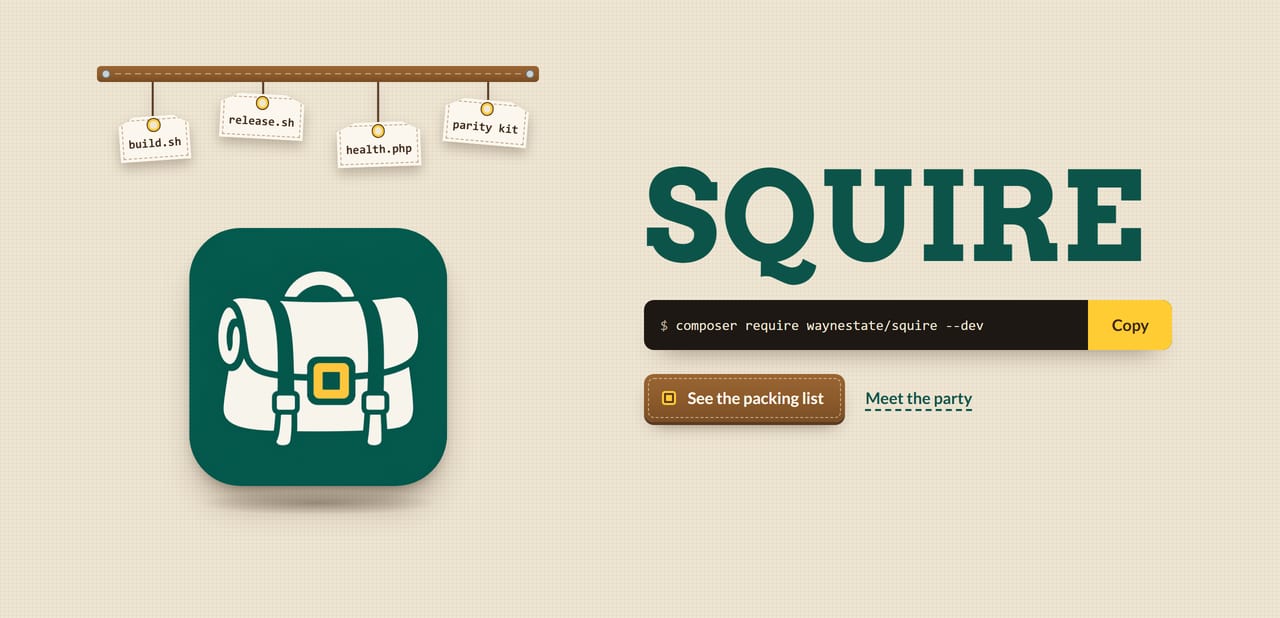
Squire


Suits you up for deploy day. A squire carries the kit, readies the armor and gets the knight on the field.
Checks: composer ci (the same command runs on GitLab and GitHub).
Squire is the Citadel kit: build.sh, the release script, the health check, and local parity on the real images. Its docs builder turns docs/ into the committed pages under site/docs/, with a changelog page generated from CHANGELOG.md when the nav lists one. It is part of WELD, the Wayne State application stack, beside WayneUI (project 0, the interface layer), CREED, PROCTOR, Preflight, SESAME, HELMET, Pinstripe and Sourdough.
Not to be confused with: squire doctor checks deploy setup only; standards checks are PROCTOR's.
A knight never suits up alone. Your app shouldn't deploy alone either.
Front page: site/index.html, a static page you can serve from anywhere.
On Citadel it is served by the raw-PHP deploy layer in deploy/: a Squire kit whose front controller serves site/ behind HELMET's security headers. For local development, keep serving site/ directly.
Status: 0.5.0, tagged and on Packagist.
Where the code lives
The canonical repository is on nougat: enterprise-apps/squire. git.wayne.edu and GitHub (waynestate/squire) are read-only mirrors of it. Open issues and merge requests on nougat, not on the mirrors. This moves to git.wayne.edu once it has CI runners. Your squire serves one banner, and it flies over nougat.
Open the bag: two more cuts of the front page

The kit bag's label: the brand board

What it does
squire initwrites the scripts a Citadel app needs from templates, for raw PHP, Laravel or a static site, and detects a Vue/Inertia layer frompackage.json, adding the layer's release script and Node 22 parity service.squire init --checkreports when your copies have drifted from the templates (depend, do not copy). In a directory below the repository root (adeploy/layer, say),initalso keeps the.gitignorehonest: it appends/vendor/,.envand.env.squirewhen they are missing, never touches a line the app added, and leaves the repository root's.gitignoreto the app.squire updatetakes the new template versions for the files you never edited, and shows a diff for the ones you did. It never overwrites your edits, and it runs the same in CI and on a laptop.squire doctorchecks an app against the best practices a machine can decide (BEST_PRACTICES.md). The lock file, composer audit and MySQL 5.6 checks are owned by PROCTOR;doctorhands off to it (S50) instead of repeating them.- A local setup that runs your app on the Citadel PHP image, behind a proxy like Citadel's, with the same MySQL 5.6.
- Squire's maintainers send platform improvement proposals to the platform team privately. Squire never touches a server.
Install
composer require waynestate/squire --dev
vendor/bin/squire init
vendor/bin/squire doctor
PHP ^8.3. Tested on 8.3, 8.4 and 8.5. The package runs on your machine or in CI, not on Citadel; what lands on Citadel
is the scripts it wrote.
Commands
vendor/bin/squire init   [--path=.] [--target=auto|raw|laravel|static] [--only=release|parity] [--check] [--force]
vendor/bin/squire update [--path=.] [--target=raw|laravel|static] [--only=release|parity] [--dry-run]
vendor/bin/squire doctor [--path=.] [--format=text|json]
Exit codes: 0 pass, 1 findings (init --check: drift; update: an edited file still differs from the template;
doctor: a failed rule), 2 the tool itself could not run.
vendor/bin/squire doctor oracle runs the same plain-language Oracle connection check that release.sh runs on
Citadel, from your terminal or sail php vendor/bin/squire doctor oracle. It reads the ORACLE_* settings from the
environment and the app's .env, prints setting names and never values, and stays silent when the app has no Oracle
settings. Add -v for the client version.
init never overwrites a file you edited, or a file it did not write, unless you pass --force. It records a SHA-256 of
each file in .squire.json; commit that file. --only=release writes just the Citadel scripts, --only=parity just the
local setup.
A Vue/Inertia app is a layer on raw, laravel or static, not a fourth target: init detects vue in package.json
(dependencies or devDependencies) and writes the layer's .npmrc and its docker-compose.squire.yml (with a Node 22 service) beside the target's files.
Every app, Vue or not, gets the one common scripts/release.sh, which installs the frontend from the lock file and runs
the build script whenever there is a package.json.
A raw PHP app (--target=raw, the default without an artisan file) gets a front controller, public/index.php, and an
.htaccess that sends every request to it. The front controller has three answers:
- a real file in
public/(CSS, images, fonts, an HTML page) is served with its type, an ETag and an hour of cache, with HELMET's headers when HELMET is installed, and HELMET's CSP nonce on every<script>of an HTML page; - a 404 for a dot file (
.htaccess,.git), a NUL byte, a path that climbs out ofpublic/, any.phpor.pharother than the front controller, and any file that is not a site asset (a.sqldump, a.bak, a.mdwith no.htmlbeside it); - everything else goes to the app's entry:
app.phpbesidepublic/, or the fileSQUIRE_APP_ENTRYnames (relative to the app directory, for examplesrc/bootstrap.php). APOST,PUTorDELETEalways goes to the entry.
The entry is the only PHP file the front controller runs, and it must sit inside the app directory and end in .php;
anything else is a plain 500 that names SQUIRE_APP_ENTRY and no path. The entry boots its own HELMET with its own
settings: the front controller boots HELMET (citadel preset) only for the answers it gives itself, never before the
entry, so HELMET is never booted twice. public/up.php answers on its own, because the .htaccess lets Apache run it
directly. The path checks and the MIME map are the static target's, and the tests keep the two in step.
An app that already has its own public/index.php or public/.htaccess keeps it: init reports the file as
app-owned, never records or overwrites it (not even with --force), and init --check does not count it as drift.
Delete your copy and run init to take Squire's. A front controller Squire wrote is tracked like any other file.
A static site is a target of its own: --target=static writes everything the raw target writes, with its own front
controller, public/index.php, and an .htaccess that routes every request that is not a real file to it. The site
itself is plain files you commit; the front controller serves them with HELMET's headers, injects the CSP nonce into the
HTML, and caches the assets. The site folder is ../../site by default (the app lives in deploy/ beside it); point
SQUIRE_STATIC_ROOT at a different folder. public/up.php still answers the health check, because a real file is served
straight by Apache and never reaches the front controller.
update reads that record: a file you never edited takes the new template, a file you edited is left alone and shown as a
diff, and a file Squire did not write is never touched. A squire polishes the armor; the knight keeps the sword.
--dry-run prints the plan and writes nothing.
What lands in your app
| File | What it is |
|---|---|
build.sh |
Citadel's build hook: system packages only, POSIX sh, runs as root with no app source. No Composer, no npm. |
deployments/001-first-release.sh |
Runs once per app: calls the release script with the smoke test off (Apache is not up yet). |
scripts/release.sh |
The idempotent release: preconditions, composer install --no-dev from the lock file, audit, Laravel migrate --force and optimize, PROCTOR (a report by default, a gate with SQUIRE_PROCTOR=enforce), an Oracle connection check (a report, never a gate), /up smoke test. Use it as the Quick Update post-script as well. |
health.php |
Citadel's health check (["php","health.php"]): one HTTP request to /up, never boots the framework. |
oracle-check.php |
The plain-language Oracle connection check the release runs: settings, host, port, driver, login. A report, never a gate; silent when the app has no ORACLE_* settings. |
public/up.php |
Raw PHP and static: the endpoint that answers ok. Laravel has /up built in. |
public/index.php |
Raw: the front controller that serves public/ files safely and hands the rest to the app's entry. Static: the one that serves the committed site with HELMET's headers. Never written over an app's own. |
public/.htaccess |
Raw: sends every request but index.php and up.php to the front controller. Static: routes every request that is not a real file to it. |
.npmrc |
Vue layer only: sets min-release-age=1 for the frontend install. |
Vue docker-compose.squire.yml |
Vue layer only: the common parity compose plus a Node 22 service for frontend tooling. |
docker-compose.squire.yml, .squire/, .env.squire.example, scripts/parity.sh, scripts/parity.ps1 |
Local parity. |

The packing list for deploy day: each tag lands on the strap and gets its stamp.
Every shell script uses set -euo pipefail (build.sh uses set -eu, because Citadel runs it with /bin/sh), prints a
[squire] ==> step N: ... marker for each step, and can be run twice with the same result.
The release also runs an Oracle connection check (oracle-check.php) after PROCTOR and before the smoke test. It is a
report, never a gate: a finding prints in the deployment log and the release goes on. When the app does not use Oracle
(no ORACLE_* settings) it prints nothing. It checks, in order, that the settings are present, that the host resolves,
that the port answers within 3 seconds, that the oci8 driver is loaded, and that the login works, stopping at the first
failure so a bad port never costs a login attempt. Settings: ORACLE_USERNAME, ORACLE_PASSWORD, and either ORACLE_TNS
(Easy Connect host:port/service, or a full (DESCRIPTION=...) descriptor) or ORACLE_HOST, ORACLE_PORT and
ORACLE_SERVICE_NAME. Only setting names are ever printed, never values.
Copies of Squire's templates
Sourdough carries a generated copy of Squire's deploy templates instead of writing its own. The copy began when its
apps could not composer require Squire from an internal repository (no internal URLs may be committed). Squire is
on Packagist now, and Sourdough requires it as a dev dependency and regenerates its copy from the package. Squire owns the templates; the copy is checked in and verified, never hand-edited.
php bin/export-templates.php --to=templates/squire            # write the copy
php bin/export-templates.php --to=templates/squire --check    # verify it; exit 1 on drift
The copy holds, for each kind (raw, laravel, static) and for the Vue layer (vue), the files a new app gets from
squire init, at their target paths, with each file's mode recorded so executables stay executable. catalog.json lists
which files each kind and layer installs and where; manifest.json records the Squire version and a SHA-256 per file.
Refresh the copy when Squire's templates move on, and run --check in CI to keep it honest. A squire keeps the armor
polished; the copy stays in step.
The agent-ready kit
Every stack repo carries the same bytes: a Markdown twin beside every page in the site folder, plus llms.txt,
llms-full.txt, robots.txt and sitemap.xml, styled by the kit's agent-ready.css and agent-ready.js in the
site's assets/ folder. Squire owns the kit, and a site takes a new version from a Squire checkout with
php bin/agent-ready.php --sync-to=<repo>, which copies the kit and the tool itself. The site then regenerates its
files with php bin/agent-ready.php and commits them, and runs --check in CI to stay honest.
A library package that carries the kit should keep it out of Composer downloads: add to its .gitattributes
/bin/agent-ready.php export-ignore
/site export-ignore
so a composer require of the package never ships the kit. A squire packs what the knight will carry, and only that.
The docs builder
bin/docs-site.php turns the Markdown under docs/ into committed, accessible HTML pages under site/docs/: one page
per file, in the order of docs/nav.json, with a sidebar, an "On this page" list, prev and next links, and the version
stamped from the top of CHANGELOG.md. The optional source and mirrors keys in docs/nav.json render a Source link
in the header and footer, with the mirrors beside it, so the canonical repo home is one config value, never a hard-coded
URL. Pages are styled by WayneUI plus the kit's docs.css and docs.js in the site's
assets/ folder, so every stack repo reads the same way. Squire owns the kit, and a repo takes a new version from a
Squire checkout with php bin/docs-site.php --sync-to=<repo>, which copies the kit and the tool itself. The repo then
builds with php bin/docs-site.php (or composer docs) and commits site/docs/, and runs --check (or
composer docs:check) in CI to fail when a page is stale or a finding is present. A squire keeps the map current, so the
knight never asks for directions twice.
Generated blocks
A page may hold a region the builder owns, marked in the Markdown source:
<!-- generated:commands -->
...whatever the builder wrote last time...
<!-- /generated -->
docs/docs.json defines the blocks by name. Each block rewrites its region from the repo's own state: json-table and
symfony-commands run a command from the repo root (a leading php means the PHP binary, so the same file works on
Windows, macOS and Linux) and render the command's JSON output, and env scans the source files for the environment
variables the code reads.
The json-table type runs its run command, takes the list at its path key from the JSON output, and renders a
Markdown table: each column is [heading, key] or [heading, key, "code"] for a code span, a missing key gives an
empty cell, booleans print yes or no, lists print comma separated, Symfony console style tags are stripped so a
help cell reads plain, and pipes in a cell are escaped.
{
    "blocks": {
        "hops": {
            "type": "json-table",
            "run": "php bin/booster hops --format=json",
            "path": "hops",
            "columns": [["Hop", "id", "code"], ["What it does", "summary"]]
        }
    }
}
The symfony-commands type runs <run> list --format=json and renders the command reference: an overview table of
command and description, then per command a heading at level (default 3), its description, one Usage: line per
usage string, an Arguments table when it has arguments, and an Options table when it has options. An option prints its
shortcut first (-p, --path=VALUE) and gets =VALUE only when it takes a value; its default prints in a code span,
or stays empty when it is false. The built-in commands (help, list, completion, _complete) and hidden commands
are skipped, and the application-level options (--help, --quiet, --verbose, --version, --ansi, --no-ansi,
--no-interaction) are listed once, under "Options every command accepts".
{
    "blocks": {
        "commands": {
            "type": "symfony-commands",
            "run": "php bin/console",
            "cli": "bin/console",
            "level": 3
        }
    }
}
The env type walks the scan folders for quoted environment variable names that start with prefix, skips the
names in ignore (an exact name, or a trailing * for a prefix), and renders one row per variable, sorted by name:
its meaning and default from describe (a [meaning, default] pair) and the first file that reads it. A variable the
code reads that describe does not list, and a variable describe lists that no scanned file reads, are findings.
{
    "blocks": {
        "environment": {
            "type": "env",
            "scan": ["src", "config"],
            "prefix": "APP_",
            "ignore": ["APP_KEY"],
            "describe": {
                "APP_NAME": ["The app name", "Demo"],
                "APP_ENV": ["The environment", "production"]
            }
        }
    }
}
A plain run rewrites stale regions in the sources and then builds; --check reports a stale region instead of writing.
A region whose name is not in docs.json, a block no page places, a block placed twice, and an opening marker with no
closing marker are findings.
Changelog page
When docs/nav.json lists a page whose path is changelog, the builder owns docs/changelog.md: a plain run writes
it from the repo's CHANGELOG.md before building, and --check never writes. The page takes the usual front matter
(title: "Changelog" and a description), a marker comment naming its source, and the changelog's body with its
top-level heading dropped, so every version heading stays as written: ## Unreleased, ## [Unreleased],
## 0.5.0 (2026-11-03) and ## [0.1.9] - 2026-11-03 all keep their shape and get the page's usual anchors. Links
follow the site's rules: an http(s) link stays, a relative link becomes a blob link under the nav.json source
(https://repo.example.com/acme/app/-/blob/main/README.md) when there is one, and loses its link, keeping its label,
when there is not. A nav entry without a CHANGELOG.md is a finding, and a changed CHANGELOG.md or a missing
docs/changelog.md is drift.
Callouts
A blockquote whose first line is a marker alone becomes a callout instead of a quotation:
> [!NOTE]
> The body keeps the note.
The marker is case-insensitive and one of [!NOTE], [!TIP], [!WARNING] or [!DANGER]. The builder renders an
<aside> with the classes docs-callout and docs-callout--note (one per kind), role="note", a visible label,
and the body below it, and drops the marker line from the body. A blockquote without a marker, or with a marker that
is not one of the four, stays a plain blockquote. The kit's docs.css styles all four kinds from WayneUI tokens, in
light and dark themes.
Code tabs
Consecutive fenced code blocks whose info string carries tab="LABEL" (double quotes, label up to 40 characters) render as one labeled tab set instead of separate code blocks:
```bash tab="composer"
composer install
```

```bash tab="sail"
./vendor/bin/sail up
```
The word before tab="..." stays the language, so the first panel keeps its language-bash class. The builder wraps the
run in a docs-tabs element keyed by the lowercased labels joined by | (data-tabs="composer|sail"), and gives each
panel a docs-tabs__panel element carrying its label and the code escaped exactly like a plain fenced block, so every
example reads without JavaScript. A lone tab="..." block renders as a plain code block with the tab="..." word dropped
from its language class, and a run broken by anything else becomes separate sets. The kit's docs.js turns each set into
an accessible tablist (click, arrow keys, Home and End), remembers the chosen label per key in localStorage, and keeps
every set sharing a key in step; docs.css styles the tabs from WayneUI tokens, and print shows every panel.
What the check proves
- For a
symfony-commandsblock, a code span or fenced line that starts with the CLI name must name a real command (helpandlistalways pass), and every--optionon it must be an option of that command or an application option; an unknown command or option is a finding. - Every command and every option the CLI keeps must appear in the docs at least once (the generated block counts); a command or option nobody documented is a finding.
- A fenced block whose info string contains
docs-test: skipis not scanned, and plain prose is never scanned. - Every link a person wrote in the docs reaches something the site serves: a built page, a file under
site/, or an external address; a relative link to a file the site does not serve (for example../README.md) is a finding. - A fragment in a link must name a real heading on the page it points at, whether that is the page itself (
#setup) or another built page (guides/start.html#setup); a missing id is a finding. - Every image a page references (a Markdown image or an HTML
<img>) must name a file underdocs/, resolved against the source page's folder, and the build copies it byte for byte to the same relative path undersite/docs/so the built page's relative src still resolves; a missing image is a finding, and unreferenced files are never copied. - Every page carries the version stamp as a
docs-versionmeta tag and in the footer, so a reader sees which release the docs describe. - A
composer.jsonwith aversionfield must agree with the stamp; a different version is a finding. --require-releasefails whenCHANGELOG.mdhas no released heading yet, because the stamp would beunreleased.--require-tagfails when the repo's latest version tag does not match the stamp (a tag such asv1.6.0counts as1.6.0); the flag is off by default, so an untagged repo builds clean.- When the nav lists a
changelogpage,docs/changelog.mdmirrorsCHANGELOG.md(front matter, marker comment, no top-level heading); a changedCHANGELOG.mdor a missing page is drift, and a nav entry without aCHANGELOG.mdis a finding.
Tested examples
php bin/docs-site.php --examples runs the tagged command examples in the docs and fails when reality drifts from
what they promise. A fenced block whose info string is bash run, sh run, console run or shell run
(optionally exit=N, default 0) is a command block: each non-empty line is a command (a leading $ is stripped),
run in order in a fresh temp copy of the examples.cwd folder; the next fenced block, when its info string is exactly
output, is the expected output (stdout then stderr). Both sides are normalized before the comparison: CRLF to LF,
trailing spaces trimmed per line, trailing blank lines removed, the example working directory and the repo root
rewritten to the placeholders below, plus every regex rule in examples.normalize:
<cwd>
<root>
Every shell block (bash, sh, shell, console, powershell or pwsh) must be tagged run or carry an HTML comment line
reading docs-test: skip REASON directly before it; a block with neither, and a marker without a reason, are
findings naming the file and line. Skips are counted and grouped by the words before the first comma, case-folded, in
the one-line summary (Examples: 7 run, 12 skipped (reasons: needs network 5, needs Docker 4)), and examples.maxSkips
in docs/docs.json caps them. The other keys of examples are optional: cwd names the repo folder copied into each
example working directory, alias replaces a matching first word with another command (a leading php means the
PHP binary, a relative script path resolves against the repo root), env adds environment variables, and timeout
caps each command in seconds (default 60). Generated-block regions are ignored, and a plain build and --check
never run examples.
JavaScript tests
The kit's docs.js carries its own tests in tests/js/ (node:test with jsdom, pinned exactly in package.json and
package-lock.json), and they run the same way locally and in CI. With Node 22 on the PATH:
npm ci && npm test
or, with only Docker:
docker run --rm -v "$PWD:/app" -w /app node:22-alpine sh -c "npm ci && npm test"
The js-tests job runs the same two commands on GitLab and GitHub. It stays out of composer ci because the PHP
image has no Node.
Use Squire from your coding agent (ADVISOR)
Squire ships an ADVISOR module, so a coding agent that runs ADVISOR can run
Squire's checks without leaving its sandbox. In the app, install ADVISOR as a dev dependency (composer require --dev waynestate/advisor) and add one line to the app's modules.json (or point ADVISOR_MODULES_FILE at a file
that holds it):
{
    "modules": [
        "Waynestate\\Squire\\Advisor\\SquireModule"
    ]
}
Two tools appear. Both are read-only, and each takes exactly one argument: a path inside the project root.
squire_doctorruns Squire's deploy-setup checks (the S-rules, S1 to S78) against the app folder and returns the same JSON reportvendor/bin/squire doctor --format=jsonprints. It runs in-process: no subprocess, no network, nothing written.squire_driftreports which of the files Squire wrote into the app have drifted from the current templates, the same checkvendor/bin/squire init --checkperforms: missing, outdated, edited or untracked, per file. It writes nothing;squire initis the fix, and it never overwrites an edit.
Every answer labels its source and says plainly what ran. Squire reports; Squire in CI decides pass or fail. A squire can tell you where the armor is dented; only the knight gets to charge.
Citadel setup
- In the dashboard set the build script to
build.sh, the health check to["php","health.php"], and the Quick Update post-script to./scripts/release.sh(usercitadel). - Commit
composer.lock, andpackage-lock.jsonorpnpm-lock.yamlif you have a frontend. - Mark the scripts executable in git. On Windows:
git update-index --chmod=+x build.sh scripts/*.sh deployments/*.sh. - Set
SQUIRE_*values in the app's./.envconfiguration file (below), not in a file in the repository. The dashboard has no environment field; its configuration-files step, after the wizard, writes./.envinto the source tree. A Laravel app reads./.envalready; a raw PHP app loads it withvlucas/phpdotenv(Dotenv\Dotenv::createUnsafeImmutable($root)->safeLoad()), sogetenv()sees the values and a real environment variable wins.
Local parity
Needs Docker with Compose v2. Windows needs Docker Desktop with the WSL 2 backend; no shell other than PowerShell is required.
On Windows, keep the source in the WSL 2 filesystem. Advice, not a requirement: keep the app's source tree inside
the WSL 2 Linux filesystem (for example under ~/src in your WSL distribution) and run scripts/parity.sh from there,
not from a Windows folder such as C:\Users\you\... reached through /mnt/c. Bind mounts from the Windows side are much
slower (Composer and npm installs feel it most), and file ownership and permissions do not map cleanly; that is the cause
of the Permission denied failure described under the bind-mount question (OPEN_QUESTIONS 15). The PowerShell
scripts\parity.ps1 still works from a Windows folder, only slower.
Engines and licenses
Squire needs any engine that runs Docker Compose v2 compatible files. The ones named here:
- Docker Engine on Linux: open source, Apache 2.0.
- Docker Desktop on Windows with the WSL 2 backend: a commercial product, free for small business, personal and educational use, and paid for larger organizations, so check your own license.
- Podman with a Compose v2 compatible provider, and Colima on macOS: expected to work, not tested here.
Only Docker Desktop and Docker Engine have been run.
# Linux and macOS
cp .env.squire.example .env.squire     # then set the passwords
scripts/parity.sh up                   # or: scripts/parity.sh up --fallback

# Windows (PowerShell 5.1 or 7)
Copy-Item .env.squire.example .env.squire
scripts\parity.ps1 up                  # or: scripts\parity.ps1 up -Fallback
Commands: up, down, reset (also removes volumes), logs [service], shell [service], status, pin (prints the
digests of the images you have pulled, so you can pin them).
It starts the app container from the Citadel image (built by Citadel's build_images command, or pulled from wherever you
keep it) with your source mounted at /citadel/src, runs your deployments/ as the citadel user the way Citadel does,
and puts an HA-Proxy in front that adds the same forwarding headers. MySQL 5.6.51 is reachable from the app as host
mysql and from your machine on 127.0.0.1:3307. Containers drop capabilities, set no-new-privileges, and carry memory
and process limits. The database port is bound to loopback only. The Vue layer's compose file adds a Node 22 service,
pinned to the same major as the Citadel image, for frontend tooling.
No access to the real image? --fallback builds an approximation from the official php image plus Citadel's extensions.
It is good for trying Squire out and not for proving parity. If the build step fails with a permission error writing
vendor/, the source folder is not writable by the container's citadel user (uid 1000 by default); on Linux set
SQUIRE_SOURCE_UID and SQUIRE_SOURCE_GID to yours.
Oracle-ready images (local)
Apps that talk to Oracle need the Instant Client and the oci8 extension. Squire ships two opt-in Docker recipes
that carry both, so nobody compiles them by hand:
squire/oracle-sail:<php>: Laravel Sail's own runtime plus the Oracle install. In yourdocker-compose.yml, swap the service'sbuild:block forimage: squire/oracle-sail:8.4and keep the rest of the service as Sail wrote it; the image keeps Sail's entrypoint contract, including theWWWUSERUID remap.squire/oracle-parity:<php>: the officialphp:<php>-cli-bookwormimage with the extensions Citadel apps use (intl, ldap, soap, zip, gd, pdo_mysql, mysqli, bcmath, pcntl, exif, redis, imagick), Composer and git, plus the Oracle install. This is the flavour WELD'scompose.oracle.yamlpoints its services at. It runs as a non-rootappuser whose UID is a build argument (APP_UID) and can still be overridden at run time.
The names above are the local names of scripts/oracle-image-build.sh. The published images live in your GitLab
container registry, at $CI_REGISTRY_IMAGE/oracle-parity:8.4 and $CI_REGISTRY_IMAGE/oracle-sail:8.4 (in GitLab
CI, $CI_REGISTRY_IMAGE is set for you; elsewhere it is the registry address of the Squire project shown on its
Container Registry page), plus :8.4-<squire version> for a fixed one. CI publishes them when a Squire version is
tagged, multi-arch (linux/amd64 and linux/arm64); a Sail app swaps build: for image: with that path.
Both flavours download Oracle's Instant Client Basic Light at build time under Oracle's license and never commit it: the install script pins the exact SHA-256 of each zip. Oracle does not publish a 21.x client for arm64, so the line differs per architecture: linux/amd64 gets 21.7.0.0.0 and linux/arm64 gets 19.32.0.0.0.
scripts/oracle-image-build.sh --flavour sail --php 8.4        # or: --flavour parity
scripts/oracle-image-test.sh --flavour all --platform linux/amd64
Configuration
All optional. On Citadel, add ./.env.squire as a configuration file (the configuration-files step after the wizard;
the wizard has no environment field) and keep it out of git. release.sh reads the release options from it, and a
variable already in the environment wins. Locally, the same file holds the parity settings.
Release script (scripts/release.sh):
| Variable | Default | Meaning |
|---|---|---|
SQUIRE_APP_DIR |
parent of scripts/ |
App root. |
SQUIRE_FRAMEWORK |
auto |
auto, laravel or raw. Laravel is detected from artisan. |
SQUIRE_ALLOW_ROOT |
0 |
1 allows running as root. |
SQUIRE_REQUIRE_ENV |
auto |
1 requires a .env file; auto means Laravel does. |
SQUIRE_WRITABLE_DIRS |
Laravel: storage, bootstrap/cache |
Directories to create. |
SQUIRE_COMPOSER_AUDIT |
report |
report, fail or skip. |
SQUIRE_NPM |
auto |
auto or skip (for committed built assets). |
SQUIRE_NPM_IGNORE_SCRIPTS |
1 |
Install with --ignore-scripts. |
SQUIRE_NPM_BUILD_SCRIPT |
build |
The package.json script to run. |
SQUIRE_MIGRATE |
1 |
Laravel: migrate --force. |
SQUIRE_ARTISAN_OPTIMIZE |
1 |
Laravel: optimize. |
SQUIRE_PROCTOR |
auto |
auto, skip or enforce. By default PROCTOR is a report and never stops the release; enforce makes a failed check stop it. |
SQUIRE_PROCTOR_BIN |
vendor/bin/proctor, then PATH |
Where PROCTOR is. It is a dev dependency, so --no-dev removes it: point this at a copy. |
SQUIRE_PROCTOR_POLICY |
vendor/waynestate/creed/policy/policy.json, when installed |
Path to the policy file. When unset, the script falls back to the policy the CREED package ships (the deploy wizard has no environment field); when CREED is not installed, PROCTOR runs on its own default policy with a notice. An explicit value always wins. |
SQUIRE_SMOKE |
1 |
Request the health URL at the end and fail unless it answers 200. |
SQUIRE_SMOKE_URL |
http://127.0.0.1:80/up (Laravel), /up.php (raw and static) |
Full URL. |
SQUIRE_SMOKE_RETRIES |
5 |
Attempts. |
SQUIRE_SMOKE_DELAY |
2 |
Seconds between attempts. |
Front controller (raw public/index.php): SQUIRE_APP_ENTRY (app.php), the app's entry, relative to the app
directory. Static public/index.php: SQUIRE_STATIC_ROOT (../../site).
Health check (health.php): SQUIRE_HEALTH_PATH, SQUIRE_HEALTH_PORT (80), SQUIRE_HEALTH_TIMEOUT (5, at most 14, inside
Citadel's 15), SQUIRE_HEALTH_VENDOR (1 also requires vendor/autoload.php).
Local parity (.env.squire): SQUIRE_PROJECT, SQUIRE_BASE_IMAGE, SQUIRE_PROXY_IMAGE, SQUIRE_MYSQL_IMAGE,
SQUIRE_PUBLIC_DIR, SQUIRE_SERVER_NAME, SQUIRE_TZ, SQUIRE_ENVIRONMENT, SQUIRE_DEPLOYMENTS, SQUIRE_HTTP_PORT,
SQUIRE_APP_MEMORY, SQUIRE_SOURCE_UID, SQUIRE_SOURCE_GID, SQUIRE_DB_NAME, SQUIRE_DB_USER, SQUIRE_DB_PASSWORD,
SQUIRE_DB_ROOT_PASSWORD, SQUIRE_DB_PORT, SQUIRE_DB_MEMORY. The Vue layer's compose file also reads
SQUIRE_NODE_IMAGE (default node:22-bookworm-slim), SQUIRE_NODE_ENV (default production) and SQUIRE_NODE_MEMORY
(default 512m). The compose file refuses to start without the two passwords. See .env.squire.example; it holds
placeholders only.
Development
Maintainers: how to build, test and release this project, and where its data comes from, is in MAINTAINING.md.
composer install
composer ci          # validate, phpunit, pint, phpstan, audit
PHPStan and Pint follow Pinstripe, the stack's coding standard: phpstan.neon includes Pinstripe's raw PHP preset
(vendor/waynestate/pinstripe/phpstan/raw.neon) and keeps only Squire's own paths and PHP version range, and Pint runs
the same built-in per preset that Pinstripe's pint/per.json wraps, so pint.json stays local with Squire's own
excludes.
Run it in Docker the same way CI does:
docker run --rm -v "$PWD:/app" -w /app composer:2.10.3 sh -c "composer install --no-interaction && composer ci"
The shell templates are linted with shellcheck in Docker (scripts/lint-shell.sh, or scripts/lint-shell.ps1 on
Windows) and the PowerShell with PSScriptAnalyzer (scripts/lint-powershell.ps1). The tests run the real shell templates
against stub composer, curl, npm, corepack and proctor programs, and start a PHP server to test health.php.
The front page has its own accessibility gate: scripts/a11y.sh on Linux and macOS, scripts\a11y.ps1 on Windows.
It serves site/, opens it in a real Chromium (Playwright in Docker, so no host browser is needed) and runs
axe-core against it with the WCAG 2.2 AA tag set, in light and dark mode at 360 px and 1280 px. It stays out of
composer ci because CI has no browser; GitHub runs it as a separate a11y job.
Known limits
See OPEN_QUESTIONS.md. The big ones: the local php.ini holds safe defaults rather than the
platform's file, the Citadel image has no digest to pin, and a full Update may not refresh vendor/. PROCTOR can now
gate a release with SQUIRE_PROCTOR=enforce; what is still missing on its side is a phar and a dedicated gate command.
- The release script is contract-tested inside the fallback image on GitHub, not yet on the real image (OPEN_QUESTIONS 19, "Contract suite on the real image and on GitLab").
License
MIT, copyright Wayne State University. A squire carries the armor; the knight still has to show up.
The rest of the party


A squire is only as good as the party it rides with. Mind the buckle.