
bymayo / curated

Manually order related elements per source in Craft CMS.
Requires
- php: >=8.2
- craftcms/cms: ^5.7.0
Requires (Dev)
- craftcms/phpstan: dev-main
Suggests
None
Provides
None
Conflicts
None
Replaces
None
README
Curated for Craft CMS 5
Craft can show you related elements, but can't reorder them when the relation lives on the other side.
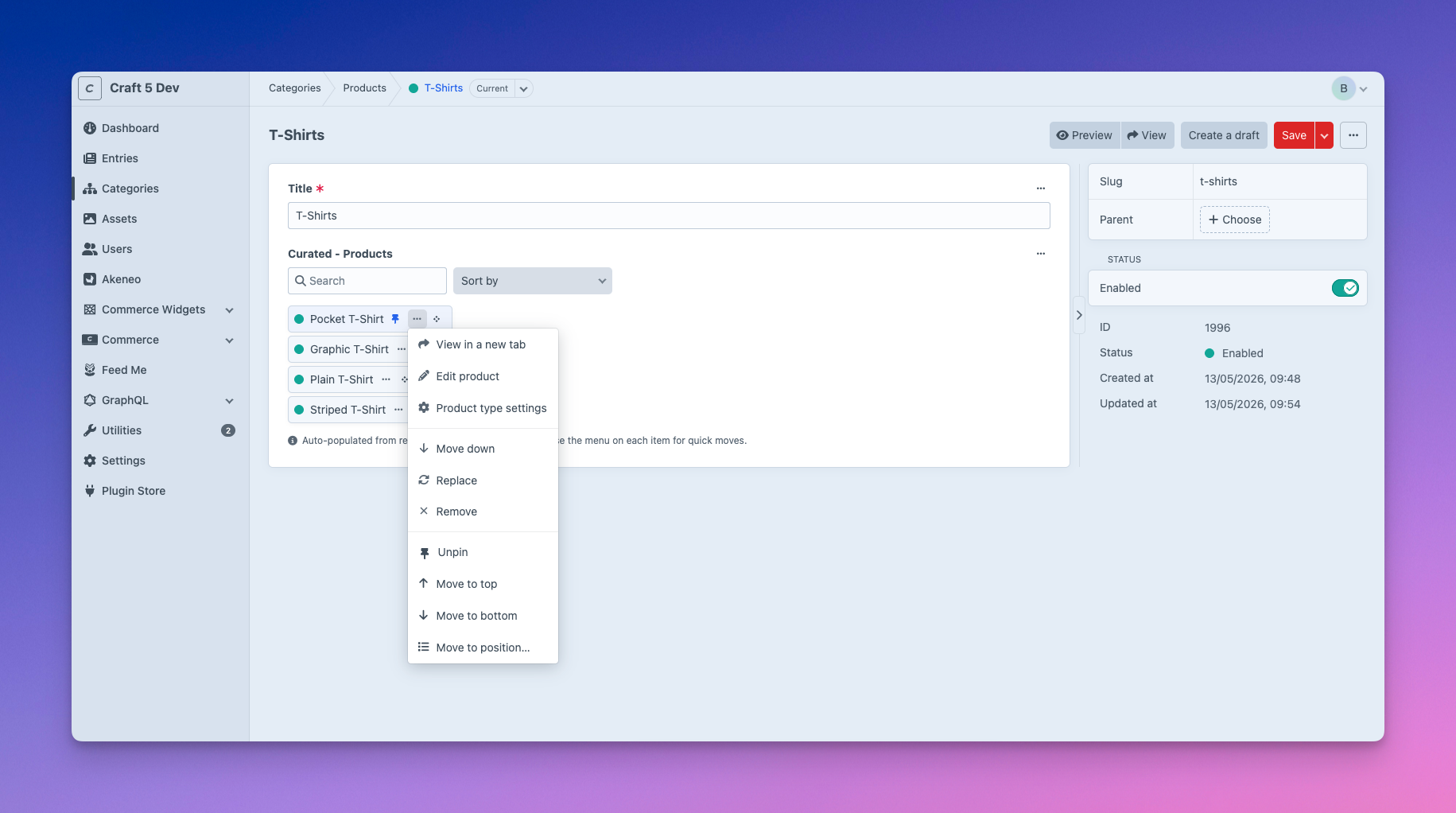
Curated fixes that. The field auto-populates from existing relations — add a Product to your T-shirts category and it appears in T-shirts' Curated field, ready to drag into place. The same Product can sit at #1 in T-shirts and #9 in Sale, each category with its own independent order. Works with Entries, Categories, Assets, Users, and (with Craft Commerce) Products and Variants.
🎬 Watch the video walkthrough →
See Curated in action in under a few minutes.
Perfect for…
- Categories with products: reorder products per category, move popular items to the top.
- Editorial / blog landing pages: "Related articles", "Editor's picks", "More from this author" in a deliberate sequence.
- Image galleries: order images per Album, lead image first.
- Event lineups: order speakers per conference, artists per festival, or sessions per day.
- Series and courses: drag episodes into the right sequence per series, modules per course, or chapters per book.
Features
- Per-source sort order: the same Entry can be #1 on one Category page and #9 on another. Same goes for Products in storefront categories, Assets in galleries, or Users on different team pages.
- Auto-populates: the field fills itself from every native relation between the source and target type, in either direction. No configuration.
- Populate from all elements: for a parent nothing relates to — a Work index page listing every Work entry — drop the relation requirement and fill the field from its sources instead. Still picks up new elements automatically; still fully orderable.
- Default Placement: where auto-discovered relations land before they're explicitly ordered. Before or after other elements, title, date created/updated, random, plus price for Commerce Products and Variants.
- Quick reorder actions: Move to top / bottom / position N inside each item's menu, alongside Craft's Move up / Move down.
- Pin items: pin items to always lead the list, per source. Survives sorts, drag-reorders, and new auto-discovered relations.
- One-shot Sort by…: dropdown above the picker for resorting the whole list (title, date, random, price).
- Search: live filter input above the picker. Hides non-matching items while preserving order, for fields holding hundreds of items.
- Ordering-first by default: the Add button is hidden; flip Allow adding elements on the field to enable curated-only additions.
- Six element types: Entries, Categories, Assets, Users, Commerce Products and Variants. Narrow by source (Section, Group, Volume, Product Type).
- Native Twig:
category.curatedProducts.all()returns a chainableElementQuery. - GraphQL: query the field on its host element, with all the usual element arguments (
limit,status,search, etc.), and mutate it with a list of IDs in your desired curated order. - Per-site ordering: different order per site.
- Element-index column: each Curated field is a column option on its host element's index. Shows the first curated item with a "+N" overflow for the rest, exactly like Craft's native relation field columns.
How Curated compares
Curated is about ordering, not establishing or proxying the relation itself.
| Capability | Craft's native relation fields | Many to Many | Reverse Relations | Curated |
|---|---|---|---|---|
| Drag-reorder per source | ❌ shared sortOrder | ❌ uses native | ❌ uses native | ✅ |
| Same target at different positions in different sources | ❌ | ❌ | ❌ | ✅ |
| Show relations created from the other side | ❌ | ✅ one configured field | ✅ one configured field | ✅ any field, either direction |
| Field's picker writes a native relation | ✅ | ✅ proxies | varies | ❌ ordering only |
| Per-site ordering | ❌ | inherits native | inherits native | ✅ |
| Auto-includes new relations created elsewhere | ❌ | ❌ | ❌ | ✅ |
| Quick reorder actions (Move to top / bottom / position) | ❌ | ❌ | ❌ | ✅ |
| Pin / Unpin items to the top of a source | ❌ | ❌ | ❌ | ✅ |
| Inline "Sort by…" reorder (title / date / random / price) | ❌ | ❌ | ❌ | ✅ |
| Default Placement for new relations | ❌ | ❌ | ❌ | ✅ |
| GraphQL support | ✅ | ❌ | ❌ | ✅ |
Different jobs. Many to Many and Reverse Relations edit the inverse side of one specific relation field. Curated orders whatever's already related (any direction, any field).
Install
composer require bymayo/curated
Enable in Settings > Plugins, or install via the Plugin Store.
Requirements
- Craft CMS 5.7+
- PHP 8.2+
Setup
- Create a Curated field. Give it a handle (e.g.
curatedProducts), pick the Element type (Entry, Category, Asset, User, Commerce Product / Variant), optionally restrict Sources, then add it to the field layout of the source element (e.g. a Category). - Open the source. The field is pre-populated with every matching element already natively related to it. Drag to reorder; save.
- Read on the front end via your field handle. The examples below assume the handle is
curatedProducts:
{% for product in category.curatedProducts.all() %}
    {{ product.title }}
{% endfor %}
Chain any normal query method:
{% set top3 = category.curatedProducts.limit(3).all() %}
{% set inStock = category.curatedProducts.status('live').all() %}
Query from the other side
{% set products = craft.products.curatedBy(category, 'curatedProducts').all() %}
The second argument is the handle of the Curated field on the source. Returns empty if the field doesn't exist on that layout.
GraphQL
Curated fields surface on their host element with the standard element argument set for the target type (limit, offset, status, search, orderBy, etc.). The resolver returns the saved curated order, then applies any arguments you pass.
{
  category(slug: "t-shirts") {
    curatedProducts(limit: 12, status: "live") {
      ... on Product {
        id
        title
      }
    }
  }
}
Mutations accept an array of element IDs in the desired curated order:
mutation {
  save_someSection_someEntryType_Entry(
    id: 1308
    curatedProducts: [1639, 1660, 1657]
  ) {
    id
  }
}
How Curated works
Curated queries every native relation between this source and elements of the target type, in either direction:
- Category has an Entries field pointing at entries (source → target), or
- Entry has a Categories field pointing at the category (target → source).
Both surface in the Curated field. The displayed list is [saved curated order] + [native relations not yet curated]. Default Placement controls where new natives land.
Sync utility
Go to Utilities → Curated Sync in the CP and click Sync now.
You don't need this for Curated fields to work, they populate themselves. Run it when you want to save the current order in one go, for example after importing a batch of entries or migrating content between environments. It's safe to re-run, nothing gets duplicated.
Console command
php craft curated/sync
Same as the Sync utility, just from the terminal. Handy after a deploy, or from a script.
Supported element types
| Element type | Common use case |
|---|---|
| Entry | "Related articles", "Editor's picks" |
| Category | Sub-categories under a parent |
| Asset | Gallery / lookbook order |
| User | Featured authors, staff order |
| Commerce Product | Drag products inside a category |
| Commerce Variant | Variant display order |
Craft Commerce is required for Commerce Product and Variant types.
Warnings
- Curated sits alongside native relations. Keep the canonical relation where Craft expects it; use Curated on the source for order.
- Removing an item is soft by default. It drops out of the saved curated order, but reappears at the end on next render because the native relation still exists. To remove for good, also remove the native relation. Or enable the Fully remove on delete plugin setting below.
- Fully remove on delete (plugin setting) is destructive. When on, removing an item from a Curated field also deletes every native relation row between the two elements, in both directions, across any relation field. There's no undo. Editors removing items here will silently edit the canonical relation elsewhere in Craft, not just this field. Off by default for a reason.
- Curated writes content, not Project Config. Field settings sync via project config; the curated order itself lives in
curated_relationsand won't sync between environments. - Large lists. The drag UI is good for hundreds of items, not tens of thousands. See the
max_input_varsnote below if you expect 1000+ items per field.
When an element is deleted entirely, it's removed from every curated list automatically.
max_input_vars and big lists
PHP's max_input_vars (default 1000) caps how many form inputs a request can have. Craft's element picker emits one input per item, so lists over ~1000 items will silently lose items on save unless you raise the limit:
max_input_vars = 5000
post_max_size = 16M
Support
If you have any issues then I'll aim to reply as soon as possible. If it's a site-breaking-oh-no-what-has-happened moment, hit me up on the Craft CMS Discord, @bymayo