
antarias / brand_logo

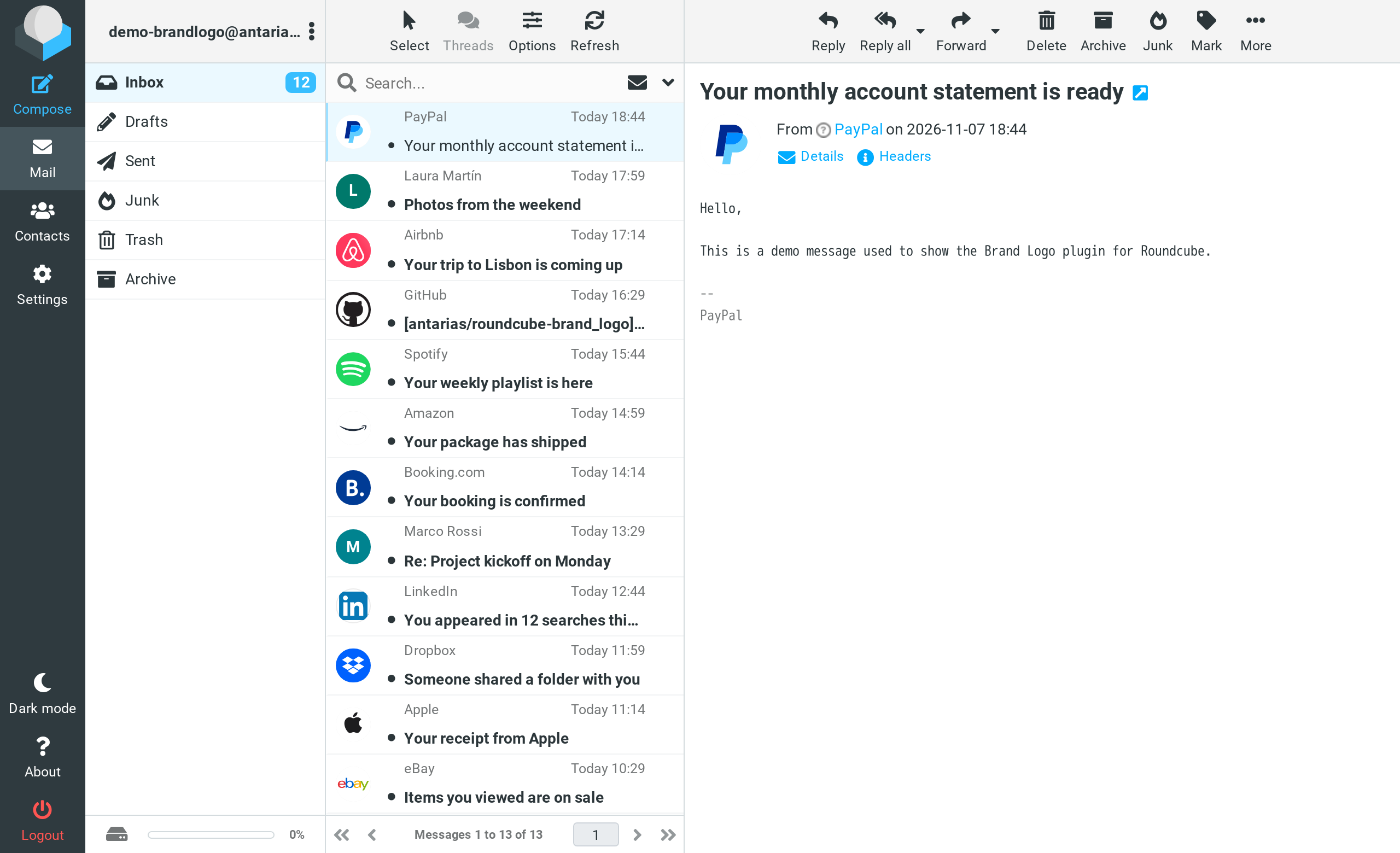
Shows the sender's brand logo as contact photo: BIMI logos with DMARC enforcement, falling back to the website icon.
Package info
github.com/antarias/roundcube-brand_logo
Type:roundcube-plugin
pkg:composer/antarias/brand_logo
Requires
- php: >=8.1
- ext-curl: *
- roundcube/plugin-installer: >=0.3.5
Requires (Dev)
None
Suggests
- ext-gd: Resizes PNG/JPEG/GIF/WebP icons when Imagick is not available
- ext-imagick: Converts ICO/WebP icons and pads logos to squares
Provides
None
Conflicts
None
Replaces
None
README
Shows the sender's brand logo in the message header, in the place of the contact photo, and as a round avatar in the message list, similar to what Yahoo Mail or Gmail do. Senders without a picture get their initial on a colored circle in the list.
Sources, in order:
- BIMI: the logo the sender domain publishes in DNS (
default._bimi.<domain>). - Website icon:
apple-touch-icon,<link rel="icon">or/favicon.icoof the sender's organizational domain. - Favicon service (optional, off by default): an external service such as Google's favicon API, for sites that block automated downloads.
Personal contact photos (and other address book sources such as Gravatar) always take precedence. When no logo is found, the next contact_photo plugin (for example identicon) runs as usual.
Safety
- DMARC gate. A logo is only shown when the sender domain's DMARC policy is
quarantineorrejectat 100%. BIMI requires this, and the plugin applies it to website icons too (configurable). Your mail server then rejects or quarantines messages that forge that domain, so a spoofed sender does not get the real brand's logo. Look-alike domains (paypa1.com) get their own icon, never the impersonated one. - No VMC check. BIMI Verified Mark Certificates are not validated.
- Server-side fetching. Logos are downloaded by the Roundcube server, never by the browser, so remote sites do not learn who reads the mail. Only HTTPS is used; private, loopback and reserved addresses are refused on every redirect; downloads are size- and time-limited.
- SVG. BIMI logos are SVG. They are rasterized to PNG when
rsvg-convertor Imagick with SVG support is available. Otherwise they are served as SVG with a sandboxingContent-Security-Policyandnosniff, after refusing documents with scripts, event handlers,foreignObjector entities.
Requirements
- Roundcube 1.6 or newer (tested with 1.7.5), PHP 8.1+
- PHP
curlextension - Recommended:
imagick(ICO/WebP support, square padding) orgd
Installation
With composer, from the Roundcube directory:
composer require antarias/brand_logo
Or manually: copy this directory to plugins/brand_logo, then add it to the plugin list before identicon (if you use it):
$config['plugins'] = ['brand_logo', 'identicon', /* ... */];
Copy config.inc.php.dist to config.inc.php to change the defaults. Logos are cached in Roundcube's shared cache (cache_shared table by default), no extra setup needed.
Configuration
See config.inc.php.dist. The most relevant options:
| Option | Default | Description |
|---|---|---|
brand_logo_sources |
['bimi', 'favicon'] |
Sources and their order. Add 'service' to use brand_logo_service_url. |
brand_logo_service_url |
null |
For example https://www.google.com/s2/favicons?domain=%d&sz=128. Sends sender domains to that service. |
brand_logo_favicon_require_dmarc |
true |
Apply the DMARC gate to website icons and the service. |
brand_logo_enabled |
true |
Default of the user option in Preferences > Displaying Messages. |
brand_logo_list |
true |
Avatars in the message list, user option in Preferences > Mailbox View. |
brand_logo_min_size |
32 |
Discard smaller icons. |
Limitations
- List avatars are designed for the Elastic skin (widescreen layout). In Sent folders they show the first recipient.
- The first time a list shows new sender domains, their logos are looked up on the server; after that they come from the cache and the browser keeps them for a day.
- DMARC is checked per domain, not per message. The plugin relies on the mail server enforcing DMARC on delivery.
- The organizational domain is derived with a short heuristic (
co.uk,com.es, ...) instead of the full Public Suffix List.
License
GNU General Public License v3.0 or later. See LICENSE.